Choosing between PMI-ACP Vs Disciplined Agile can feel confusing, especially if you want to grow your agile career. Both certifications come from PMI, but they serve different goals. PMI-ACP focuses on agile principles across frameworks like Scrum and Kanban, while Disciplined Agile helps you design a flexible way of working for your team or organization. So, which one should you choose?
The answer depends on your experience, role, and career direction. If you want a broad understanding of agile practices, PMI-ACP is a strong option. If you aim to guide teams and shape processes at scale, Disciplined Agile may be a better fit.
This agile certification comparison will help you understand the differences clearly and choose the right path with confidence.
Key Takeaway
- PMI-ACP: A broad certification that covers multiple agile frameworks (Scrum, Kanban, XP) and suits practitioners seeking a general agile project management credential.
- Disciplined Agile: A flexible toolkit from PMI that helps teams “choose your way of working” and scale agile practices across complex organizations. Ideal for those guiding agile transformations.
- Choosing: Your choice depends on your current experience, career goals and organizational context. If you need a wide understanding of agile methods, PMI-ACP fits. If you aim to shape enterprise-wide agility, Disciplined Agile is the better choice.
What is PMI-ACP?
The Project Management Institute – Agile Certified Practitioner (PMI-ACP) is an exam-based certification that validates your knowledge of agile principles and practices. Introduced in 2011, it covers a range of frameworks including Scrum, Kanban, Extreme Programming and Lean. PMI designed it for professionals who work on agile teams or plan to adopt agile project management.
Eligibility and Exam
To sit for the PMI-ACP exam, you must complete at least 21 contact hours of agile training, hold a secondary degree (high school diploma or equivalent) and have 2,000 hours of general project experience plus 1,500 hours of agile project experience in the past three years. The exam consists of 120 multiple-choice questions with a three-hour time limit. You may take it at a Pearson Vue center or online.
The current exam fee is about $495 for non-members and $435 for PMI members. Maintaining the certification requires 30 professional development units (PDUs) every three years.
Why Choose PMI-ACP?
- Broad Knowledge – The curriculum covers several agile frameworks, giving you a versatile foundation. You’ll learn principles, values, tools and techniques that apply across industries.
- Career Advancement – Many job postings list PMI-ACP as a preferred credential. Roles such as agile project manager, Scrum Master or product owner often call for this certification.
- Leadership Skills – Training highlights collaboration, stakeholder communication and adaptability, helping you guide teams through iterative delivery.
One challenge is the preparation time and cost, especially for those new to agile. The diversity of frameworks can also feel overwhelming at first. Yet the investment often pays off through increased credibility and job opportunities.
What is Disciplined Agile?
Disciplined Agile (DA) began as a lean and agile toolkit developed by Scott Ambler and Mark Lines. PMI acquired it in 2019 and has since expanded it into a structured program for organizational agility. Unlike a single framework like Scrum, Disciplined Agile invites teams to tailor their Way of Working (WoW) by selecting practices from a menu of options.
Core Principles
Disciplined Agile is not a methodology; it’s a decision framework. Key concepts include:
- Choose Your Way of Working: Teams assess their context and select practices that fit their needs rather than following a rigid script.
- Full Delivery Lifecycle: DA addresses everything from initiation and planning to delivery and operations, making it applicable beyond software teams.
- Enterprise Awareness: It scales to large organizations and integrates with portfolio management, IT operations and business domains.
- Defined Roles: The toolkit includes guidance for roles like scrum masters, coaches and product owners to clarify responsibilities across the organization.
Certification Levels
PMI offers several DA credentials:
- Disciplined Agile Scrum Master (DASM): An entry-level certification that introduces the DA mindset and basic practices. No experience is required; you must complete a two-day training and pass a 50-question online test to earn the credential.
- Disciplined Agile Senior Scrum Master (DASSM): Builds on DASM and targets experienced agile practitioners who lead teams. Prerequisites include two years of agile experience.
- Disciplined Agile Coach (DAC): Designed for those guiding enterprise adoption and transformations.
- Certified Disciplined Agilist (CDA): A foundational certification for team members and stakeholders who want to understand DA principles.
To maintain your DA certification, you need 7 PDUs per year and a nominal renewal fee (currently around $50 for non-members and $20 for PMI members
Why Choose Disciplined Agile?
- Flexibility – DA lets you tailor practices to your environment. You aren’t locked into one framework; you can blend Scrum, Kanban, Lean and DevOps.
- Scalability – Because DA covers the entire delivery lifecycle and includes enterprise-level roles, it works well for large organizations and complex projects.
- Accessibility – The DASM is an entry point that requires no work experience, making it easier for students and newcomers to start learning agile.
A potential drawback is that the toolkit can feel complex for those new to agile, and some employers still prioritize the more widely recognized PMI-ACP.
PMI-ACP Vs Disciplined Agile
To help you visualize the differences between PMI-ACP and Disciplined Agile, the following infographic summarizes key attributes such as provider, focus, prerequisites and renewal requirements.
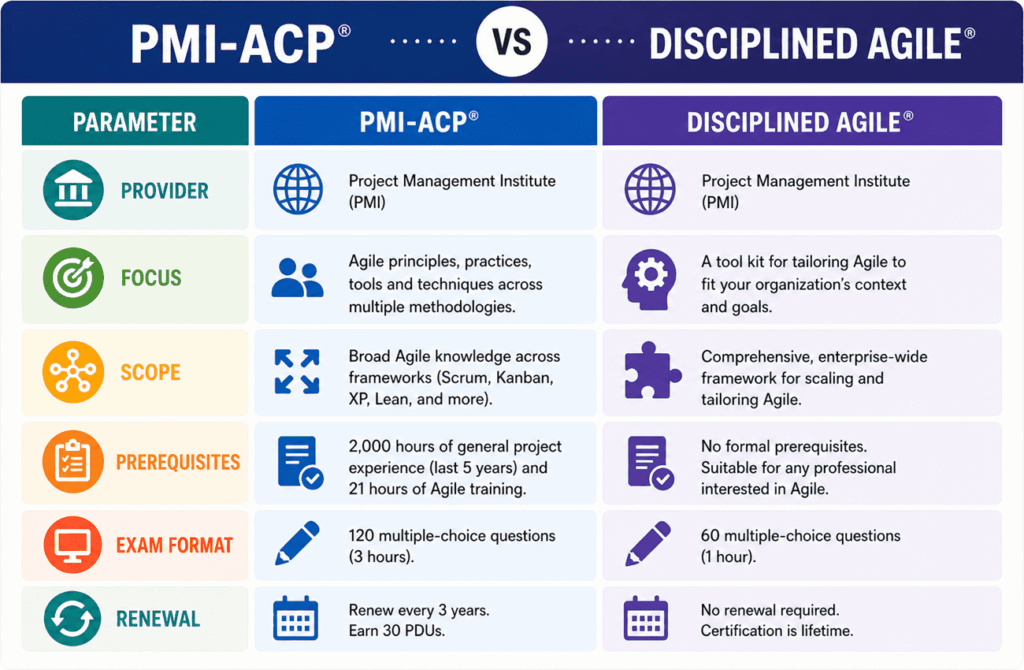
The left column highlights PMI-ACP’s broad and exam-based nature, while the right column shows DA’s flexible, toolkit-driven approach.
Advantages and Disadvantages
PMI-ACP: The certification builds comprehensive knowledge across multiple frameworks, enhances career prospects and develops leadership skills. It requires significant preparation and can be costly, but its recognition often outweighs these challenges.
Disciplined Agile: DA empowers teams to design their own processes and scales well across enterprises. Its flexibility is both an advantage and a challenge; novices might find the choices confusing. Some employers are still more familiar with PMI-ACP.
Career Opportunities
Both certifications open doors to a variety of roles. Agile project managers, Scrum Masters, agile coaches, product owners, release managers and program managers all benefit from formal credentials. According to the U.S. Bureau of Labor Statistics, computer and information systems managers earned a median salary of $171,200 per year in 2024, reflecting strong demand and compensation for leaders who can blend technical and managerial skills. While this figure is not specific to agile roles, it highlights the earning potential for professionals managing complex technology projects.
Agile Trends and Industry Insights
The landscape for agile certifications is shaped by broader adoption trends. Digital.ai’s 2023 State of Agile Report surveyed 788 professionals and found that business leaders and executives drive 32% of agile transformations, technical teams drive 31% and CIO/CTOs drive 20%. Nearly 42% of respondents reported using hybrid models that combine agile, DevOps and other approaches. Among larger organizations, 49% favor a hybrid model, compared with 45% of medium-sized companies. These figures show that agile adoption is no longer confined to IT departments; it’s now an enterprise-wide strategy.
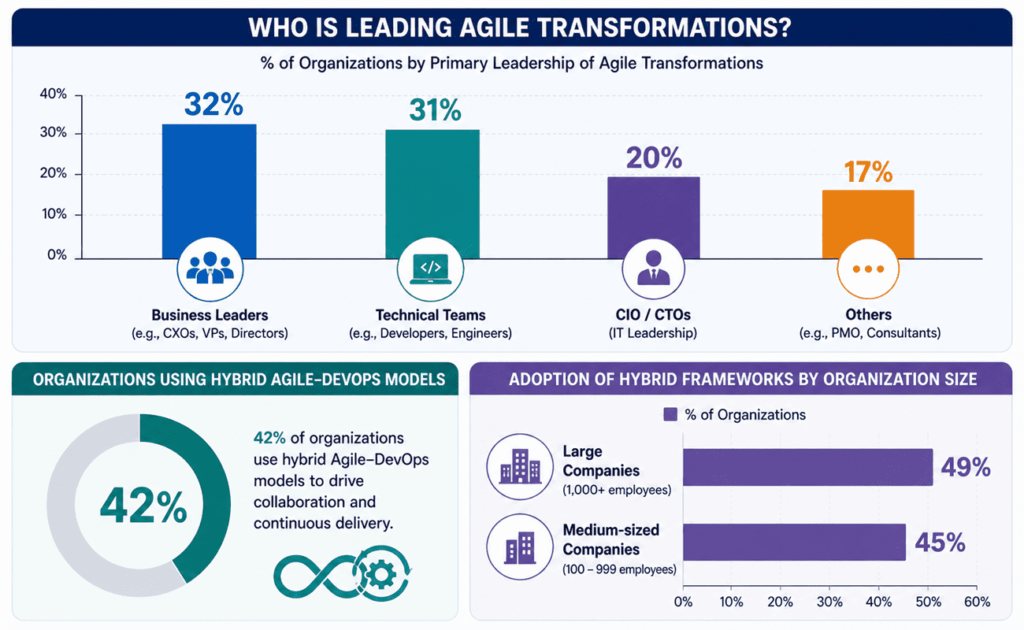
The infographic above illustrates these trends and helps you grasp who champions agile initiatives and how hybrid practices are spreading across company sizes.
Choosing the Right Certification
Deciding between PMI-ACP and Disciplined Agile depends on your experience and goals. Consider the breadth versus depth of knowledge you need, the size and maturity of your organization and your career aspirations.
- If you want a broad overview of agile methods and plan to work across industries or join a variety of teams, PMI-ACP offers versatility.
- If your role involves tailoring practices, scaling agile or coaching teams through transformations, Disciplined Agile provides the tools to design a custom way of working.
Reflect on where you want to be in three years. Do you need a foundation across multiple frameworks, or are you ready to architect enterprise agility? Your answer will guide your choice.
FAQs
Q1. What experience do I need for PMI-ACP?
You need at least 2,000 hours of general project experience and 1,500 hours on agile teams within the past three years, plus 21 hours of agile training.
Q2. How long is the PMI-ACP exam?
The exam has 120 multiple-choice questions and lasts three hours. You can take it in person or online.
Q3. Do I need experience for a Disciplined Agile Scrum Master?
No. The DASM credential has no prerequisites. Complete a two-day course and pass a 50-question online test.
Q4. Can I easily renew my Disciplined Agile credential?
Yes. You must earn 7 PDUs annually and pay a small renewal fee (around $50 for non-members and $20 for PMI members).
Q5. Which certification is more recognized?
PMI-ACP has broader name recognition, but Disciplined Agile is gaining traction as more organizations adopt hybrid frameworks and need flexible toolkits.
Summary
Choosing between PMI-ACP and Disciplined Agile depends on your career path and work environment. PMI-ACP builds a strong foundation across multiple agile methods, while Disciplined Agile offers flexibility to tailor ways of working at scale. Both certifications add value and improve your credibility in today’s evolving project landscape. Think about your goals, experience, and organization’s needs. When you align your certification with your role, you set yourself up for long-term growth and success.
References:

I am Mohammad Fahad Usmani, B.E. PMP, PMI-RMP. I have been blogging on project management topics since 2011. To date, thousands of professionals have passed the PMP exam using my resources.