The world of work has changed dramatically, and companies must adapt quickly to survive and grow. Customer needs change fast, and markets shift without warning. This is where agile transformation becomes important. It helps organizations move from rigid processes to flexible and responsive ways of working.
Agile transformation is more than adopting new tools or methods. It requires a change in mindset, culture, and leadership approach. Teams learn to work in short cycles, gather feedback often, and improve continuously. This approach leads to faster delivery and better outcomes.
If your organization struggles with delays or inefficiencies, agile transformation can be a powerful solution to improve performance and stay competitive.
Key Takeaway
- Agile transformation shifts the whole organization toward flexibility, speed, and customer focus.
- Success depends on strong leadership, clear goals, and a culture that supports change.
- The process includes assessing current work, applying agile methods, and tracking progress with the right metrics.
- Benefits include faster delivery, better collaboration, and improved customer satisfaction.
- Common challenges include resistance to change, lack of training, and unclear priorities.
What is Agile Transformation?
Agile transformation is the process of changing how an organization works so it can respond faster to change and deliver better value to customers. It involves shifting from rigid, traditional methods to flexible and iterative ways of working. Project teams adopt Agile practices like short work cycles, regular feedback, and continuous improvement.
This transformation is not limited to one team. It affects the entire organization, including culture, leadership, processes, and technology. Leaders must support open communication, collaboration, and quick decision-making.
The goal is to improve speed, quality, and customer satisfaction. Agile transformation takes time and effort, but it helps businesses stay competitive in a fast-changing market.
The Agile Transformation Process
Transforming an enterprise does not happen overnight. It’s a long-term effort that examines processes, technology, culture, and metrics and then re-shapes them. For example, a finance division might analyze vendor invoice workflows, replace a legacy system with a modern tool, encourage collaboration between accounting and contracts teams and track invoice turnaround time. After adopting agile practices, invoices are processed faster, morale improves and financial reporting becomes more accurate.
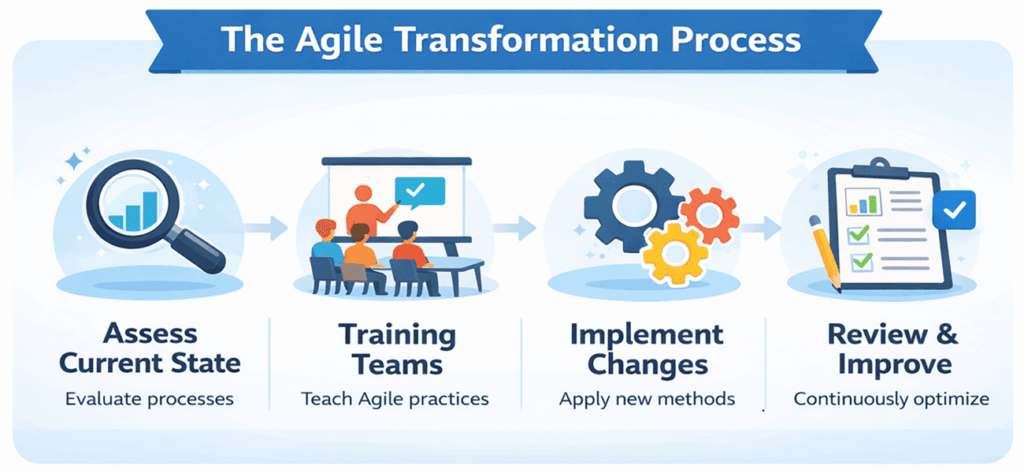
Agile transformation unfolds in phases:
- Assess the current state. Map existing processes, tools and team dynamics. Ask: Where are the delays? What causes rework? Use retrospectives and process mapping to gather insights.
- Identify the desired future state. Define clear goals, for example, faster delivery, better quality or improved customer satisfaction. Set realistic timeframes, acknowledging that agile transformation can take months to years, depending on size and complexity.
- Design and implement changes. Select practices such as Scrum, Kanban or hybrid models and integrate them into workflows. The most popular team-level methodology remains Scrum: 63% of agile users practice team Scrum. However, large organizations often blend frameworks such as SAFe and DevOps to scale agility across departments.
- Measure and adapt. Choose metrics aligned with goals, such as speed to market, customer satisfaction, quality and employee engagement. Regularly review data, celebrate successes and adjust processes when they no longer serve the transformation. Remember, metrics may evolve as maturity grows.
The journey includes setbacks, people resist change, priorities shift and resources can be scarce. Patience and persistence are essential.
Agile Transformation Strategy
Success depends on a clear strategy supported by leaders and embraced by teams. A five-step strategy helps guide the journey:
1. Understand Why
Change is easier when everyone understands the purpose. Reasons might include responding faster to customer needs, reducing bureaucracy or staying ahead of competitors. If the only motive is to say “we’re doing Agile,” the organization isn’t ready. Leaders should communicate the why repeatedly and transparently to build trust and alignment.
2. Develop a Roadmap
A roadmap outlines milestones, timeframes and responsibilities. It should include process improvements, metric targets and cultural milestones. Multiple roadmaps may be needed for large enterprises. The Agile transformation roadmap provides a structured example.
3. Embrace Agile Methods and Assess the Team
Agile is not one method. It includes Scrum, Kanban, extreme programming and many hybrids. Select methods that fit your work and culture. Assess whether teams align with agile values and empower them to self-organize. Encourage cross-team collaboration and recognize individuals who model agile principles.
4. Provide Training and Coaching
Skills gaps can derail transformation. Pair assessments with training programs to build a common understanding of agile practices. Coaching leaders is crucial; leaders who embody agile values influence others through example. Team training boosts collaboration and fosters camaraderie. External consultants or internal change agents can offer unbiased perspectives and help maintain momentum.
5. Define Performance Metrics
Metrics give visibility into progress. Common measures include speed to market, customer satisfaction scores, quality indicators and employee engagement. As transformation matures, metrics may change to reflect new priorities. Align metrics with business goals and avoid vanity metrics that do not drive improvement. For more on measuring teams, explore how to evaluate team productivity.
Benefits of Agile Transformation
Agile transformation brings tangible advantages when executed well:
- Faster delivery and adaptability. Teams deliver product increments quickly, incorporate feedback and pivot when customer needs change. In the 17th State of Agile survey, improved collaboration and better alignment to the business were cited as top benefits.
- Higher productivity. Self-organizing teams with clear goals work more efficiently. When a finance division adopted agile practices, invoices were processed faster and reporting accuracy improved.
- Enhanced customer satisfaction. Focusing on customer feedback throughout development reduces rework and increases satisfaction. According to the same report, 43% of respondents prioritize customer satisfaction in software development.
- Improved employee engagement. Agile empowers people, giving them ownership and a voice in how work is done. This leads to higher morale and retention.
- Competitive advantage. The enterprise agile transformation services market was valued at USD 49.0 billion in 2025 and is projected to reach USD 193.7 billion by 2034, growing at a compound annual rate of 16.01%. Organizations that embrace agility are better positioned to seize market opportunities.
Challenges of Agile Transformation
Despite the advantages, many organizations struggle. In a survey of 112 companies, nearly 90% reported difficulties in scaling agile across the organization; many succeeded in pockets but failed enterprise-wide.
Common hurdles include:
- Cultural resistance. Long-standing habits and hierarchies can hinder collaboration and transparency. Some team members fear losing control or status.
- Lack of leadership support. Without committed executives championing change, teams may revert to old ways. One-third of State of Agile respondents cited leadership understanding and support as a major barrier.
- Unclear priorities. Agile requires clear objectives, but nearly one-third of respondents reported a lack of clear priorities and direction.
- Insufficient training. When teams lack skills, agile practices become rituals rather than meaningful improvements. Continuous learning is essential.
- Inconsistent adoption. Some departments adopt agile while others cling to traditional approaches. Hybrid models work, but fragmentation can cause confusion.
Recognizing these challenges and addressing them through training, transparent communication and supportive leadership increases the likelihood of success.
FAQs
Q1. What is agile transformation?
It is an organization-wide shift from traditional management to agile ways of working. The focus is on flexibility, customer value and empowered teams that iteratively deliver results.
Q2. How long does agile transformation take?
A transformation can take several months to a few years, depending on company size, complexity and readiness. It’s a continuous journey rather than a one-time project.
Q3. Which agile framework should we use?
There is no single answer. Scrum suits time-boxed work with clear deliverables; Kanban fits continuous flow; hybrid models blend practices. Choose methods that align with your culture and goals.
Q4. How do we measure success?
Track metrics that reflect your objectives: delivery speed, customer satisfaction, product quality and employee engagement. Adapt metrics as the transformation matures.
Q5. Can non-software teams adopt agile?
Yes. Finance, marketing, HR and other functions can benefit from agile principles. Focus on visualizing work, limiting work-in-progress and delivering incremental value.
Summary
Agile transformation helps organizations adapt faster, improve teamwork, and deliver value consistently. It is not just about tools or methods but a shift in mindset and culture. With clear goals, strong leadership, and continuous learning, businesses can overcome challenges and achieve lasting success. Though the journey takes time, the results bring better performance, happier teams, and stronger customer relationships. In today’s fast-changing world, agile transformation is no longer optional but a smart strategic move.

I am Mohammad Fahad Usmani, B.E. PMP, PMI-RMP. I have been blogging on project management topics since 2011. To date, thousands of professionals have passed the PMP exam using my resources.