Are you wondering whether a traditional project management credential or an Agile certification will deliver the best return on your effort? The debate around PMP vs Agile has never been more important. Demand for skilled project professionals is booming. A recent Project Management Institute survey found that PMP-certified respondents in the United States reported a median salary of $135,000, while peers without the credential earned $109,157, a difference of almost 24 percent.
Another PMI report forecasts that global demand for project talent will grow by 64 percent between 2025 and 2035, creating a shortfall of nearly 29.8 million qualified project managers. With such compelling data, choosing between PMP and Agile certification is not just a personal milestone. It is a strategic career move that can shape your income, credibility, and long-term growth.
Understanding Waterfall and Agile Methodologies
Project methodologies shape how teams plan, execute, and deliver work. Waterfall is a linear, plan-driven approach that works well when the scope is fixed and requirements are clear. It relies on sequential phases, requirements, design, build, test, and deploy, so changes are costly after the project has begun. This model is popular in construction, manufacturing, and regulated industries where predictability matters.

Agile takes a very different path. It uses short, iterative cycles to deliver small increments of value, allowing teams to adapt as needs evolve. Agile emphasizes collaboration, feedback, and continuous improvement. Although it started in software development, it now influences marketing, product design, and even hardware projects.
A State of Agile report shows that 71 percent of organizations use Agile in their software development lifecycle, and 63 percent of Agile teams follow the Scrum framework. Notably, 42 percent of organizations combine Agile with other methods in a hybrid model.
Certification Paths For PMP, Agile, and Requirements
Traditional (Waterfall) Certifications
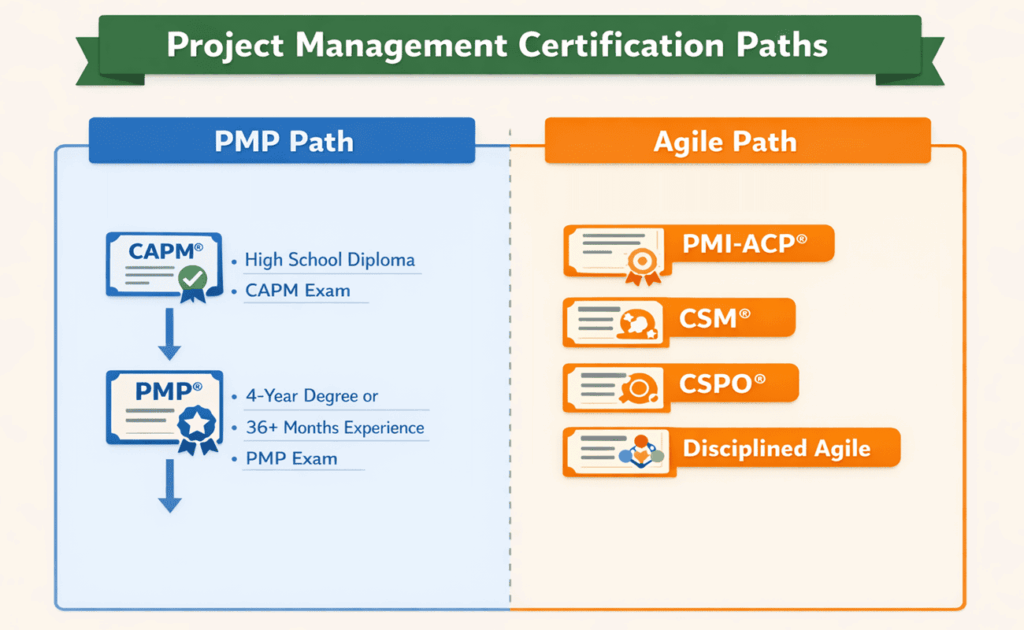
The Project Management Institute offers two main credentials for practitioners of predictive project management. The Certified Associate in Project Management (CAPM) is designed for newcomers. Applicants need a secondary degree (high school or associate’s) and 23 hours of project management education. The exam has 150 questions and a three-hour time limit.
The Project Management Professional (PMP) certification is one of the most respected in the field. Candidates must have a four-year degree plus 36 months of project leadership and 35 hours of formal project management education, or a high school diploma with 60 months of leadership experience. The exam contains 180 questions and takes just under four hours. Since 2021, the PMP exam has included predictive, Agile, and hybrid topics, reflecting today’s blended practice environment.
Agile-Focused Certifications
There is no single “Agile PMP.” Instead, several bodies offer credentials tailored to iterative delivery practices. PMI’s Agile Certified Practitioner (PMI-ACP) validates experience across multiple Agile frameworks. Eligibility requires a secondary degree, 21 contact hours of Agile training, 12 months of general project experience within the last five years, and eight months of Agile experience within the last three years. The exam has 120 multiple-choice questions and lasts three hours. PMI also offers Disciplined Agile credentials, such as the Disciplined Agile Scrum Master (DASM) and the Disciplined Agile Senior Scrum Master (DASSM), which emphasize tailoring Agile practices to organizational context.
The Scrum Alliance offers widely recognized certifications for specific roles. The Certified ScrumMaster (CSM) and Certified Scrum Product Owner (CSPO) certifications require completion of a certified course and passing a brief exam with approximately 50 questions. Advanced certificates, such as Certified Scrum Developer (CSD) and Certified Scrum Professional (CSP), build on these foundations and include coaching and technical tracks. Scrum Alliance certifications generally focus on team roles and emphasize hands-on practice with Scrum events, artifacts, and values.
Factors to Consider When Choosing a Certification
No single credential suits everyone. Use the factors below to guide your decision:
- Industry and organizational culture: Technology firms and startups often favour Agile, while construction, engineering, and government projects lean on predictive methods. If your employer uses a hybrid approach, choose a certification that matches its practices.
- Employer requirements and support: Review job postings and consult HR about mandatory certifications. Many organizations reimburse exam fees or provide training budgets; take advantage of these benefits.
- Career goals: Do you aim to become a specialist in one methodology or showcase versatility across several? Holding both a PMP and an Agile certificate can open doors in diverse sectors.
- Time and prerequisites: Entry-level credentials like the CAPM and CSM have few prerequisites and shorter exams. The PMP requires more experience, while the PMI-ACP demands verified Agile practice. Plan study time for each exam.
- Return on investment: Salary surveys show that PMP-credentialed professionals command higher pay, and global demand for project managers is soaring. Investing in certification can quickly pay off in raises and promotions.
Ask yourself: Do you prefer to deliver large, sequential projects where scope and resources are defined up front? Or are you drawn to iterative work that embraces change and client feedback? Answering that question will steer you toward the right learning path.
Preparing for Your Certification Exam
Success requires more than memorizing terms. Follow these tips to build confidence:
- Use official exam outlines: Download the PMP Exam Content Outline or the PMI-ACP Handbook from PMI’s site, or the course guide from the Scrum Alliance. These documents define the scope of the exams.
- Enroll in authorized training: Accredited training partners teach the latest best practices and provide practice questions. Look for providers with strong pass rates.
- Practice with simulations: Full-length practice exams build endurance and reveal weak areas. Many authorized courses include question banks and timed tests.
- Gain real experience: Apply project management techniques in your current role. The situations you face will make abstract concepts stick.
- Join a study group: Learning with peers keeps you accountable, provides different perspectives, and makes the journey more enjoyable.
Remember that preparation is a marathon, not a sprint. Most candidates spend three to six months studying for the PMP exam. Agile certifications may require less time, but they still demand focused effort and hands-on practice.
FAQs
Q1. Is the PMP exam harder than an Agile exam like PMI-ACP?
Difficulty varies by person. The PMP covers predictive, Agile, and hybrid practices and requires more experience. The PMI-ACP focuses on Agile frameworks, but both demand disciplined study and practice.
Q2. Can I earn both PMP and Agile certifications?
Yes. Many professionals hold multiple credentials. You can start with one and add the other later. Having both shows you can lead in different environments and increases job prospects.
Q3. Do employers value the PMI-ACP as much as the PMP?
It depends on the role. Agile credentials are prized in software and product teams, while the PMP remains widely recognized across industries. Combining them helps you stand out.
Q4. How long does it take to prepare for the PMP exam?
Preparation time differs by background. Many candidates study three to six months, taking courses, reading the PMBOK Guide and Agile references, and practicing with simulated exams until they score consistently high.
Summary
Choosing between the PMP and an Agile certification isn’t a trivial decision. Both credentials can elevate your career and are not mutually exclusive. Traditional project management teaches you to plan, lead, and control complex initiatives, while Agile certifications hone your ability to adapt quickly and deliver incremental value. With demand for project professionals poised to rise sharply and certified practitioners earning more on average, investing in the right certification is one of the smartest moves you can make.
Reflect on your industry, ambitions, and learning style, then commit to the path that aligns with your goals. Once you earn your chosen credential, don’t stop; continue building your skills, and consider pursuing complementary certifications when the time is right.

I am Mohammad Fahad Usmani, B.E. PMP, PMI-RMP. I have been blogging on project management topics since 2011. To date, thousands of professionals have passed the PMP exam using my resources.