A project premortem is a powerful way to improve project success before work even begins. In a premortem analysis, teams imagine that a project has already failed and then identify the possible reasons behind that failure. This simple approach helps you uncover hidden risks, align stakeholders, and strengthen planning. Unlike traditional methods, a project premortem encourages open thinking and honest discussion.
By using a premortem analysis early, you can reduce uncertainty and make better decisions. Whether you manage small tasks or large initiatives, applying a project premortem ensures you address problems before they grow and improves project outcomes.
What is a Project Premortem?
A project premortem happens before you start. Your team steps into the future and assumes the project went wrong. Then you work backwards to list the reasons for that failure. Researchers call this perspective “prospective hindsight,” imagining an event has happened to better understand it. This method encourages participants to be honest about potential pitfalls and helps them see risks they might otherwise overlook.
Premortem workshops differ from postmortems, which occur after a project ends. Postmortems are useful for learning from past work, but they cannot prevent the failures that have already happened. Premortems, on the other hand, give you a chance to fix issues before they derail your progress. They are also distinct from risk registers, which track known risks throughout execution. In a premortem, you do not just list risks; you visualize them as real events to make them more tangible.
Why Do a Project Premortem?
Running a premortem provides several benefits beyond a standard risk review:
- It reduces overconfidence and bias. When project teams want a project to succeed, optimism can hide warning signs. Starting with failure in mind forces you to confront uncomfortable truths. This shift helps curb overconfidence and groupthink.
- It encourages candid conversation. People often stay quiet in meetings to avoid conflict or social pressure. A premortem removes the fear of sounding negative because everyone is tasked with imagining failure.
- It surfaces hidden issues. A 2024 qualitative study on health programs showed that an “implementation premortem” helped participants identify gaps in programme fit, accessibility, and community trust. These themes might have remained invisible without the premortem exercise.
- It broadens perspectives. Inviting people from different roles, such as designers, developers, and marketers, reveals diverse viewpoints that enrich the discussion. This cross-functional approach prevents blind spots.
- It improves planning. By listing reasons for failure, your team can update the project plan and allocate resources to the highest-risk areas. According to PMI’s 2024 Pulse of the Profession report, projects that adopt hybrid practices perform better, with an average performance rate of 73.8% and a 57% jump in hybrid adoption. Such evidence underscores the value of flexible planning.
Premortem Vs Postmortem Vs Risk Management
| Approach | Timing | Focus |
| Premortem | Before the project starts | Assume a failure has occurred, brainstorm reasons, and update the project plan accordingly. |
| Postmortem | After the project ends | Review what happened, gather lessons, and improve future work. |
| Risk register | Throughout project | Identify known risks, monitor them, and plan responses. |
Premortems complement other tools. Use them alongside a project charter, a clear timeline, and a communication plan. The premortem helps you discover unknown unknowns, while the risk register tracks known uncertainties.
How to Run a Project Premortem
Though every team works differently, the core steps are similar. Here is a simple framework you can follow:
- Build a solid project plan. Before you can predict failure, you need a clear roadmap. Outline goals, success metrics, roles, scope, budget, and timelines. Sharing this plan gives everyone the same starting point.
- Invite diverse stakeholders. Bring together people who will work on or influence the project. Include subject-matter experts, front-line staff, and even customers when possible. A variety of voices produces richer insights.
- Brainstorm failure scenarios. Ask each participant to imagine the project has failed and write down the reasons. Encourage them to think independently at first to avoid group bias. Remind them there are no bad ideas at this stage.
- Share and discuss risks. Gather everyone’s inputs and discuss them one by one. Group similar risks and allow participants to build on one another’s ideas. A whiteboard or virtual board helps keep the conversation organised.
- Rank by likelihood and severity. Not every risk is worth addressing. As a group, decide which failures are most likely to happen or most damaging if they do. For medium-sized projects, about ten key risks is a workable number.
- Update the project plan. Translate the critical risks into actions. Add contingency tasks, adjust budgets or timelines, and assign owners. If needed, create a risk register to monitor these items as work progresses.
An Example: Planning a Marketing Campaign
Suppose your team is preparing a new marketing campaign. You gather the campaign manager, copywriter, designer, social media specialist, and video producer. After reviewing the project plan, each person writes down reasons the campaign could fail. Examples might include delayed deliverables, budget overruns, poor audience targeting, website crashes, or misalignment among stakeholders.
During the discussion, you realise that the timeline is aggressive and may cause quality issues. The designer warns that the creative concept might not resonate with the target audience. The social media specialist notes that algorithm changes could reduce organic reach. By ranking these risks, you decide to add buffer time, conduct user testing on the concept, and prepare a paid media budget. This exercise helps you avoid common pitfalls and align expectations.
After the Premortem: Turning Insights Into Action
A premortem is only valuable if you act on the findings. Once your meeting ends, integrate the prioritised risks into your plan. Create contingency tasks, communicate them to the team, and adjust deadlines or budgets as needed. For large initiatives, maintain a simple risk register to track progress on these items. Consider holding brief check-ins to ensure that mitigation actions are completed. Remember that proactive communication keeps everyone aligned and reduces anxiety.
Project Postmortem Vs Premotem
A project premortem and a project postmortem serve different purposes, but both improve project success. A premortem happens before the project begins. The team assumes the project has failed and identifies possible reasons for the failure. This helps uncover risks early and allows teams to prevent problems before they occur.
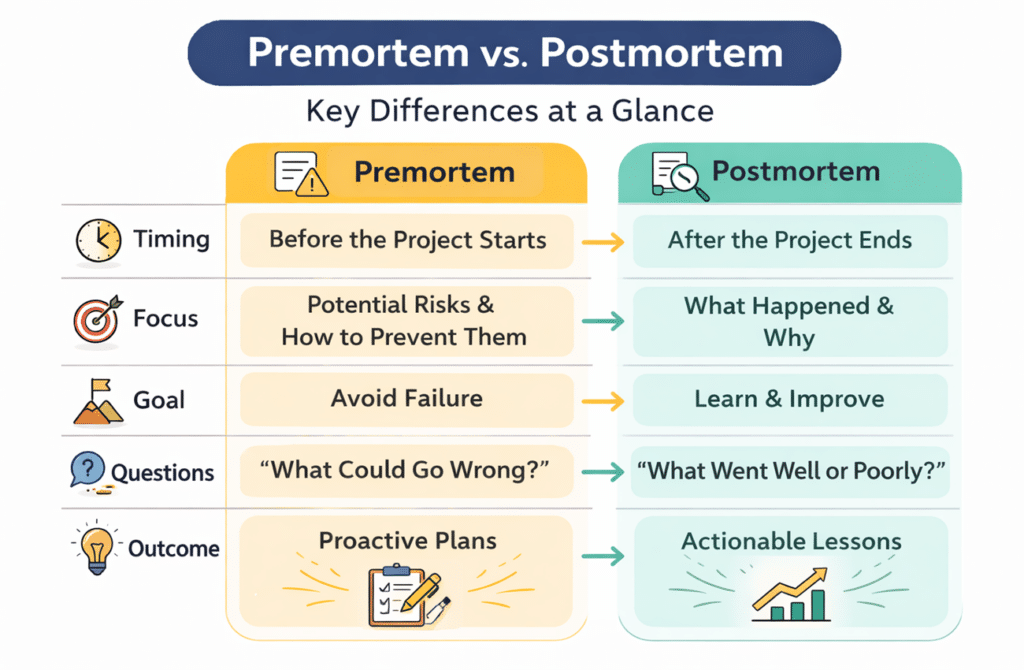
In contrast, a postmortem takes place after the project ends. The team reviews what went well and what did not. This helps capture lessons learned for future projects. While a premortem is proactive and focuses on risk prevention, a postmortem is reactive and focuses on learning. Using both together gives teams a complete approach to continuous improvement and better decision-making.
FAQs
Q1. How long does a premortem meeting take?
In most cases, a premortem can be completed in one to two hours. Give participants time to brainstorm on their own and then discuss as a group.
Q2. Who should attend a premortem?
Include the project team and anyone with insight into potential pitfalls. Diverse perspectives from engineering, marketing, customer support, and finance can help surface hidden issues.
Q3. Is a premortem the same as risk management?
Not exactly. Risk management tracks known uncertainties. A premortem imagines failure has already occurred and invites creative thinking about unknown risks.
Q4. Do remote teams benefit from premortems?
Yes. Remote teams may be more prone to miscommunication and hidden risks. Holding a premortem over video with collaborative tools helps everyone contribute.
Q5. How often should you run a premortem?
Run a premortem whenever you start a major initiative or when there is uncertainty. You might repeat the exercise if the scope changes dramatically.
Summary
A project premortem helps you think ahead and avoid failure before it happens. By using premortem analysis, you can identify risks early, improve planning, and align your team on key challenges. This simple method builds stronger decisions and reduces surprises during execution. When team members openly discuss potential issues, they create better solutions and more realistic plans. In today’s fast-changing projects, a project premortem is not optional; it is a smart step that improves outcomes and increases the chances of success.

I am Mohammad Fahad Usmani, B.E. PMP, PMI-RMP. I have been blogging on project management topics since 2011. To date, thousands of professionals have passed the PMP exam using my resources.