Project risk management can feel like a moving target. You set up a risk register, meet with your team, and yet you still wonder whether you’re focusing on the right things. Do you need to conduct a risk audit or a risk review? Both tools are essential, but they serve different purposes.
This blog post explains when to use a risk review or a risk audit and how to integrate them into your project management routine.
Let’s get started.
Why Risk Management Matters Now
Risk management is essential because it helps you identify, assess, and control uncertainties before they become serious problems. It improves decision-making by providing clear insights into potential threats and opportunities.
When risks are managed well, projects are more likely to stay on schedule, within budget, and aligned with objectives. It also enhances stakeholder confidence by demonstrating proactive planning and control. Effective risk management reduces costly surprises, supports better resource allocation, and strengthens overall project performance.
It helps organizations to adapt quickly, protect value, and achieve consistent, successful outcomes across projects.
Risk and the Risk Management Plan
Before diving into audits and reviews, it helps to clarify what “risk” means in project management. PMI defines a risk as an uncertain event or condition that, if it occurs, has a positive or negative effect on one or more project objectives. A risk management plan describes how risk activities are structured and performed. This plan is not a static document; it evolves with the project’s environment and guides the team in identifying, analyzing, responding to, and monitoring risks.
What is a Risk Audit?
A risk audit is an examination of how well your project is managing risk. It looks back at the defined risks, analyses, responses, and mitigation results. The goal is to verify that risk responses are working and that the risk management process is effective. PMI’s knowledge base describes a risk audit as the examination and documentation of the effectiveness of risk responses and the overall risk management process. Unlike financial audits, a risk audit evaluates planning and execution rather than numbers.
Purpose and Timing
The main purpose of a risk audit is to determine whether the risk management plan and activated responses are producing the desired outcomes. Audits are usually scheduled around major milestones or at predetermined intervals. Large or long projects might require a series of audits, while a small project might only need one near the end. Audits provide feedback on how processes are working so the team can make adjustments before issues become major problems.
How to Conduct a Risk Audit
- Prepare the data. Compile risk statements, analyses, and response plans. Make sure the risk register and logs are up to date. This documentation forms the baseline for the audit.
- Assemble an objective team. Involve people who understand the project’s environment and any regulatory requirements. The team’s mix of perspectives improves accuracy.
- Evaluate each risk response. Review mitigation strategies one by one. Identify gaps where controls are not working or where responses need adjustment. Document these findings along with recommendations for improvement.
- Translate findings into actions. The audit team’s insights become actionable updates to the risk management plan. These updates should be recorded as part of the project’s lessons learned and post-mortem documentation.
Real-world example: A software development project for a banking client schedules a risk audit after a regulatory compliance testing phase. The audit reveals that the team’s data encryption procedures are effective but that incident-response drills are seldom practiced. Management adds quarterly drills to the risk management plan and assigns a security consultant to train the team.
This small change reduces the likelihood of compliance failures and aligns with the broader trend of cybersecurity being a top risk (73% of surveyed organizations list it among their top five risks).
What is a Risk Review?
A risk review examines whether the risk management plan remains relevant as the project evolves. It looks forward rather than back. Unlike an audit, which verifies that planned actions happened, a review assesses new and emerging risks, shifts in existing risks, and the ongoing suitability of the risk management plan.
Although PMI’s lexicon does not formally define the term, risk reviews are embedded in the PMBOK Guide as a tool conducted at regular intervals to assess the current project environment and determine if changes are needed to manage future risks.
Purpose and Timing
The purpose of a risk review is to spot changes early. Risk reviews typically occur during regular status meetings or at times aligned with planned changes. They should involve the project manager, risk owners, and team members.
Not every change triggers a full risk review; only those that could significantly affect the project environment warrant one. Because reviews are iterative, they help the team adapt to evolving conditions without waiting for scheduled audits.
How to Conduct a Risk Review
Risk reviews follow a consistent structure so that participants come prepared and important details are not missed.
The following are the key steps:
- Update the context. Begin by summarizing what has changed since the last review, such as new stakeholders, scope changes, schedule delays, or external events.
- Ask structured questions. Discuss whether new risks have emerged, how likely they are to occur, and how severe their impact could be. Check whether the probability or impact of existing risks has shifted and whether any risks are now interconnected.
- Decide on actions. Determine which risks should be closed, which require additional monitoring, and what responses should be triggered. If a recent audit occurred, incorporate lessons learned.
- Document and communicate. Record the review’s findings and decisions. Update the risk register and share changes with stakeholders so everyone stays aligned.
Risk reviews are best viewed as part of ongoing project conversations rather than formal stand-alone meetings. Embedding these discussions into status updates makes them less intrusive and ensures that risk management remains an everyday habit.
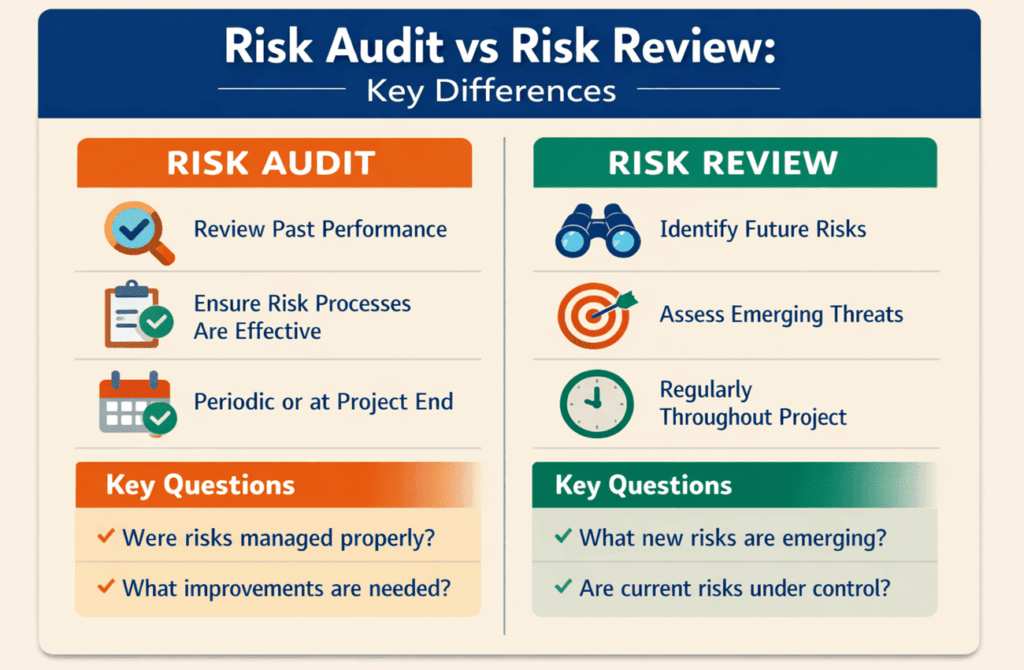
Risk Audit Vs Risk Review: Similarities and Differences
Both risk audits and risk reviews are part of the Monitor Risks process and rely on input from the project team. The project manager leads both activities, and findings should be stored with other project documentation. The table below summarizes how they align and differ.
| Parameter | Risk Audit | Risk Review |
| Primary focus | Looks backward at executed risk responses | Looks forward to identifying new or changing risks |
| Purpose | Verify the effectiveness of risk management processes | Keep the risk management plan relevant |
| Timing | Scheduled around milestones or at project end | Embedded in regular status meetings |
| Scope | Detailed analysis of each risk and response | Broad assessment of the overall risk landscape |
The size and complexity of the project influence how frequently you use each tool. Large or long projects might need multiple audits, whereas any project can benefit from regular reviews.
Applying Audits and Reviews in Practice
To get the most value from these tools, integrate them into your project lifecycle rather than treating them as separate exercises.
Here are practical tips:
- Align with project phases. Plan risk audits at key milestones, such as after requirements gathering, design approval, or major releases. Use these checkpoints to confirm that mitigation strategies still make sense.
- Use risk reviews as a radar. Schedule risk reviews during status meetings or sprint retrospectives. Treat them as moments to look around the corner and adjust before issues grow.
- Leverage technology. Modern project management tools increasingly embed AI to predict risks and automate analysis. Since 55% of buyers invest in new software for AI features, take advantage of predictive analytics to surface patterns you might miss.
- Watch emerging risks. Digital disruption and geopolitical uncertainty are rising fast. During reviews, ask how global events, such as supply chain disruptions or regulatory changes, could affect your project.
- Document consistently. For both audits and reviews, ensure that findings are recorded in the risk register and lessons learned repository. This documentation supports organizational knowledge and helps with future PMP exam preparation.
Risk Audit and Risk Review for the PMP Exam
If you’re studying for the PMP certification, you may encounter questions that require distinguishing between a risk audit and a risk review. Remember these exam tips:
- Know the definitions. A risk audit examines the effectiveness of risk responses. A risk review assesses whether the risk management plan needs updating.
- Match the tool to the scenario. For a question describing a formal evaluation of past risk responses, select “risk audit.” For a scenario where the project manager and team discuss new risks during a status meeting, select “risk review.”
- Understand timing cues. Words like “lessons learned” and “retrospective” hint at audits, while phrases like “regularly scheduled meeting” or “emerging risks” indicate reviews.
- Remember the bigger picture. Both audits and reviews are tools within the Monitor Risks process, but they complement rather than replace each other. Using both enhances the project’s resilience.
Risk Review Checklist
To help you facilitate productive risk reviews, use the following checklist. Each question prompts the team to explore the changing risk landscape.
FAQs
Q1. What is the goal of a risk audit?
The goal is to verify that risk responses are working and to assess whether the risk management process is effective.
Q2. How often should I conduct a risk review?
Schedule reviews at regular intervals, often during status meetings, and whenever a significant change affects the project environment.
Q3. Can a risk review replace a risk audit?
No. A review looks forward to adjusting plans, while an audit looks back to assess execution. Both are needed to manage risks comprehensively.
Q4. Who participates in a risk audit?
A multidisciplinary team with knowledge of the project’s context conducts the audit, ensuring objective evaluation and regulatory awareness.
Q5. Why are emerging risks like digital disruption so important?
The 2026 Risk in Focus report noted that digital disruption and geopolitical uncertainty saw the largest increases in risk ratings. These trends can affect project timelines, resources, and stakeholder expectations, so they should be monitored actively.
Summary
Understanding the difference between a risk audit and a risk review is key to strong project risk management. A risk audit helps evaluate past actions, while a risk review prepares teams for future challenges. Using both ensures continuous improvement and better decision-making throughout the project lifecycle. By combining these tools, you can stay proactive, reduce uncertainty, and improve overall project success in today’s complex and evolving business environment.

I am Mohammad Fahad Usmani, B.E. PMP, PMI-RMP. I have been blogging on project management topics since 2011. To date, thousands of professionals have passed the PMP exam using my resources.