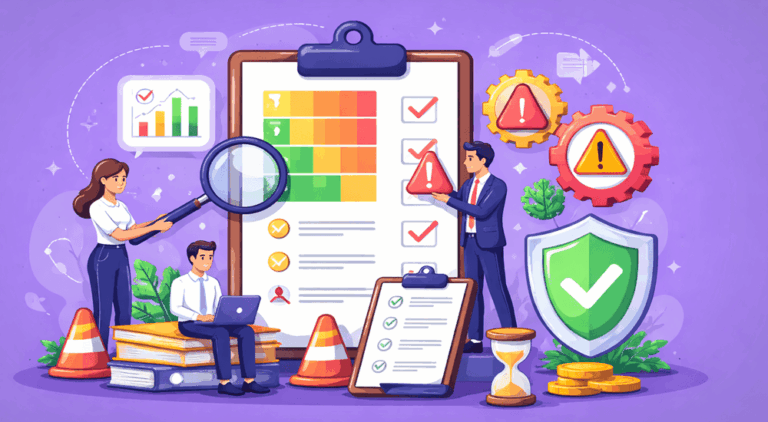
Every project faces uncertainty, from budget problems to schedule delays and changing market conditions. That is why understanding risk management fundamentals is important for project success. Strong risk management fundamentals help you identify possible threats early, reduce losses, and make smarter decisions throughout the project lifecycle.
A structured project risk management process also improves communication, planning, and stakeholder confidence. Organizations that apply effective risk management strategies can respond more quickly to unexpected events and protect their business goals.
This blog post explains the key steps, tools, and methods used in modern risk management so you can manage uncertainty with greater confidence and improve long-term project performance.
Key Takeaways
- Structured processes matter: A defined risk management process helps you see hazards early and respond effectively.
- Data shows risk is real: Surveys reveal (survey-1, and survey-2) cyber incidents top global concerns with 38% of responses and nearly three quarters of firms suffered a critical risk event.
- Human factors count: Communicating with stakeholders and building a risk-aware culture is as important as tools and techniques.
- Use both qualitative and quantitative analysis: Combine judgment with numeric models to prioritize risks and make informed decisions.
- Tailor your responses: Strategies such as avoidance, mitigation, transfer and acceptance help you align actions with business goals.
What is Risk Management?
Risk management is the discipline of recognizing uncertain events that could affect a project and taking steps to reduce negative outcomes or enhance positive ones. When done well, it makes projects more predictable and builds confidence among stakeholders. Neglecting it can lead to cost overruns, schedule slips and even total failure. Having a defined approach creates cost-effective projects and boosts reputation.
Risk management is proactive. Instead of waiting for problems to occur, you systematically think about what might happen and plan responses. This mindset turns uncertainty into an opportunity for better planning.
Why Does Risk Management Matter?
Risk management is important because it helps organizations prepare for uncertainty and reduce the impact of unexpected problems. Every project faces risks related to cost, schedule, quality, resources, or technology. Without a clear risk management process, small issues can quickly become serious challenges.
Effective risk management helps you identify potential threats early, assess their impact, and develop response plans before problems escalate. It also improves decision-making because managers can act with better information and greater confidence. Strong risk management strategies support better budget control, smoother operations, and improved project performance.
In addition, risk management increases stakeholder trust by showing that the organization is prepared for potential disruptions. Businesses that practice risk management regularly are more adaptable, more resilient, and better equipped to achieve long-term goals in a changing and competitive environment.
Types of Project Risks
Risks come in many flavors. Understanding categories helps you think broadly:
- Technical risks – issues with software, equipment, or technology integration. For example, adopting a new platform may cause compatibility issues.
- Schedule risks – delays from unrealistic timelines, dependencies, or resource conflicts. Changing scope without adjusting the schedule is a common culprit.
- Financial risks – cost overruns, currency fluctuations, or unexpected expenses. Materials price spikes or inaccurate cost estimates can have big impacts.
- Operational risks – process breakdowns, supply chain disruptions, or human errors. A manufacturing line stoppage due to equipment failure is one example.
- External risks – regulations, weather events, political instability, or market conditions. New legislation or a natural disaster can derail plans.
- Strategic risks – misaligned objectives or changes in organizational priorities. If the company shifts strategy mid-project, your objectives may no longer align.
When you categorize risks, you avoid tunnel vision. It encourages thinking beyond immediate technical issues.
The Risk Management Process
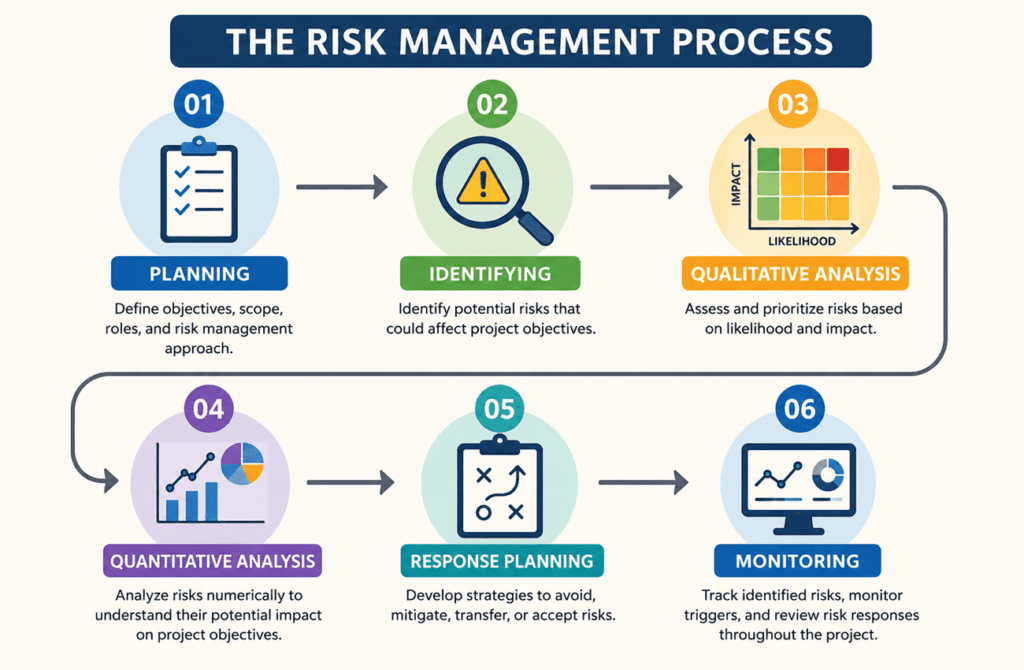
Effective risk management follows a repeatable series of steps. Each step builds on the previous one and feeds into the next.
1. Plan Risk Management
Begin by defining how you will conduct risk activities. Develop a risk management plan that outlines roles, responsibilities, tools, and reporting methods. Consider tailoring guidelines based on project size and complexity. Align the plan with organizational policies and stakeholder expectations.
2. Identify Risks
Gather your team and brainstorm uncertainties. Use techniques like interviews, checklists, cause-and-effect diagrams, and document reviews. Encourage open discussion; risks are often uncovered by those closest to the work. Capture each risk in a risk register with a description, potential cause, and effect.
3. Perform Qualitative Risk Analysis
Evaluate the probability and impact of each risk using expert judgment. You can use a simple risk matrix: categorize probability (e.g., low, medium, high) and impact on cost, schedule, or quality. Prioritize the risks that fall into high categories. This step helps focus attention on the most significant threats and opportunities.
4. Perform Quantitative Risk Analysis
When high-impact risks require deeper insight, apply quantitative techniques. These include expected monetary value, Monte Carlo simulations, and decision tree analysis. The goal is to estimate numeric effects on cost and schedule. For example, a simulation might reveal a 20% chance that the project will exceed its budget by $50,000.
5. Plan Risk Responses
For each prioritized risk, decide how to act:
- Avoid – change plans to eliminate the risk. For example, remove a risky feature.
- Mitigate – reduce probability or impact by taking preventive actions like adding testing or extra resources.
- Transfer – shift the impact to a third party, such as purchasing insurance or outsourcing a risky component.
- Accept – acknowledge the risk and prepare a contingency plan if it occurs.
- Exploit or enhance – when dealing with positive risks (opportunities), adjust plans to increase the chance of benefit.
- Escalate – An escalate risk response strategy means transferring ownership of a risk to higher management or another authority when the project team lacks the power, budget, or expertise to handle it effectively.
Assign an owner for each risk and document the chosen strategy in your risk register.
6. Implement and Monitor
Put your planned responses into action. Monitor risks and review the register regularly. New risks may emerge as the project evolves. Hold periodic risk reviews with your team, update probabilities and impacts, and adjust strategies as needed. Effective monitoring ensures that risk management remains a living process rather than a one-time exercise.
Qualitative Vs Quantitative Analysis
Both qualitative and quantitative methods have a place in risk management. The side-by-side graphic below highlights their differences:
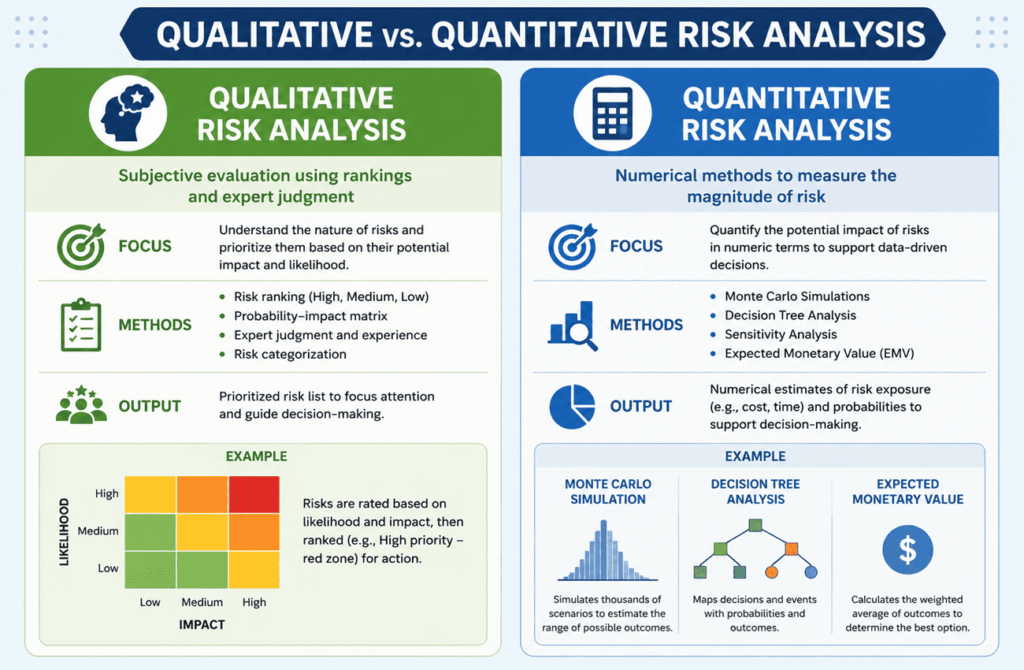
Qualitative analysis is faster and relies on expert opinions. It helps prioritize risks without requiring detailed data. Quantitative analysis, by contrast, uses numbers to model outcomes and often needs specialized tools or software. Combining both approaches offers a balanced view, allowing you to identify which risks warrant further investment of time and resources.
Strategies for Responding to Risks
Choosing the right response depends on the nature of each risk. Here are common strategies with simple examples:
- Avoid – If a supplier’s reliability is questionable, choose a different supplier to prevent delays.
- Mitigate – Add extra quality testing to reduce the chance of defects.
- Transfer – Purchase warranty coverage for critical equipment to shift financial risk.
- Accept – When the cost of mitigation outweighs the potential impact, simply acknowledge the risk and watch for triggers. Set aside a contingency reserve.
- Exploit or share – For opportunities, such as a chance to gain market share, invest more resources to capture the benefit or partner with another firm to share rewards and risks.
- Escalate – An escalate risk response strategy means transferring ownership of a risk to higher management or another authority when the project team lacks the power, budget, or expertise to handle it effectively.
It is important to assign a risk owner to oversee each response and to define triggers that signal when to act.
Tips for Successful Risk Management
- Start early – Consider risks during project initiation. Early identification allows more options for response.
- Tailor the process – Adjust the level of detail to match project size and complexity. A small project may only need a simple risk log, while a large initiative could require sophisticated analysis.
- Keep your risk register current – Update probabilities, impacts, and responses regularly. Archive closed risks for lessons learned.
- Engage the team – Risk management is not just the project manager’s job. Encourage team members, sponsors, and stakeholders to contribute.
- Review lessons learned – After a project ends, analyze which risks occurred and how well responses worked. Apply these lessons to future projects.
FAQs
Q1. Why should small projects bother with risk management?
Even small projects can fail without risk planning. A simple risk log and periodic review can prevent minor issues from becoming major problems.
Q2. How often should I review the risk register?
Review risks at every major milestone or at least monthly. More frequent reviews may be needed for high-risk projects.
Q3. Do I need specialized software for quantitative analysis?
Not always. Simple expected monetary value calculations can be done in a spreadsheet. For simulations, dedicated tools can help, but start small.
Q4. What is the difference between a risk and an issue?
A risk is a potential event that might occur. An issue is a problem occurring now. Risks may turn into issues if not managed.
Q5. How can I encourage my team to participate?
Lead by example. Share your own concerns openly and celebrate when team members surface risks. Make risk discussions part of regular meetings.
Summary
Risk management fundamentals help you prepare for uncertainty and reduce project disruption. By following a clear project risk management process, you can identify threats early, evaluate impacts, and apply effective risk management strategies. Using both qualitative risk analysis and quantitative risk analysis improves decision-making and project stability. Strong communication, regular monitoring, and timely responses also support better outcomes. Whether managing a small initiative or a complex enterprise project, a proactive approach to risk management builds confidence, protects resources, and increases the chances of long-term success.

I am Mohammad Fahad Usmani, B.E. PMP, PMI-RMP. I have been blogging on project management topics since 2011. To date, thousands of professionals have passed the PMP exam using my resources.