Large organizations often struggle to scale agile practices across many teams. The Scaled Agile Framework was created to solve this problem by helping enterprises align strategy, development, and delivery. Today, many companies adopt the Scaled Agile Framework to improve collaboration, speed, and product quality while managing complex projects.
However, scaling agile is not always easy. Teams may face challenges such as rigid processes, communication gaps, limited autonomy, and top-down decision-making.
This blog post explains the biggest SAFe challenges and practical ways to overcome them. You will also learn how organizations can balance structure with flexibility to achieve better business outcomes.
Key Takeaway
- The Scaled Agile Framework (SAFe) helps large organizations coordinate multiple agile teams and improve enterprise-wide delivery.
- Many companies struggle with SAFe due to rigid processes, excessive planning, and limited team autonomy.
- Poor communication, lack of training, and top-down decision-making often reduce the benefits of agile transformation.
- Organizations that adapt SAFe to their culture and business needs usually achieve better collaboration and faster delivery outcomes.
- Strong leadership support, continuous learning, and clear prioritization are critical for successful SAFe adoption.
- Teams perform better when they focus on customer outcomes, open communication, and continuous improvement rather than only feature delivery.
What is the Scaled Agile Framework?
The Scaled Agile Framework, commonly called SAFe, is a method that helps large organizations apply agile practices across many teams. It combines ideas from Scrum, Lean, and Kanban to improve collaboration, planning, and product delivery at scale. SAFe gives companies a structured way to align business goals with development work while keeping teams focused on customer value.
The framework organizes work into different levels, such as team, program, and portfolio. This structure helps teams coordinate large projects without losing visibility or control. SAFe also promotes continuous improvement, regular planning cycles, and faster customer feedback.
Many enterprises use SAFe because it supports better communication, predictable delivery, and stronger teamwork. However, organizations must adapt the framework carefully. Too many rules or excessive planning can reduce flexibility and slow innovation if teams are not empowered properly.
Top 7 SAFe Challenges and their Solutions
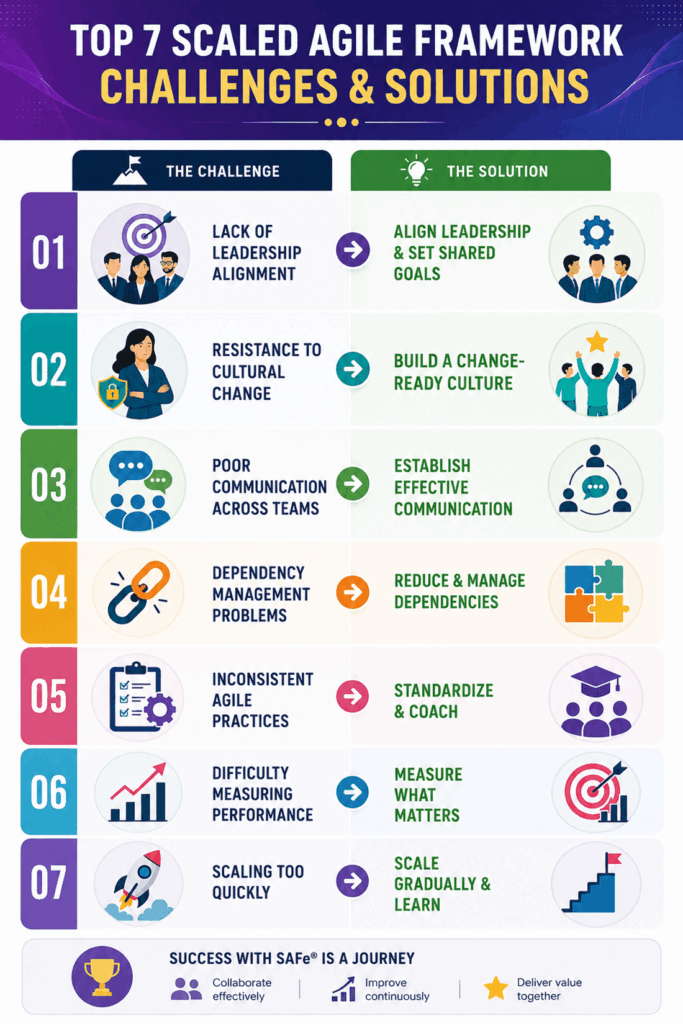
The top seven Scaled Agile Framework challenges and their solutions are as follows:
1. Lack of Leadership Alignment
Many scaled Agile transformations fail because senior leaders support Agile in theory but continue to use old management habits. Teams receive mixed signals. One manager asks for flexibility while another demands rigid reporting and fixed plans. This confusion slows progress and lowers trust across departments.
The solution starts with leadership alignment workshops and shared goals. Executives, product leaders, and delivery managers should agree on Agile values, decision-making methods, and success metrics before scaling begins. Organizations also benefit when leaders actively join planning sessions and review cycles. When leadership acts consistently, teams adapt faster and work with greater confidence.
2. Resistance to Cultural Change
Scaling Agile changes how people communicate, plan work, and measure success. Employees who spent years in traditional environments may fear losing control, authority, or job security. Resistance often appears through delayed decisions, poor collaboration, or passive support.
Organizations should address culture early rather than focusing solely on tools and frameworks. Clear communication helps people understand why the transformation matters. Training programs, coaching sessions, and small pilot projects reduce fear and build confidence. Leaders should also celebrate quick wins to show visible progress. People support change more easily when they see practical benefits in daily work.
3. Poor Communication Across Teams
As Agile expands, communication becomes more difficult. Multiple teams may work on related features while using different priorities or timelines. Small misunderstandings can create delays, duplicate work, and integration problems.
The best solution is to create structured communication channels without adding unnecessary bureaucracy. Regular Scrum-of-Scrums meetings, shared dashboards, dependency tracking, and cross-team planning sessions improve visibility. Teams should also use common terminology and shared objectives. Good communication reduces confusion and keeps everyone focused on delivering value rather than on solving avoidable coordination problems.
4. Dependency Management Problems
Large organizations often have many interconnected teams. One team may depend on another for approvals, testing, infrastructure, or design work. These dependencies slow delivery and create bottlenecks during Program Increment planning.
Companies can reduce dependency issues by forming cross-functional teams with broader skill coverage. Teams should include developers, testers, architects, and business representatives whenever possible. Organizations should also map dependencies early in planning cycles and prioritize high-risk items. Smaller batch sizes and continuous integration practices help teams detect issues before they grow into major delays.
5. Inconsistent Agile Practices
Some teams follow Agile closely while others continue using traditional methods. This inconsistency creates reporting conflicts, planning issues, and uneven delivery speeds. One team may work in short iterations while another still relies on long approval cycles.
A strong Agile Center of Excellence or transformation office can solve this issue. Organizations should provide standardized training, common workflows, and shared Agile guidelines. Coaching also plays an important role. Teams need flexibility, but they should still follow core principles consistently. Standardization improves collaboration while allowing teams to adapt practices to their own environments.
6. Difficulty Measuring Performance
Many organizations struggle to measure success after scaling Agile. Traditional metrics like hours worked or percentage completed often fail to reflect real business value. Teams may focus on activities rather than outcomes.
The solution is to track value-driven metrics. Organizations should measure customer satisfaction, delivery predictability, lead time, defect rates, and business impact. Objectives and Key Results (OKRs) also help teams connect daily work to strategic goals. Simple, transparent metrics give leaders greater visibility without creating pressure that undermines Agile behavior.
7. Scaling Too Quickly
Some organizations attempt a company-wide Agile rollout before teams fully understand the framework. This rushed approach usually creates confusion, burnout, and weak adoption. Teams become overwhelmed by new ceremonies, roles, and tools.
A phased rollout works far better. Start with a few pilot teams, learn from their experiences, and improve the process before expanding further. Continuous feedback and gradual scaling help organizations build sustainable Agile maturity. Agile transformation is a long-term journey, not a one-time project. Companies that scale carefully usually achieve stronger and more stable results over time.
FAQs
Q1. What are the main levels of planning in SAFe?
SAFe uses three layers: team, program and portfolio to align work from detailed tasks to strategic objectives.
Q2. What is an epic in SAFe?
In SAFe, an epic is a significant initiative that requires investment and must deliver clear business outcomes. It’s not just a big user story; it drives strategic change.
Q3. How often should program increments occur?
Many organizations plan program increments of eight to twelve weeks, but you can shorten or lengthen them to suit your environment. Shorter cycles expose issues sooner.
Q4. Do we have to adopt every SAFe role and ceremony?
No. Treat SAFe as a toolkit. Adopt roles and events that deliver value and adapt or omit those that don’t. Successful adoptions balance structure with flexibility.
Summary
Scaling agile is hard work. The Scaled Agile Framework offers a robust system, but its success depends on how you implement it. Instead of following it blindly, tailor it to your organization, involve people at every level and foster a culture of learning. Training, leadership support and open communication reduce resistance and misalignment. Remember the ultimate goal: delivering meaningful outcomes for customers and employees. By addressing these SAFe challenges thoughtfully, you can unlock SAFe’s benefits and build a more responsive organization.

I am Mohammad Fahad Usmani, B.E. PMP, PMI-RMP. I have been blogging on project management topics since 2011. To date, thousands of professionals have passed the PMP exam using my resources.