Earning a professional certification can open many doors for you. The Project Management Institute (PMI) recommends two entry-level certifications for those with three or fewer years of experience: the Certified Associate in Project Management (CAPM) and the PMI Agile Certified Practitioner (PMI-ACP).
Both credentials validate project management skills and show employers that you are serious about your career. With the project management field growing rapidly and organizations expecting a shortage of project talent by 2035, choosing the right certification is more important than ever.
Key Takeaways
- CAPM is broad. It introduces project management fundamentals across multiple methodologies and is ideal for newcomers with no experience.
- PMI-ACP is agile-focused. It emphasizes hands-on agile practices and is suited to professionals with some agile experience.
- Demand is rising. Project management roles are expected to grow by 64% through 2035, making it one of the fastest-growing career paths.
- Check eligibility. CAPM requires a high school diploma and 23 contact hours of training. PMI-ACP requires either two years of agile experience or one year plus a relevant degree or certification.
- Align with your goals. Choose CAPM if you need a foundation across various approaches; choose PMI-ACP if you want to specialize in agile and already have some experience.
Why Certifications Matter for Early-Career Project Managers
Project management has become one of the most in-demand skill sets, touching industries from finance to healthcare. Certifications provide several benefits for newcomers:
- Validation of knowledge. Formal training demonstrates that you understand standardized methodologies and processes.
- Commitment to the profession. Earning a credential signals a desire to grow and meet global project management standards.
- Career advancement. With demand for project managers projected to rise sharply and talent shortages expected, certified professionals stand out. 65% of organizations require a project management certification for senior roles.
- Increased marketability. High-performing project managers often hold at least one certification, and pay premiums are common.
Understanding Your Options
Certified Associate in Project Management (CAPM)
The CAPM is designed for individuals new to project management. According to PMI, it lays a foundation for future certifications like PMP and shares exam content from the PMBOK Guide.
Purpose and Scope
The CAPM covers fundamental knowledge, processes and terminology needed for effective project management. Because it spans multiple methodologies, including predictive, agile and hybrid approaches, it prepares you for diverse projects and roles.
Eligibility and Training
To sit for the CAPM exam, you must have a high-school diploma and complete 23 contact hours of project management education. No professional experience is required.
Exam Format
The exam has 150 questions and a three-hour time limit. Fifteen questions are unscored pretest items. A recent update added new question types, including drag-and-drop and hotspot questions. Candidates get a ten-minute break after the first half of the exam.
Badge and Recognition
PMI issues a digital badge upon passing, which you can display on your résumé and LinkedIn profile.
PMI Agile Certified Practitioner (PMI-ACP)
The PMI-ACP credential recognizes hands-on experience applying agile practices across methodologies such as Scrum, Kanban and Lean. It is more specialized than the CAPM and targets practitioners who already work in agile environments.
Purpose and Scope
PMI designed the PMI-ACP to validate real-world agile skills and to signal your ability to work effectively as part of an agile team. The exam tests your understanding of agile principles, mindset, value-driven delivery, stakeholder engagement, team performance, adaptive planning, problem solving and continuous improvement.
Eligibility and Training
To qualify, you need at least a secondary diploma (high school or equivalent). Applicants must also meet one of several agile experience options:
- Two years of agile experience within the last five years.
- One year of agile experience plus a degree from a Global Accreditation Center (GAC) program.
- One year of agile experience plus an active third-party agile certification, such as Scrum Master (CSM), SAFe, or PMP.
- Active PMP holders automatically meet the agile experience requirement.
In addition, you must log 28 contact hours of formal training in agile practices.
Exam Format
The exam contains 120 multiple-choice questions, of which 100 are scored and 20 are pretest items. You have three hours to finish, averaging roughly 90 seconds per question.
Badge and Recognition
Like CAPM, PMI-ACP holders receive a digital badge that enhances their professional brand.
CAPM Vs PMI-ACP: Key Similarities and Differences
PMI manages both certifications and recommends PMI-authorized study resources. Both credentials aim at early-career professionals and emphasize the value of formal exam preparation. They share a three-year renewal cycle with continuing education requirements.
However, the two certifications differ in focus, eligibility, exam format and industry demand. The table below summarizes the main differences.
| Factor | CAPM | PMI-ACP |
| Career focus | General project management across methodologies | Agile specialist with hands-on experience |
| Eligibility | High-school diploma + 23 contact hours; no experience | Secondary diploma + 28 contact hours + 2 years agile experience or 1 year with GAC degree or third-party certification |
| Exam | 150 questions; 3-hour time limit | 120 questions; 3-hour time limit |
| Exam difficulty | Entry level; primarily tests project management fundamentals | Intermediate; scenario-driven and tests agile mindset across multiple frameworks |
| Industry demand | #1 on Entrepreneur’s list of in-demand certifications; broad appeal across sectors | Rapid growth as agile adoption spreads across industries; demand up 25% in 2023 |
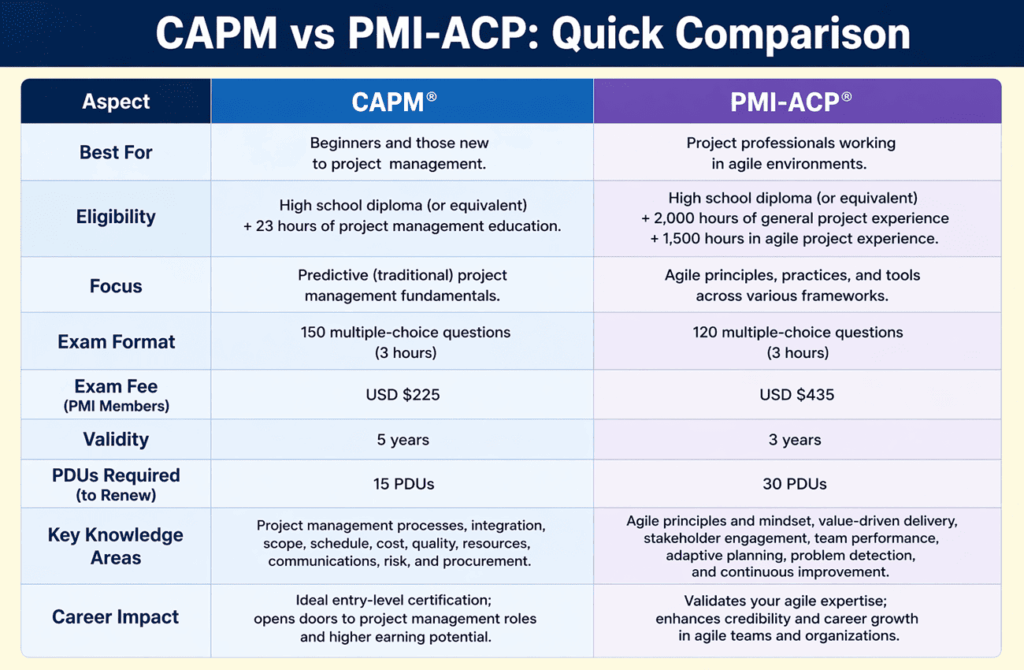
The infographic below presents a side-by-side comparison of CAPM and PMI-ACP. The left column highlights CAPM’s eligibility, exam format and generalist focus, while the right column summarizes the PMI-ACP’s agile-centric requirements and exam structure.
Deciding Which Certification Fits Your Goals
Selecting between CAPM and PMI-ACP depends on your background and career objectives. Consider the following questions:
- Do you want broad project management knowledge? If you are just entering the field or work in environments that combine predictive and agile practices, CAPM provides a strong foundation. It also counts toward the education requirement for the PMP credential, making it a stepping stone.
- Are you already working with agile teams? PMI-ACP recognizes hands-on agile experience. If you see your career in software development, product management or organizations that value adaptability, PMI-ACP aligns well.
- What are your long-term aspirations? Many professionals eventually pursue the PMP or advanced agile credentials. CAPM and PMI-ACP are not mutually exclusive; some practitioners earn both to show versatility.
- How soon do you need a credential? CAPM can be achieved quickly because it has no experience requirement. PMI-ACP may take longer due to the required experience and training, but it can lead to greater recognition in agile roles.
FAQs
Q1. What challenges do candidates face when preparing for these exams?
Many candidates struggle when they answer based on personal experience rather than following the PMBOK Guide or the Agile Practice Guide. Studying the official materials and practicing exam-style questions helps avoid this trap.
Q2. How has the growing adoption of agile influenced the demand for certifications?
Even though the CAPM covers agile concepts, the growing adoption of agile methodologies has not diminished its popularity. PMI-ACP demand is growing because organizations want proof of agile expertise.
Q3. Is there a scenario where one certification is more beneficial than the other?
Yes. New project managers seeking a broad foundation should start with CAPM, while those working in software or agile environments should choose PMI-ACP.
Q4. Can I earn both certifications?
Absolutely. Obtaining CAPM first provides foundational knowledge, and PMI-ACP later shows specialization. Many professionals hold multiple credentials to demonstrate versatility.
Summary
Choosing between CAPM and PMI-ACP depends on your experience and career goals. CAPM builds a strong foundation for beginners, while PMI-ACP proves your ability in agile environments. Both certifications can boost your credibility and job prospects in a growing field. Think about where you are today and where you want to go next. The right choice will help you move forward with confidence and stand out in a competitive job market.

I am Mohammad Fahad Usmani, B.E. PMP, PMI-RMP. I have been blogging on project management topics since 2011. To date, thousands of professionals have passed the PMP exam using my resources.