Traditional planning, also known as push planning, is a structured project management approach that follows a clear, step-by-step sequence. In this method, you complete one phase before moving to the next, ensuring control, clarity, and predictability throughout the project lifecycle. It works best when requirements are well defined and changes are minimal. Many industries, such as construction and manufacturing, rely on this model to manage complex work with fixed timelines.
In today’s blog post, we will learn about traditional, or push planning, in detail.
Key Takeaways
- Sequential process: Traditional planning moves through defined stages: requirements, design, development, testing and deployment.
- Schedules and dependencies: A formal plan tracks dates, task estimates, constraints and resource availability to calculate a schedule.
- Fixed scope: Changes are controlled and limited; tasks rarely shift once work begins.
- Best for predictable work: Projects with clear requirements, regulatory oversight or long-term dependencies benefit most from this approach.
What is Traditional Planning
Traditional planning is a predictive approach. You establish a roadmap at the start and follow it through to completion. Each phase has deliverables and sign-offs. Once a phase ends, the team pushes its output to the next phase.
This model is common in construction, manufacturing, infrastructure and other regulated industries. The process emphasizes predictability and control, making it easy to estimate costs and timelines in advance. However, it leaves little room for late changes.
The Phases of Traditional Planning
Traditional projects usually follow five core stages. Each stage feeds the next, and teams cannot begin a later phase until the earlier one is complete.
The diagram below illustrates the flow:

In this model, requirements are gathered first. The team then designs the solution, followed by development and testing. Finally, the project enters the deployment phase, where the result is delivered to the customer. Because these stages are tightly linked, any change in early requirements can ripple through the entire plan. That’s why clear scope and stakeholder alignment are critical.
How Traditional Planning Works
When you build a traditional plan, you establish the schedule up front. A schedule defines the timing and sequence of work items in a release or iteration plan. As the plan evolves, the schedule adjusts if task estimates or constraints change.
Several factors influence the schedule, including:
- Estimated effort for each work item.
- Schedule constraints such as “start no earlier than” or “finish no later than”.
- Dependencies between tasks; for example, one task may start only after another finishes.
- Actual start and finish dates; these depend on when a task moves to In Progress and when it is marked Resolved.
- Time spent on the task; remaining work recalculates the finish date.
- Project working days and hours, including holidays or weekends.
- Resource availability; tasks may be delayed until assigned resources are free.
Because many of these elements change during a project, the plan must account for them up front. Teams use scheduling tools, Gantt charts and dependency links to visualize the sequence.
For example, you might set a start no earlier than constraint on a task if regulatory approval is required. If Task B depends on Task A, Task B cannot start until Task A finishes. Likewise, if a resource is over-allocated, the scheduler may delay one task to prevent a conflict.
Dependencies and Constraints
Dependencies help teams build a logical flow. The most common type is finish-to-start, where a successor task begins only after its predecessor ends. For example, “Build foundation” must finish before “Frame the house” can start. Without defining dependencies, tasks may overlap, causing resource conflicts.
Constraints impose limits on start or finish dates. Formal planning supports three main constraint types:
- As soon as possible: The task starts at the earliest time allowed by the schedule.
- Start no earlier than: The task cannot begin before a specified date.
- Finish no later than: The task must finish on or before a specified date.
Constraints take precedence over other factors. For example, if you impose a start no earlier than constraint on a task, it will not begin even if all dependencies are satisfied. This ensures regulatory deadlines are met.
Managing Resources and Time
Resource availability plays a major role in push planning. You need to assign team members to tasks and account for their working hours and absences. If a resource is allocated at 50% of their time, the task duration doubles compared to a full-time allocation. Planned absences, holidays, and work environment settings (such as 8-hour days and 5-day work weeks) are built into the schedule.
When multiple tasks are assigned to the same person on the same day, the scheduler delays lower-priority tasks to avoid over-allocation. Ranking tasks helps the scheduler decide which task to execute first.
Critical Path and Slack
At the heart of traditional planning is the critical path. This is the longest sequence of tasks that determines the shortest time to complete the project. To calculate the critical path, planners consider:
- Earliest start (ES): Earliest date a task can start.
- Earliest finish (EF): ES plus the task’s duration.
- Latest finish (LF): The latest date a task can finish without delaying the plan.
- Latest start (LS): LF minus the task’s duration.
The difference between LS and ES gives you slack. If slack is zero, the task sits on the critical path and any delay will extend the project. By monitoring slack, project managers can focus on the tasks that matter most and adjust resources accordingly.
Advantages and Disadvantages of Traditional Planning
Advantages:
- Clear expectations: The linear approach makes it easy to define scope, budget and timeline from the start. Stakeholders know what to expect and when.
- Predictability: Because all phases are planned up front, managers can forecast costs and resource needs with reasonable accuracy.
- Documentation: Traditional planning produces detailed documentation and deliverables, which are essential for regulated industries and audits.
Disadvantages:
- Limited flexibility: The rigid sequence leaves little room for changes once work begins. Adjustments often require revisiting earlier phases.
- Late feedback: Customers or users see results only after testing or deployment. Issues discovered late may be expensive to fix.
- Resource risks: If estimates are wrong or resources become unavailable, the schedule can slip. Resolving conflicts is harder when tasks are locked in sequence.
Traditional Vs Agile Vs Hybrid
Many organizations now combine predictive and adaptive methods to suit their needs. According to the Pulse of the Profession 2024 report, the use of hybrid project management approaches grew from 20% in 2020 to 31% in 2023. Predictive approaches declined by 24% over the same period, while Agile adoption increased slightly. The average project performance rate across all approaches is 73.8%, and 61% of project professionals work remotely at least part of the time.
The bar chart below summarises these trends:
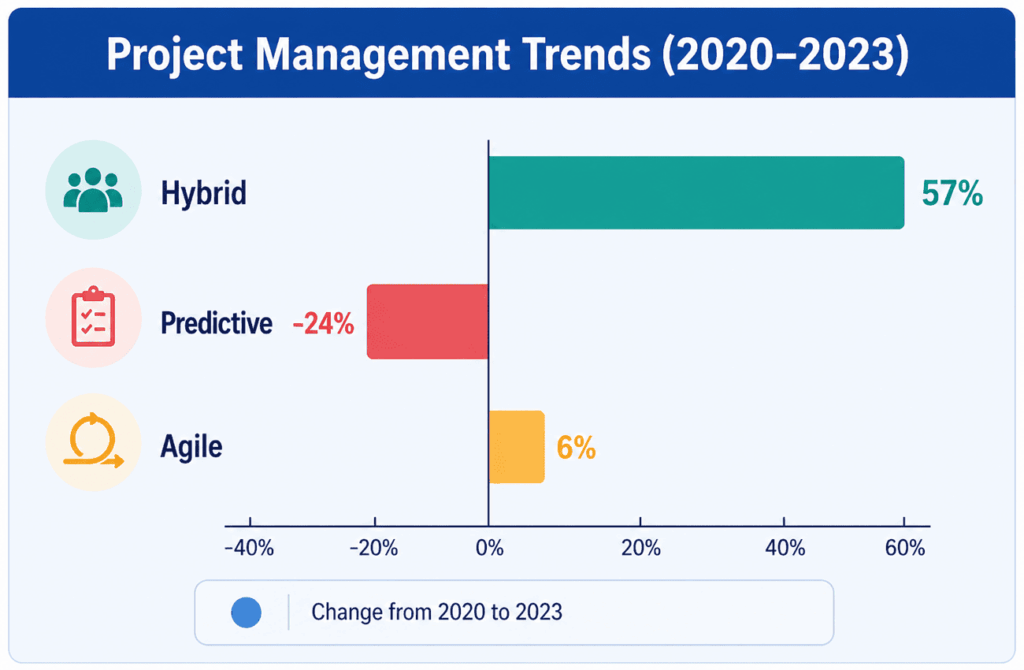
Hybrid approaches blend the stability of traditional planning with the adaptability of Agile. You might use predictive planning for hardware and infrastructure while applying Agile sprints for software components. This mix allows organizations to adapt to change without losing long-term vision. It also reflects shifting work patterns; with more teams working remotely, flexible frameworks are essential.
Best Practices for Effective Push Planning
Even with increased hybrid adoption, there are times when push planning is the right choice. To get the most from this method:
- Define the scope clearly. Gather requirements with stakeholders and document them thoroughly. A clear scope reduces costly changes later.
- Break work down. Use a work breakdown structure to decompose large deliverables into manageable tasks. Estimate effort for each item.
- Map dependencies. Identify finish-to-start relationships and enter them into your scheduling tool.
- Set realistic constraints. Apply start or finish constraints only when necessary and ensure they align with external deadlines.
- Allocate resources wisely. Check availability, consider part-time allocations and plan for holidays or absences. Rank tasks to resolve potential conflicts.
- Monitor the critical path. Track tasks with zero slack and update estimates as work progresses.
- Communicate often. Even with a fixed plan, keep stakeholders informed. Early discussions can reveal risks or changes that must be addressed.
FAQs
Q1. What is push planning and how does it differ from pull planning?
Push planning (traditional planning) uses a linear, sequential model. Tasks are “pushed” from one phase to the next. Pull planning (often used in Agile) allows teams to “pull” work when ready, using iterations and continuous feedback.
Q2. When is traditional planning appropriate?
Traditional planning works best when requirements are stable, regulations are strict or safety is critical. Projects such as construction, infrastructure and compliance-focused initiatives benefit from a clear roadmap and fixed milestones.
Q3. What are schedule constraints?
Schedule constraints are rules that limit when a task can start or finish. “Start no earlier than” sets a minimum start date. “Finish no later than” sets a deadline. Constraints override other scheduling factors.
Q4. How do dependencies influence scheduling?
Dependencies define relationships between tasks. In a finish-to-start dependency, a successor task begins only after its predecessor finishes. Setting dependencies helps avoid conflicts and ensures logical sequencing.
Q5. Why are hybrid approaches gaining popularity?
Hybrid methods combine predictive and agile practices, allowing teams to tailor their approach. The Pulse of the Profession report noted a 57% rise in hybrid adoption from 2020 to 2023, while predictive use declined.
Summary
Traditional or push planning remains valuable for projects that need structure and certainty. By defining scope, mapping dependencies and managing resources, you can deliver predictable results. However, the rise of hybrid approaches shows that flexibility is increasingly important. When selecting a planning method, consider your project’s complexity, regulatory environment and tolerance for change. No matter the method, clear communication and disciplined execution are key to success.

I am Mohammad Fahad Usmani, B.E. PMP, PMI-RMP. I have been blogging on project management topics since 2011. To date, thousands of professionals have passed the PMP exam using my resources.