Earning a PMI certification is a big step, but keeping it active takes ongoing effort. Many professionals ask, how do you calculate PDU and stay compliant with renewal rules? The answer is simple. PMI defines one PDU as one hour of learning or professional activity. You earn these units through training, reading, mentoring, or working in your role.
To maintain certifications such as PMP, you must earn a set number of PDUs over a three-year cycle. You also need to split them between the Education and Giving Back categories.
This blog post explains the process clearly. It helps you calculate PDUs, track your hours, plan your learning, and avoid last-minute stress at renewal time.
Key Takeaway
- 1 hour = 1 PDU: Every 60 minutes of qualifying activity counts as one PDU.
- Two PDU categories: PDUs fall into the Education and Giving Back categories, each with its own requirements.
- Updated Talent Triangle: The PMI Talent Triangle now emphasizes Ways of Working, Power Skills and Business Acumen.
- Certification requirements vary: PMP, PgMP, PfMP and PMI-PBA require 60 PDUs (35 education and 25 giving back) while PMI-ACP, PMI-RMP and PMI-SP require 30 PDUs. CAPM requires 15 PDUs.
- Global demand for project professionals is growing: PMI projects that demand for project talent could increase by 64% between 2025 and 2035.
What is a PDU?
A Professional Development Unit (PDU) is PMI’s measurement for tracking continuing education and professional growth. PDUs record learning activities and service contributions that expand your project management knowledge, skills, and involvement. PMI’s Continuing Certification Requirements (CCR) Handbook explains that PDUs are earned through Education or Giving Back to the Profession.
Certification holders must accumulate a specific number of PDUs within a renewal cycle to maintain their credentials.
How Many Hours Equal One PDU?
The conversion is simple: one hour of qualifying activity equals one PDU. Qualifying activities include instructor-led courses, webinars, self-directed reading, mentoring, and volunteering. Each hour must be rounded to the nearest quarter hour when reporting. For example, a 90-minute webinar yields 1.5 PDUs.
Knowing this straightforward formula helps you plan your learning schedule. Remember that not every task counts; only activities aligned with the Talent Triangle or defined service contributions qualify.
Understanding the PMI Talent Triangle
PMI updated its Talent Triangle to reflect the skills project professionals need today. The three sides: Ways of Working, Power Skills and Business Acumen replace the previous labels of technical project management, leadership and strategic business management. The Talent Triangle ensures that you balance technical skills with interpersonal abilities and strategic insight.
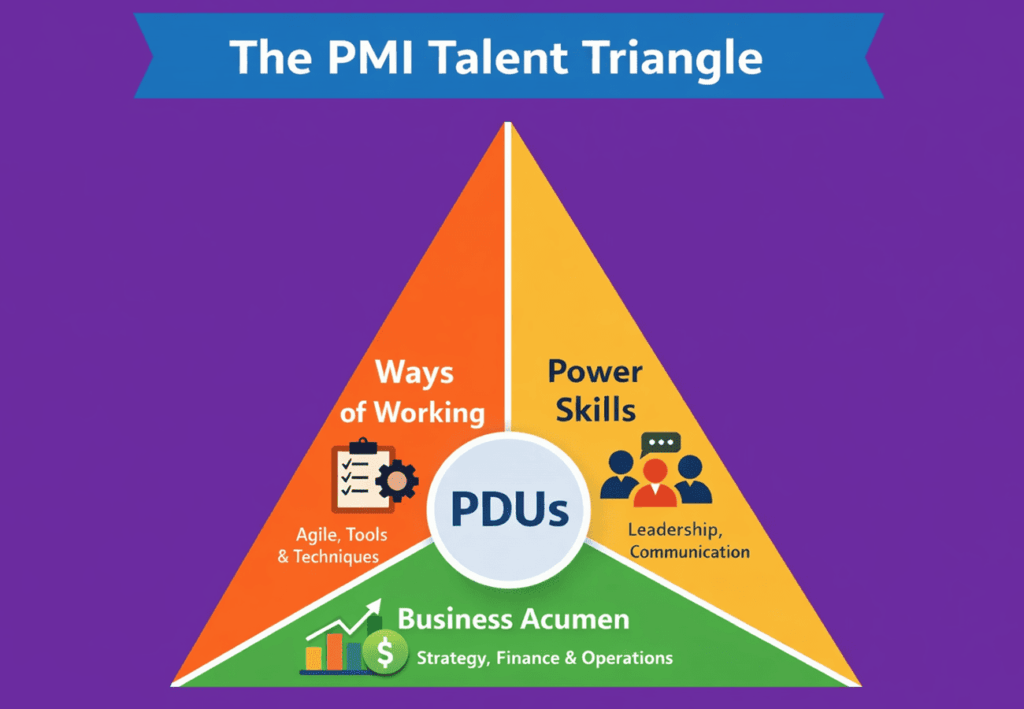
- Ways of Working – This area encourages you to master various delivery approaches such as predictive, agile and design thinking. PMI notes that there is more than one way to deliver work and professionals should adapt techniques to the situation.
- Power Skills – Formerly called leadership, power skills include collaboration, communication, empathy and innovative thinking. These interpersonal skills help you influence stakeholders and motivate teams.
- Business Acumen – Business acumen means understanding your organization’s industry and strategy, then using that knowledge to make smart decisions. PMI describes it as grasping both macro and micro influences and aligning projects with broader organizational goals.
When claiming Education PDUs, you must record time spent in each Talent Triangle area. PMI advises asking yourself whether the content covered power skills or business acumen and allocating the remaining time to ways of working.
Types of PDUs: Education Vs Giving Back
PMI divides PDUs into two main categories:
Education PDUs involve learning opportunities that broaden your knowledge. Examples include attending training courses, participating in webinars, listening to podcasts, reading project management texts, or engaging in structured discussions. PMI’s CCR Handbook emphasizes that project professionals need a skillset that spans various disciplines, which is why the Talent Triangle guides your education choices.
Giving Back PDUs recognize service contributions that support the profession. You earn these by working as a practitioner, mentoring others, volunteering, or creating content. Writing articles, giving presentations, or participating in PMI chapter activities all count. While giving back PDUs are important, you cannot exceed the maximum allowed for your certification.
PDU Requirements by Certification
The number of PDUs needed for renewal varies by certification. According to the CCR Handbook, PMP, PgMP, PfMP and PMI-PBA certifications require 60 PDUs over a three-year cycle, with at least 35 in education and up to 25 in giving back. PMI-ACP, PMI-RMP and PMI-SP require 30 PDUs (minimum 18 education, maximum 12 giving back). CAPM holders need 15 PDUs (minimum 9 education, maximum 6 giving back).
This table summarizes the requirements:
| Certification | Renewal cycle | Total PDUs | Education (min) | Giving Back (max) |
| PMP, PgMP, PfMP, PMI-PBA | 3 years | 60 | 35 | 25 |
| PMI-ACP, PMI-RMP, PMI-SP | 3 years | 30 | 18 | 12 |
| CAPM | 3 years | 15 | 9 | 6 |
How to Calculate PDUs
Calculating PDUs involves more than converting hours into units. You must ensure that the activity counts toward the correct category and Talent Triangle component. Follow these steps:
- Identify the activity: Confirm that the course, webinar or service qualifies. Training from a PMI Authorized Training Partner automatically qualifies.
- Track your time: For every session, record the start and end time in hours and minutes. Convert the total to PDUs (60 minutes = 1 PDU) and round to the nearest quarter hour.
- Classify by Talent Triangle: Estimate how much of the content fits under ways of working, power skills or business acumen. PMI suggests asking whether the material covered interpersonal skills or business context and assigning the rest to technical ways of working.
- Enter the claim: Log into PMI’s Continuing Certification Renewal System (CCRS) and submit the claim. Include details such as provider name, activity title, dates, and PDU distribution. For education PDUs earned through an Authorized Training Partner, approvals are automatic.
You can use this PDU Calculator to accurately calculate PDUs.
How to Earn PDUs
Looking for ways to earn PDUs? Here are practical options:
- Enroll in courses and webinars. PMI and its partners offer instructor-led classes, on-demand courses, and live webinars on project management, agile practices, risk management, and leadership. These count toward education PDUs when they align with the Talent Triangle.
- Leverage online resources. Podcasts and self-paced video lessons let you learn on the go. PMI’s Projectified podcast, for example, covers emerging trends and thought leadership.
- Read and reflect. Self-directed reading of PMI standards, whitepapers, or books counts as education PDUs. Keep notes to justify the time spent.
- Join discussions and mentoring. Structured professional discussions at lunch-and-learns or mentoring sessions allow you to earn informal learning PDUs. You can also mentor junior project managers; this counts toward giving back PDUs.
- Volunteer or create content. Become active in your local PMI chapter, volunteer for events, or write articles to share your knowledge. Creating content, such as blog posts or webinars, is another way to give back.
Reporting Your PDUs
Once you earn PDUs, log into the CCR System at ccrs.pmi.org and submit your claim. Provide the activity title, dates, provider details, number of PDUs earned and their distribution across the Talent Triangle categories. Check your certification dashboard regularly to ensure your claims are approved and that you are on track to meet the renewal deadline. Keeping receipts or confirmation letters can help in case of an audit. For more details on the submission process, see PMI’s official guide.
FAQs
Q1. What types of activities count for PDUs?
Any learning or service that aligns with PMI’s Talent Triangle categories counts. Instructor-led courses, webinars, self-directed reading, volunteering, mentoring and creating content all qualify.
Q2. Do PDUs earned for one certification count toward another?
Yes, PDUs earned during a renewal cycle can often be applied to multiple PMI certifications, as long as they meet each certification’s requirements. The CCR Handbook explains how to maintain multiple certifications simultaneously.
Q3. Are there limits on Giving Back PDUs?
Yes. Each certification has a maximum number of giving back PDUs: 25 for PMP/PgMP/PfMP/PMI?PBA, 12 for PMI?ACP/PMI?RMP/PMI?SP and six for CAPM.
Q4. Do I need to align every PDU with the Talent Triangle?
Only education PDUs must be classified into the three Talent Triangle categories. Giving back PDUs does not need to be split across the triangle.
Summary
Keeping your PMI certification active becomes easier when you understand how to calculate PDU and track your progress. Focus on earning the right balance of Education and Giving Back credits while aligning your learning with the PMI Talent Triangle. Plan your activities, record your hours, and submit them on time through the CCR system. As demand for project professionals grows, staying up to date will strengthen your skills, boost your value, and keep your career moving forward.

I am Mohammad Fahad Usmani, B.E. PMP, PMI-RMP. I have been blogging on project management topics since 2011. To date, thousands of professionals have passed the PMP exam using my resources.