
Experiments are not just for scientists. In project management, the design of experiments (DOE) helps project managers test multiple factors simultaneously and observe their interactions. A well-planned experiment can give clear answers without wasting time.
Instead of guessing which variable matters most, DOE lets you compare multiple options and choose the best path.
In this blog post, I will show you why DOE matters for project managers and how to use it.
What is Design of Experiments?
Design of experiments (DOE) is a structured method for testing how different factors affect a result. Instead of changing one variable at a time, DOE tests multiple factors together. This helps you see not only individual effects but also how variables interact.
In project management, DOE supports better decisions. For example, you can test how cost, time, and resources impact project quality. Rather than guessing, you use data to find the best combination. DOE follows a simple process. First, define your goal. Then identify key factors and their levels. Next, design and run experiments. Finally, analyze the results and apply what you learn.
This approach saves time and reduces waste. It also improves accuracy and reliability. By using DOE, project managers can optimize processes, improve quality, and achieve better outcomes with fewer trials.
DOE helps you learn how changes in inputs affect the outcomes.
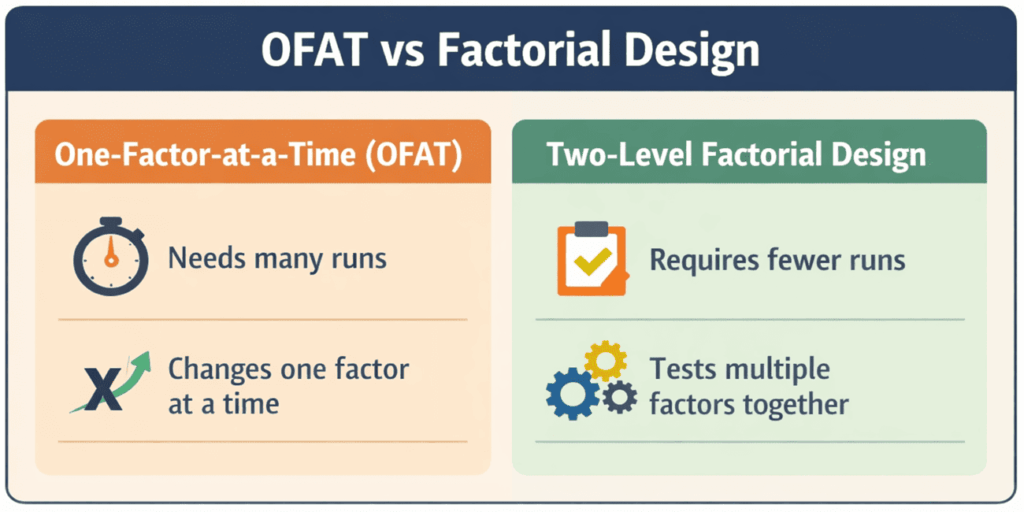
DOE differs from the old one-factor-at-a-time (OFAT) approach. In OFAT, you change one factor while keeping others constant. This seems simple, but it hides interactions and requires many runs. A factorial design changes multiple factors together. It can measure interactions and needs fewer runs than OFAT. The infographic below compares these two approaches.
Why Should Project Managers Use DOE?
Project managers often face schedules or costs that exceed targets. Many teams respond by trying random changes or depending on intuition, yet this rarely solves the problem. Traditional methods such as trial and error, Monte Carlo simulation, and sensitivity analysis can be useful but may not find the best solution. DOE offers a systematic alternative.
With DOE, you can determine which measurements are truly needed and skip unnecessary tests. By carefully choosing factors and levels, you can determine each factor’s impact, its relative influence, and any synergy between them.
For example, if you want to reduce product defects, you might test material quality, process temperature, and inspection frequency together. DOE reveals which combination yields the best results. Because the method focuses only on key measurements, it saves resources and time.
Key Concepts and Methods
Factorial designs Vs OFAT
In an OFAT experiment, you test each factor separately. Suppose you have three factors: A, B, and C. To estimate effects properly, OFAT needs four runs at the high level and four at the low level for each factor. This results in sixteen runs. A two-level factorial design, on the other hand, changes all factors simultaneously and only requires eight runs. Factorial designs, therefore, use parallel processing and uncover interactions, making them more efficient.
Common DOE plans
Researchers have developed many plans for DOE. Popular examples include:
- Factorial designs – test all combinations of factors at high and low levels.
- Plackett-Burman designs – screen many factors with few runs.
- Box-Behnken designs – useful for exploring curvature in response surfaces.
- Central composite designs – extend factorial designs with center points for quadratic effects.
- Latin hypercube sampling – spreads experimental points evenly across the design space.
These methods help you model complex processes and identify important drivers.
Applying DOE in Project Management
Using DOE in a project follows a clear sequence. The infographic below outlines the main steps.
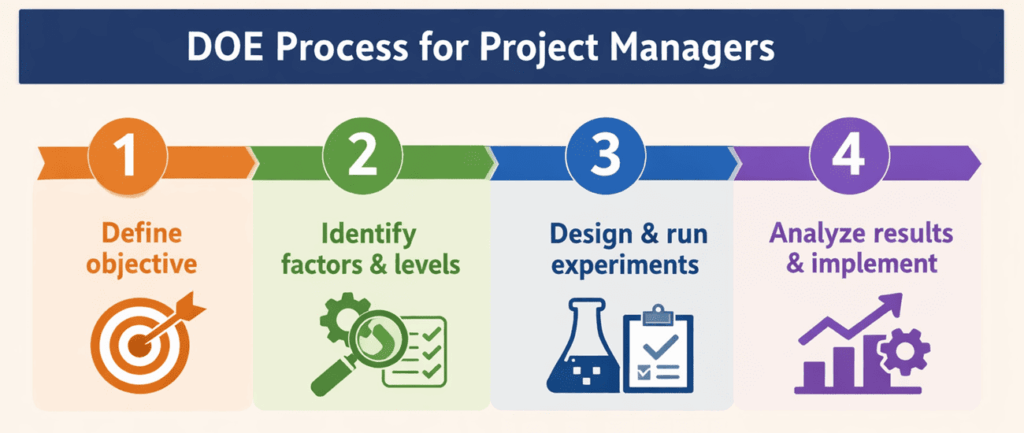
- Define your objective. Decide what you want to improve or understand. Define the response variable and why it matters.
- Identify factors and levels. List the controllable variables (factors) that might influence the response and decide the range for each.
- Design and run experiments. Choose a DOE plan that matches your goals and constraints. Run the tests, keeping conditions controlled. Randomize the order to reduce bias and measure experimental error.
- Analyze and implement. Use statistical methods to estimate effects and interactions. Determine which factors matter most and implement changes. Verify that improvements hold under real conditions.
Example
Imagine you manage a software development project with complaints about long build times. You suspect that the programming language, the build server hardware, and the developer training affect the speed. Instead of changing one thing at a time, you run a two-level factorial DOE with these factors. After eight runs, analysis shows that the choice of hardware and language interacts strongly. Investing in faster servers while switching to a compiled language reduces build time by 30%.
The DOE also reveals that extra training has little effect, allowing you to allocate training funds elsewhere. This simple study demonstrates how DOE can guide decisions.
FAQs
Q1. What is the difference between DOE and one-factor-at-a-time (OFAT)?
DOE changes multiple factors together to measure interactions and requires fewer runs, whereas OFAT tests one factor at a time and often misses important interactions.
Q2. How many experiments do I need?
The number depends on the number of factors and the chosen design. A two-level factorial design with three factors needs eight runs, while OFAT would require sixteen.
Q3. Do I need statistical software to use DOE?
While basic DOE can be planned manually, software tools help generate designs and analyze results quickly.
Q4. Can DOE handle more than two levels per factor?
Yes. Designs such as central composite and Box-Behnken allow for three or more levels and help capture curvature in the response surface.
Summary
Design of experiments is a powerful tool for project managers. It lets you test several variables at once, understand interactions, and make data-driven decisions. By following a structured process such as defining objectives, identifying factors, designing experiments, and analyzing results, you can optimize projects faster and more confidently. Adopting DOE improves product quality, shortens schedules, and reduces costs.

I am Mohammad Fahad Usmani, B.E. PMP, PMI-RMP. I have been blogging on project management topics since 2011. To date, thousands of professionals have passed the PMP exam using my resources.