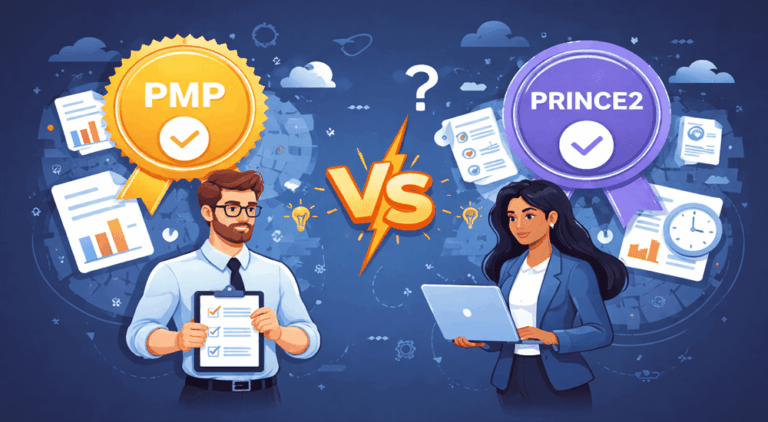
Choosing the right certification can shape your career path. Many professionals compare ITIL vs Agile certifications to decide their next step. Both options offer strong benefits but serve different roles. ITIL focuses on IT service management and structured processes.
Agile, especially PMI-ACP, supports flexible and iterative project delivery. Today, Agile adoption continues to grow across industries, while ITIL remains valuable in IT operations. So, which one fits your goals?
In this blog post, you will learn the key differences between ITIL and Agile, the benefits, and real use cases. This will help you choose the certification that matches your skills, role, and long-term career plans.
Key Takeaway
- Both ITIL and Agile certifications help project managers build stronger skills. They support career growth and open new opportunities.
- ITIL focuses on IT service delivery and structured processes. It works best in stable, controlled environments.
- PMI-ACP focuses on Agile methods and flexible project execution. It helps teams adapt quickly and deliver value in small steps.
- More than 70% of organizations use Agile in their software lifecycle. Agile adoption in R&D teams increased by 16 percentage points from 2022 to 2023.
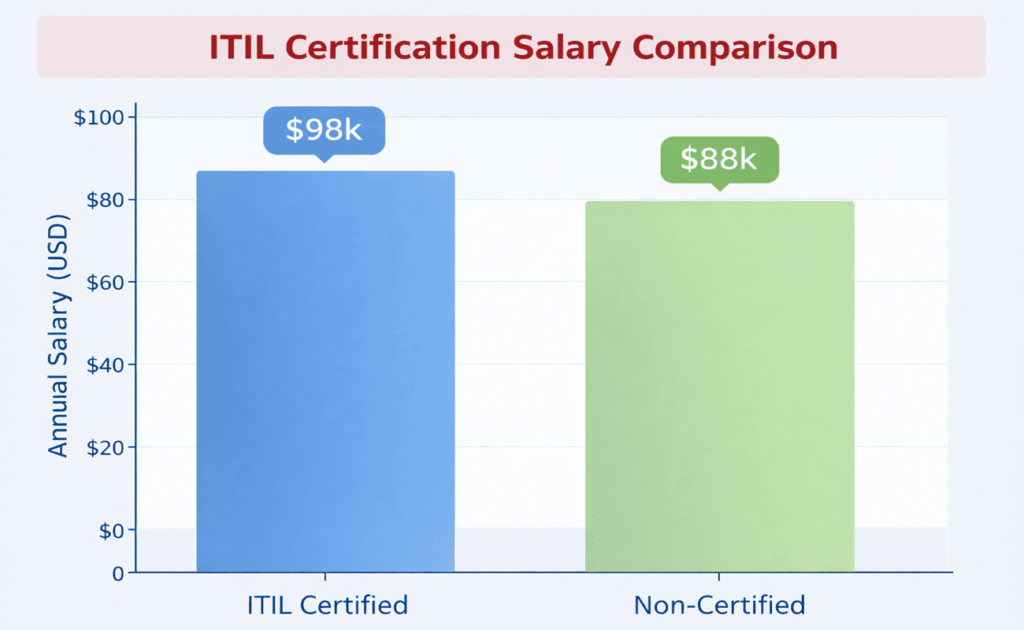
- ITIL Foundation-certified professionals earn about $98,000 per year on average. This reflects strong demand and solid earning potential.
What is ITIL?
ITIL (Information Technology Infrastructure Library) is a framework for managing IT services. It provides best practices for aligning IT services with business needs and delivering consistent value. The framework is maintained by AXELOS, and its current version (ITIL 4) emphasizes co-creation of value through service management. ITIL is not a project management method; rather, it guides how organizations design, deliver, and improve services.
The ITIL certification path has five main levels:
- Foundation – An entry-level course covering basic concepts and terminology.
- Practitioner – Focuses on practical application and continual improvement.
- Intermediate – Offers modular courses that dive into service lifecycle and capability streams.
- Expert – Demonstrates a comprehensive understanding across all modules.
- Master – Requires real-world experience showing that you can implement ITIL principles in complex situations.
You can take the Foundation exam without any prerequisites. Higher levels require passing previous exams and often benefit from professional experience. Many candidates pair ITIL with PMP because the frameworks complement one another: PMP provides a broad project management toolkit, and ITIL offers depth in IT service delivery. ITIL is best suited for IT operations managers, service desk leads, and other professionals who oversee the end-to-end delivery of IT services.
What is PMI-ACP (Agile Certification)?
The PMI-Agile Certified Practitioner credential recognizes an individual’s ability to use Agile principles in project management. Agile emphasizes iterative development, early and continuous delivery, collaboration, and adaptability. Unlike ITIL, which is process-oriented, Agile focuses on delivering value in small increments and quickly responding to change.

To sit for the PMI-ACP exam, candidates need:
- General project experience – 12 months of project experience gained within the last five years. Holding a current PMP or PgMP satisfies this requirement.
- Agile experience – 12 months of experience working on Agile teams or using Agile methodologies within the last three years.
- Education – 21 hours of formal Agile training from a Registered Education Provider.
The exam covers multiple Agile frameworks, including Scrum, Kanban, Extreme Programming, and Lean. While Agile concepts now make up about half of the PMP exam, the PMI-ACP certification offers deeper knowledge and signals to employers that you can lead Agile teams effectively.
ITIL Vs Agile (PMI-ACP)
Choosing between ITIL and PMI-ACP depends on your role, industry, and career goals. Both certifications add credibility, but they emphasize different skill sets.
Role and Industry
If you work in IT service management or aspire to manage service desks or infrastructure teams, ITIL provides a structured framework for improving service delivery and aligning IT with business objectives. On the other hand, if you lead product development teams, software projects, or cross-functional initiatives in which requirements evolve rapidly, the PMI-ACP will equip you with the tools to manage uncertainty and deliver value iteratively.
Career Goals
Professionals seeking leadership roles in IT operations may find ITIL more valuable because it demonstrates expertise in processes, governance, and continual improvement. Those looking to guide innovation, product development, or digital transformation efforts may lean toward PMI-ACP, which showcases flexibility and responsiveness.
Market Demand
According to the 17th State of Agile Report, just over 70% of surveyed organizations use Agile practices in their software development lifecycle. The same report highlights that engineering and R&D teams increased Agile adoption by 16 percentage points between 2022 and 2023, reflecting growing demand for Agile skills.
Meanwhile, salary data from PayScale, compiled by New Horizons, shows that ITIL Foundation-certified professionals earn an average of $98,000 per year. These figures suggest strong opportunities in both fields, and you can choose based on which environment aligns with your professional aspirations.
Time and Effort
The ITIL Foundation exam is straightforward and requires around 18–24 hours of study. Advanced levels demand deeper knowledge and project experience. The PMI-ACP exam is more demanding; in addition to the prerequisites, you need to master multiple Agile frameworks and pass a 120-question exam. Assess your available time and willingness to commit to studying before deciding.
Advantages and Disadvantages
Advantages of ITIL
- Improved service delivery: ITIL teaches how to align IT services with business goals, increasing efficiency and customer satisfaction.
- Structured framework: The methodology provides detailed guidance on processes, roles, and metrics, reducing guesswork in service management.
- Professional network: Joining the ITIL community connects you with peers worldwide who share best practices and job leads.
Disadvantages of ITIL
- Narrow focus: ITIL centers on IT service management, so it may not be as useful if you work outside IT operations.
- Time to reach higher levels: Progressing beyond the Foundation level requires additional exams and real-world experience.
Advantages of PMI-ACP
- Versatility: Agile principles can be applied in software development, marketing, product design, and many other domains.
- Focus on value: Agile emphasizes delivering incremental value to customers and quickly adapting to feedback.
- Recognized credential: PMI-ACP demonstrates your ability to lead Agile teams and may open doors to roles such as Scrum Master, Agile Coach, or Product Owner.
Disadvantages of PMI-ACP
- Experience prerequisites: You need documented Agile project experience and formal training before you can sit for the exam.
- Continuous learning: Agile practices evolve rapidly; staying current requires ongoing education and involvement with Agile communities.
How These Certifications Complement PMP
The PMP certification provides a broad foundation of project management knowledge across predictive, adaptive, and hybrid approaches. Adding ITIL or PMI-ACP builds on this foundation and helps you specialize.
- ITIL and PMP: PMP tools like risk management, stakeholder engagement, and scope control apply directly to IT service improvement initiatives. ITIL’s focus on process design and continual improvement complements the PMP’s emphasis on planning and monitoring. Together, they help you manage projects in IT environments where quality and service levels are paramount.
- PMI-ACP and PMP: The PMP introduces Agile concepts, while the PMI-ACP dives deeper into frameworks such as Scrum and Kanban. This allows you to adapt PMP tools to iterative projects, such as releasing software updates or developing new products. Understanding both predictive and adaptive approaches makes you more versatile and better equipped to manage hybrid teams.
Which Certification is Right for You?
Ask yourself the following questions as you choose your path:
- What role do I play? If your work involves managing IT infrastructure or service delivery, ITIL may be the better fit. If you lead cross-functional teams that develop products or services, the PMI-ACP could be more relevant.
- What does my organization need? An organization focused on stability and compliance may prioritize ITIL. Companies aiming for rapid innovation or digital transformation may value Agile skills.
- How much experience do I have? If you’re early in your career and lack Agile experience, the ITIL Foundation exam is a quicker win. If you already work on Agile projects, PMI-ACP will deepen your expertise.
- Do I plan to stay in IT? ITIL is most beneficial within IT service management. PMI-ACP applies across many industries, from marketing to healthcare.
No single certification is objectively better; your choice should reflect your goals and your team’s needs.
FAQs
Q1. How long does it take to get ITIL Foundation certified?
Most candidates complete the training and pass the exam within a few weeks.
Q2. What are the prerequisites for the PMI-ACP exam?
You need 12 months of project experience, 12 months of Agile experience, and 21 hours of Agile training.
Q3. Can I pursue both ITIL and PMI-ACP?
Yes. Many professionals start with one and later obtain the other to broaden their skill set.
Q4. Will Agile certification replace my PMP?
No. PMI-ACP complements the PMP by adding adaptive techniques; it does not supersede it.
Summary
Choosing between ITIL and Agile certification depends on your role and career goals. ITIL suits professionals focused on IT service management and structured processes. Agile is ideal for those working in fast-paced, flexible project environments. Both certifications offer strong career benefits and industry recognition. By understanding their differences and strengths, you can make a smart choice. Invest in the certification that aligns with your work and future plans to grow your skills and advance your career.

I am Mohammad Fahad Usmani, B.E. PMP, PMI-RMP. I have been blogging on project management topics since 2011. To date, thousands of professionals have passed the PMP exam using my resources.