
Estimate at Completion (EAC) helps you predict the total cost of a project at the end. It uses current project data to show where the final cost may land. This helps you find budget trouble early and make better decisions. There are four standard ways to calculate EAC, each suited to a different project situation. The right formula depends on whether current cost performance will continue, whether the issue was one-time, whether schedule delays affect cost, or whether you need a fresh estimate for the remaining work.
That is why an EAC calculator is useful. You enter the values, click a button, and get the result right away. This saves time, reduces manual errors, and helps you review different cost scenarios fast.
Estimate at Completion (EAC) Calculator
Use the following calculators to find the Estimate at Completion for your project.
EAC Calculator 1
Formula: EAC = BAC ÷ CPI
Use this formula when you expect future cost performance to continue at the same rate as current performance.
EAC Calculator 1
Formula: EAC = BAC ÷ CPI
EAC Calculator 2
Formula: EAC = AC + (BAC – EV)
Use this formula when the cost variance was a one-time event, and you expect future work to follow the original plan.
EAC Calculator 2
Formula: EAC = AC + (BAC – EV)
EAC Calculator 3
Formula: EAC = AC + [(BAC – EV) ÷ (CPI × SPI)]
Use this formula when both cost and schedule performance affect the remaining work.
EAC Calculator 3
Formula: EAC = AC + [(BAC – EV) ÷ (CPI × SPI)]
EAC Calculator 4
Formula: EAC = AC + ETC
Use this formula when the original estimate is no longer reliable, and you prepare a fresh estimate for the remaining work.
EAC Calculator 4
Formula: EAC = AC + ETC
How to Calculate EAC
You can calculate the Estimate at Completion in four ways. The correct formula depends on what is happening in the project. PM Study Circle explains these four cases clearly, and they match the standard EAC methods used in earned value management.
Step 1: Review Your Project Condition
Before you choose a formula, ask a simple question: What do current results tell you about the rest of the project? Are cost issues likely to continue? Was the problem one-time? Is schedule pressure raising future cost? Or do you need a fresh estimate?
Step 2: Gather the Required Values
Depending on the formula, you may need the following values: Budget at Completion (BAC), Actual Cost (AC), Earned Value (EV), Cost Performance Index (CPI), Schedule Performance Index (SPI), and Estimate to Complete (ETC).
Step 3: Choose the Right Formula
Use one of these formulas:
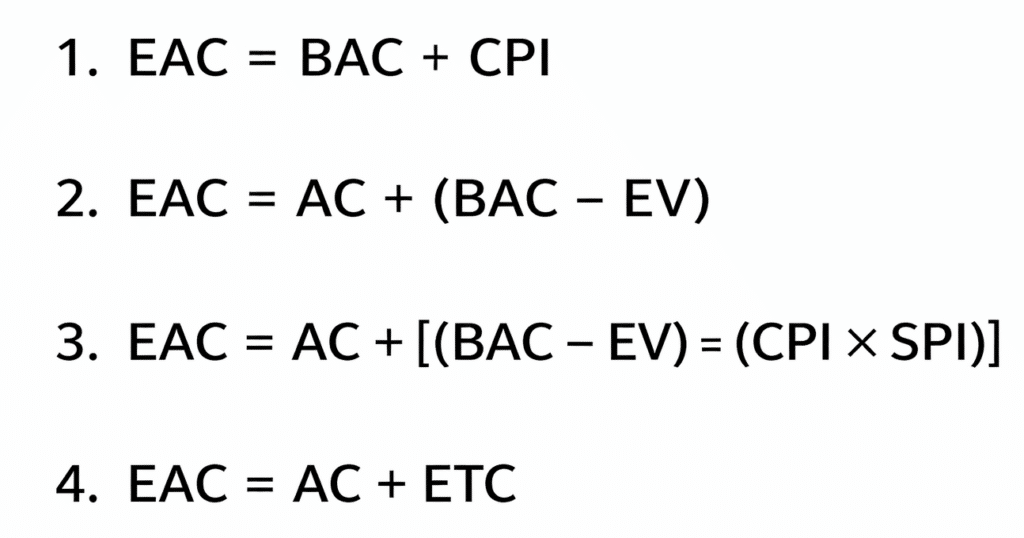
- EAC = BAC ÷ CPI
- EAC = AC + (BAC – EV)
- EAC = AC + [(BAC – EV) ÷ (CPI × SPI)]
- EAC = AC + ETC
Step 4: Calculate the Result
Enter the values into the right formula. You can do it by hand, but a calculator makes the work faster and reduces mistakes.
Step 5: Interpret the Result
The EAC value represents the expected total cost at project completion. If EAC is higher than BAC, your project may finish over budget. If it is lower than BAC, your project may finish under budget. That quick comparison tells you a lot.
Step 6: Take Action
Once you know the new forecast, decide what to do next. You may need to adjust resources, control costs, review scope, or speak with stakeholders. Why wait until the last minute?
Estimate at Completion Formula
You have four standard ways to calculate EAC, each corresponding to a different planning assumption.
EAC Examples
The following are four examples of calculating EAC in different scenarios:
Example 1: EAC = BAC ÷ CPI
Suppose BAC = 100,000 and CPI = 0.67.
EAC = 100,000 ÷ 0.67 = 149,253.73
This means the project may finish at about 149,253.73 if current cost performance continues.
Example 2: EAC = AC + (BAC – EV)
Suppose AC = 200,000, BAC = 500,000, and EV = 175,000.
EAC = 200,000 + (500,000 – 175,000)
EAC = 525,000
This means the project may finish at 525,000 if the earlier cost problem does not happen again.
Example 3: EAC = AC + [(BAC – EV) ÷ (CPI × SPI)]
Suppose AC = 200,000, BAC = 500,000, EV = 175,000, CPI = 0.88, and SPI = 0.78.
EAC = 200,000 + [(500,000 – 175,000) ÷ (0.88 × 0.78)]
EAC = 671,000
This shows a much higher final cost because both cost and schedule performance are weak.
Example 4: EAC = AC + ETC
Suppose AC = 200,000 and ETC = 400,000.
EAC = 200,000 + 400,000 = 600,000
This method works well when the original estimate no longer fits reality, and the team builds a new estimate for the remaining work.
Importance of EAC
Estimate at Completion helps you forecast the final project cost before the project ends. It gives you an early warning when spending trends move in the wrong direction. This helps you control the budget, adjust plans, and manage stakeholder expectations with real data instead of guesswork.
EAC also helps you compare the original budget with the latest forecast, which improves decision-making. When you review EAC often, you can catch cost problems sooner and respond before the damage grows. In simple words, EAC helps you stay in control of project cost performance.
FAQ
Q1. What is Estimate at Completion in project management?
Estimate at Completion is the expected total cost of the project when all work is complete. It combines actual spending with the forecast for remaining work.
Q2. Why are there four EAC formulas?
There are four formulas because projects do not all behave the same way. Each formula fits a different assumption about future cost and schedule performance.
Q3. When should I use EAC = BAC ÷ CPI?
Use it when you believe current cost performance will continue for the rest of the project. This method is common when work patterns stay steady.
Q4. What is the difference between EAC and ETC?
ETC shows the cost needed to finish the remaining work. EAC shows the total expected project cost, including money already spent.
Q5. What does it mean if EAC is higher than BAC?
It usually means the project is trending over budget. The final cost may exceed the approved budget unless you take corrective action.
Summary
Estimate at Completion is one of the most useful earned value metrics for cost forecasting. It helps you predict the final project cost, compare it with the approved budget, and respond early when things drift off track. Since EAC can be calculated in four ways, you must choose the formula that matches your project condition. An EAC calculator makes that work fast and easy. Use it often, and you will make better cost decisions throughout the project.

I am Mohammad Fahad Usmani, B.E. PMP, PMI-RMP. I have been blogging on project management topics since 2011. To date, thousands of professionals have passed the PMP exam using my resources.