Have you ever wondered exactly how long you’ll be sitting for the Project Management Professional (PMP) exam? Understanding how long the PMP Exam is essential for planning your study routine and managing your energy on test day.
This blog post breaks down the current exam (through July 8, 2026) and the new exam launching on July 9, 2026. You’ll learn how much time you have, how the questions are structured, and how to pace yourself. Whether you’re scheduled to take the exam soon or considering certification in the future, this blog post will help you prepare confidently.
Let’s get started.
How Long is the PMP Exam Today and After 8 July 2026
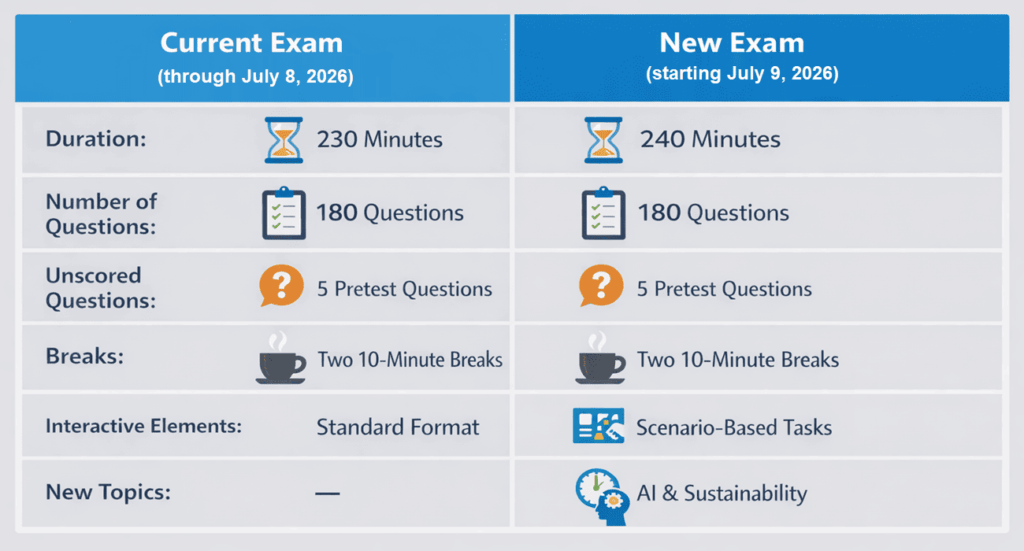
The PMP exam is undergoing a notable update. Through July 8, 2026, the exam lasts 230 minutes and consists of 180 scored questions and 5 unscored pre-test questions. Starting July 9, 2026, PMI will introduce a new exam version that extends the total time to 240 minutes while keeping 180 questions. PMI describes the forthcoming test as more interactive and scenario-based.
Current Exam Length (through July 8, 2026)
If you sit for the exam before July 9, 2026, you will have 3 hours and 50 minutes (230 minutes) to complete 180 questions. Five of those questions are unscored pre-test items that PMI uses for future exams. The remaining 175 questions determine your score. You will have two optional 10-minute breaks after question 60 and question 120, but those breaks count toward the total allotted time. Plan to arrive at the testing center or log into the online proctoring system at least 30 minutes early to allow for check-in procedures.
New Exam Length (starting July 9, 2026)
On July 9, 2026, PMI will launch a revised PMP exam. While the number of questions remains at 180, the total time increases to 4 hours (240 minutes). The updated exam will include more interactive, scenario-based items. PMI notes that new topics, such as artificial intelligence, sustainability, and value delivery, will appear alongside the traditional project management domains. Two 10-minute breaks will still divide the exam into three sections, and the unscored pre-test questions will remain.
Exam Structure and Breaks
Both the current and new exams have three sections. Each section comprises 60 questions. After the first section, you may take an optional 10-minute break; after the second section, you may take a second 10-minute break. If you skip a break, the next section begins immediately. These breaks are your chance to stretch, drink water, and refocus before tackling the next set of questions.
The following infographic compares the current and new exams at a glance:
Question Types and Content Domains
The PMP exam assesses a candidate’s ability to manage people, processes, and business considerations across different project environments. The current exam divides content into three domains: People (42%), Process (50%), and Business Environment (8%). Multiple question types appear on the test, including multiple-choice, multiple-response, matching, “hot spot” (clicking on graphics), drag-and-drop, and limited fill-in-the-blank questions. Effective preparation involves practicing each type so you aren’t surprised on exam day.
When the new exam launches in 2026, the domain weights will shift. PMI’s new Exam Content Outline suggests that the Business Environment domain will receive greater emphasis, while People and Process will slightly decrease. New question formats will include richer scenarios and interactive elements, requiring you to interpret charts, graphs, or case studies before answering several related questions. Familiarity with AI-driven tools, sustainable practices, and value delivery models will become increasingly important.
I will update this blog post once the new format launches and we see the new question types.
Time Management Strategies
Completing 180 questions within the allotted time requires careful pacing. You will have about 76 seconds per question on the current exam. If you take the new exam, the average time per question climbs to 80 seconds because of the longer overall time. Here are simple strategies to manage your time:
- Use the exam timer. Divide the total time by the number of questions to set a mental pace. Aim to answer each question within about a minute on the first pass. Mark difficult items and return to them later.
- Read carefully. Focus on keywords in the question stem. Eliminate obviously wrong answers, then choose the best option based on PMI best practices.
- Take your breaks. Standing up, stretching, hydrating, and having a light snack during the two 10-minute breaks helps restore focus and reduce fatigue. Don’t skip them unless you are far behind schedule.
- Manage tough questions. If you spend more than two minutes on a question, make your best guess and flag it for review. You can revisit flagged items before submitting the section.
- Practice pacing. Use practice tests to simulate exam conditions and refine your time management approach.
The following infographic summarizes these tips visually:

Preparing for the PMP Exam
Preparation begins months before test day. Most candidates spend two to three months studying, though your timeline may vary depending on experience. Start by reviewing the PMBOK Guide (6th and 7th editions) and PMI’s Exam Content Outline. Join a reputable prep course, the PM Sprout online course that provides structured lessons, practice questions, and access to expert instructors. Taking a mix of practice exams and timed quizzes will help you identify weak areas and build stamina.
PMI membership includes access to the Study Hall, an online platform with practice questions and simulated exams. Whether you choose to study independently or enroll in a boot camp, create a study plan that covers each domain and question type. Break up your sessions into manageable blocks and allow time for review.
Why PMP Certification Matters
PMP certification is more than a test; it’s a globally recognized credential that signals competence in leading projects. According to PMI’s 14th edition Project Management Salary Survey, respondents with PMP certification reported earning a 17% higher median salary than non-certified peers across 21 countries. In the United States, the median salary for PMP-certified professionals was $135,000, roughly 24% higher than that of non-certified project managers. Nearly 60% of PMP-certified respondents saw a compensation increase in the prior year.
These figures illustrate the tangible career benefits of earning the credential.
Beyond salary, PMP holders enjoy enhanced credibility and access to a global professional network. As organizations prioritize strategic project management and value delivery, the demand for skilled project leaders continues to grow. Obtaining your PMP demonstrates commitment to the profession and opens doors to challenging roles worldwide.
FAQs
Q1. How much time should I set aside to study for the PMP exam?
Most candidates allocate two to three months of consistent study, balancing reading, practice tests, and review sessions. Adjust your schedule based on your familiarity with project management processes and agile methods.
Q2. Are breaks mandatory during the exam?
No. You’re allowed two 10-minute breaks between sections, but you can skip them if you prefer. Taking breaks is recommended to recharge and maintain focus.
Q3. Will the 2026 exam be harder?
The updated exam includes more interactive and scenario-based questions and adds topics such as AI and sustainability. With proper preparation, you can succeed; the core project management principles remain the same.
Summary
Knowing the PMP exam length and structure allows you to prepare effectively and manage your test-day pace. Until July 8, 2026, you will have 230 minutes to complete 180 questions. After July 9, 2026, the exam extends to 240 minutes and introduces richer scenarios and emerging topics. Plan your study schedule early, practice under timed conditions, and take advantage of PMI-approved courses and resources. As the world demands skilled project leaders, earning the PMP certification can enhance your career and increase your earning potential.

I am Mohammad Fahad Usmani, B.E. PMP, PMI-RMP. I have been blogging on project management topics since 2011. To date, thousands of professionals have passed the PMP exam using my resources.