PDU credits play a key role in maintaining your project management certification. If you hold a PMP or any PMI credential, you must earn PDU credits to stay certified and relevant. These project management PDUs help you build new skills and stay up to date with industry changes.
Many professionals ask, how can I earn PDUs online or meet PMP renewal PDUs requirements easily?
This blog post answers those questions simply. It explains PDU requirements by certification, the PMI Talent Triangle, and smart ways to earn PDUs online so you can grow your career with confidence.
Understanding PDU Credits: What They Are and Why They Matter
What is a PDU? A professional development unit is simply a one-hour block of learning or service. When you read a book on leadership, attend a project management course, or volunteer to mentor someone, you are earning PDUs.
There are two categories:
- Education PDUs — credits for structured learning such as courses, workshops, webinars, and independent study. PMI requires certificate holders to earn a minimum number of Education PDUs in every cycle to prove they are developing their skills.
- Giving Back PDUs — credits for sharing knowledge or serving the profession. Mentoring a junior colleague, presenting at a conference, or writing an article all count as giving back. PMI places a cap on how many of these you can apply toward your total.
Every PMI certification has its own renewal cycle. For example, the PMI certification renewal guidelines state that holders of the Certified Associate in Project Management (CAPM) certification must earn 15 PDUs over three years. At least nine of those PDUs must come from education, and no more than six can come from giving back.
The guidelines also require CAPM holders to earn at least two PDUs in each of the three skill areas of the PMI Talent Triangle: ways of working, power skills, and business acumen. More advanced certifications require more PDUs.
We’ll look at those requirements next.
Why PDUs Are Important for Your Career
Continuing education may sound like a chore, but it offers real benefits. PMI’s Project Management Salary Survey – 14th Edition found that respondents with a PMP certification earned a 17% higher median salary than peers without the certification across 21 countries. In the United States, the median salary for PMP-certified respondents was $135,000, 24 percent higher than that of non-certified practitioners. Nearly 60 percent of certified professionals surveyed reported an increase in compensation in the last year. Those numbers show that staying current pays off.
Professional development also makes you more adaptable and confident. According to an executive education article from the University of Virginia’s Darden School, investing in yourself is a game-changing tool for career growth. The article points out that upskilling boosts your earning potential and your chances of getting hired. Employers value candidates who commit to lifelong learning because it shows a willingness to adapt. Earning PDUs is a structured way to stay sharp, grow your network, and demonstrate your dedication to excellence.
PDU Requirements for PMI Certifications
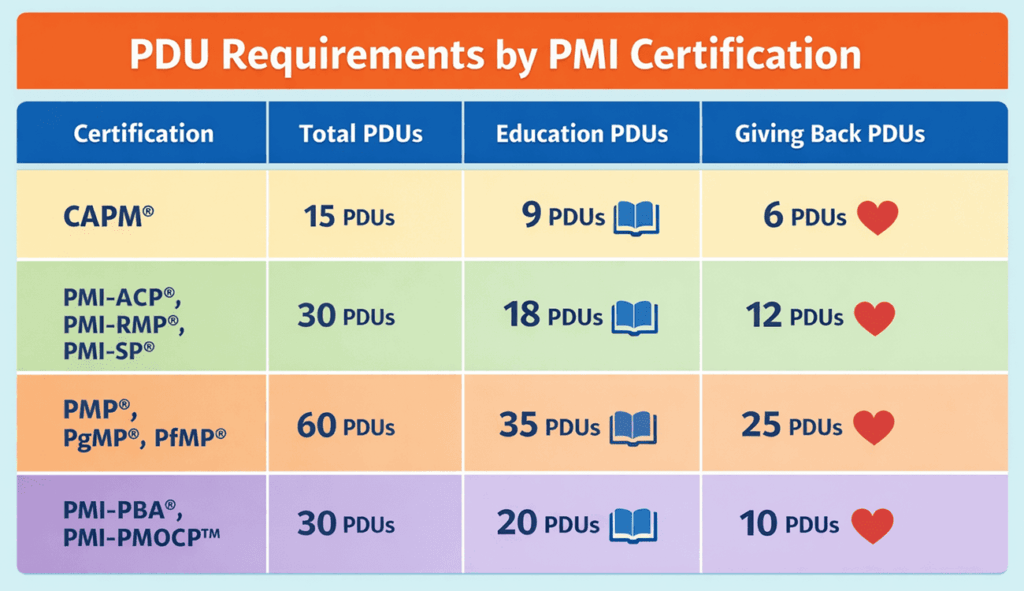
The number of PDUs you need depends on the certificate you hold. In addition to total hours, PMI specifies a minimum number of Education PDUs and a maximum number of Giving Back PDUs for each certification.
This table summarizes the core requirements for the most common credentials.
| Certification | Total PDUs (3?year cycle) | Minimum Education PDUs | Maximum Giving Back PDUs | Minimum PDUs per Talent Triangle Area |
| CAPM | 15 | 9 | 6 | 2 in each area |
| PMI-ACP, PMI-RMP, PMI-CP, PMI-SP | 30 | 18 | 12 | 4 in each area |
| PMP, PgMP, PfMP, PMI-PBA | 60 | 35 | 25 | 8 in each area |
| PMI-PMOCP | 30 | 20 | 10 | 3 (Ways of Working) 7 (Power Skills) 10 (Business Acumen) |
These numbers illustrate how PMI emphasizes continuous education. You cannot simply volunteer your way through renewal; you must balance learning and service. Each certification also requires a spread of PDUs across the ways of working, power skills, and business acumen categories, ensuring you are growing as a well-rounded professional.
To visualize these requirements, the infographic below presents a colorful table of PDU totals and the minimum education and giving-back credits for the major PMI certifications.
Education PDUs vs Giving Back PDUs
Education PDUs are the backbone of your renewal plan. They include:
- Courses and workshops – instructor-led or on-demand classes on project management, agile methodologies, or related skills.
- Independent study – reading books, academic papers, or blogs on project management topics. Keep records of what you read and how long you spent.
- Webinars and conferences – live or recorded sessions that offer deep dives into emerging trends or tools.
Giving Back PDUs recognize your contributions to the profession. Examples include:
- Creating content – writing articles, producing videos, or developing webinars that teach others.
- Speaking or teaching – presenting at conferences, mentoring new project managers, or leading study groups.
- Volunteering – serving on a PMI chapter board, organizing community events, or providing pro bono project management support.
Both categories help you grow. Education PDUs expand your knowledge, while giving back PDUs strengthen the community and showcase your expertise. Remember that PMI limits how many giving back credits you can report. Focus first on education; then add giving back activities as bonus points.
Exploring the PMI Talent Triangle
PMI structures PDUs around three skill areas known as the Talent Triangle. These categories ensure that your learning is balanced across technical, interpersonal, and strategic domains. Here is a plain-language description of each area:
- Ways of Working – techniques, methods, and approaches for delivering projects. This includes predictive (waterfall), agile, hybrid, design thinking, and emerging practices. Learning multiple ways of working helps you select the right approach for each project.
- Power Skills – interpersonal abilities such as communication, collaboration, leadership, and problem solving. Power skills help you build trust, influence stakeholders, and lead teams effectively.
- Business Acumen – understanding your organization’s strategy, finances, and market. Business acumen connects your projects to broader goals and helps you make decisions that create value.
The PMI Talent Triangle
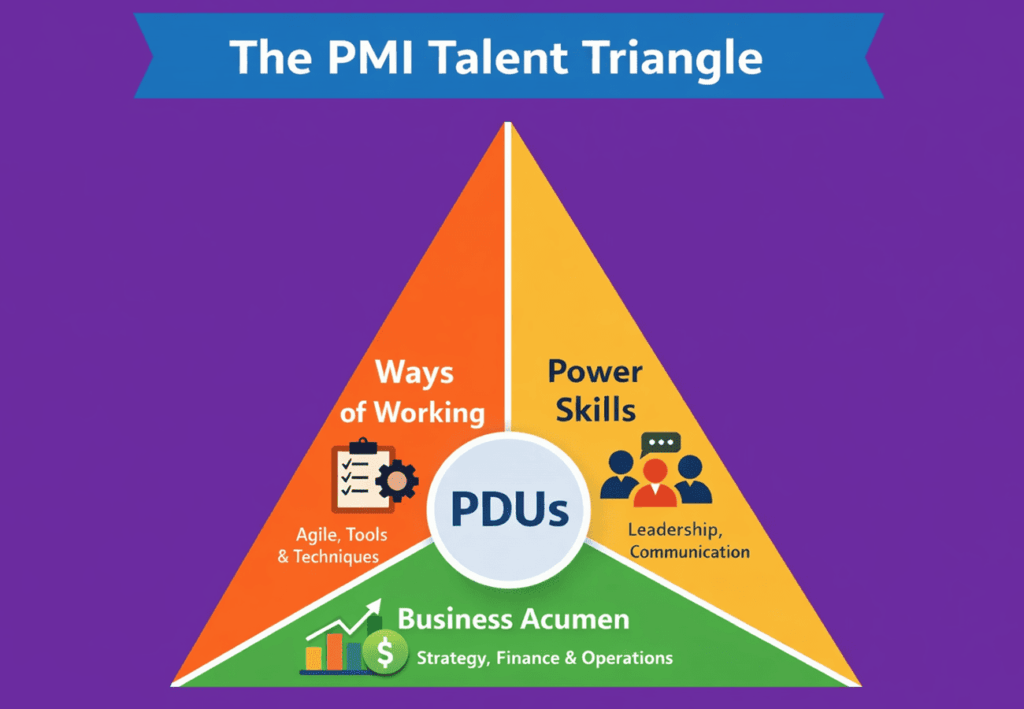
The Talent Triangle is more than a diagram. PMI’s renewal rules require a minimum number of PDUs in each area (see the table above). By focusing on all three, you become not only technically competent but also a strong leader and strategic thinker. This balance makes you more valuable to employers and teams.
How to Earn PDUs
You can collect PDUs through a wide range of activities. Here are practical ways to accumulate credits without feeling overwhelmed:
- Plan your education early. Look at the total PDUs you need for your certification and break them into yearly goals. For example, if you are a PMP holder needing 60 PDUs, aim to earn about 20 PDUs per year.
- Take courses that match your goals. On-demand classes are flexible, while live workshops allow you to engage with instructors and peers. Choose topics that strengthen areas you want to improve, such as agile methods or stakeholder communication.
- Attend webinars and conferences. PMI and other organizations host free and paid webinars. These sessions often provide one or two PDUs each. Signing up for a monthly webinar can quickly add points to your total.
- Learn by reading or listening. Books, articles, and podcasts count as independent study. Keep a log of what you read and note how many hours you spent.
- Earn PDUs at work. If your role involves project management, the time you spend planning, executing, and closing projects can earn you PDUs under the “professional practice” category. Confirm eligibility in PMI’s rules.
- Volunteer or teach. Share your knowledge with others. Volunteer for your local PMI chapter or mentor a colleague preparing for certification. Teaching or speaking not only earns PDUs but also enhances your power skills.
- Track your progress. Use a spreadsheet or the PMI Continuing Certification Renewal System (CCRS) to record activities as you complete them. This habit prevents last-minute scrambling.
By combining formal learning with on-the-job experience and service, you will build a rich portfolio of PDUs that reflects your professional growth.
How to Report PDUs and Renew Your Certification
Collecting PDUs is only half of the process. You must also report them and renew your credential before your cycle ends. PMI outlines a clear four-step process:
- Earn the required PDUs. Follow the guidance for your certification, ensuring you meet the minimum Education PDUs and spread credits across the Talent Triangle areas.
- Enter your PDUs in the CCRS. Log in to the online Continuing Certification Renewal System and record each activity. Provide details such as the provider, title, date, and number of PDUs. The system tracks your progress against requirements.
- Pay the renewal fee. When your cycle is nearing its end, PMI will send you a renewal notice. Pay the fee to keep your certification active.
- Start planning for the next cycle. After renewing, celebrate your achievement and then set goals for the next three years. Early planning makes the process painless.
If you do not earn enough PDUs by the end of your cycle, PMI will place your certificate in suspension for up to 12 months. During that time, you can continue earning PDUs and submit them to regain active status. Letting your credential lapse means you lose the recognition and must reapply. It’s much easier to stay current.
FAQs
Q1. What happens if I earn more PDUs than I need?
Any PDUs earned after you meet your requirements can roll over to your next three-year cycle if they come from educational activities. This carryover provision helps you stay ahead.
Q2. Do all PDUs have to come from PMI courses?
No. PDUs can come from a variety of sources, including university classes, professional conferences, and independent study. The activity must relate to project management and align with the Talent Triangle.
Q3. How often do I need to report my PDUs?
You can enter PDUs at any time during your cycle. It’s smart to log activities as you complete them so you don’t forget details when the renewal deadline approaches.
Q4. Can volunteering really help with renewal?
Yes. Giving back PDUs include volunteering for PMI chapters, mentoring, or presenting. However, there is a cap on giving back credits, so combine volunteer work with structured learning.
Q5. Is there a penalty if my certification expires?
If you don’t renew within the suspension period, your certification will expire, and you must reapply. Maintaining an active status is simpler than starting from scratch.
Summary
PDU credits are essential for maintaining your PMI certification and staying competitive. By understanding project management PDUs and meeting PMP renewal PDUs requirements, you can keep your skills sharp. The PMI Talent Triangle helps you balance technical, leadership, and business skills. When you earn PDUs online or through real work, you invest in your future. Stay consistent, track your progress, and meet PDU requirements by certification to grow your career with confidence.

I am Mohammad Fahad Usmani, B.E. PMP, PMI-RMP. I have been blogging on project management topics since 2011. To date, thousands of professionals have passed the PMP exam using my resources.