
Every project has a rhythm. Tasks begin, overlap, and end, and some must wait on others before they can start. Without a clear plan, things quickly get messy. The precedence diagramming method (PDM) is a straightforward schedule network diagramming technique that shows how work fits together.
By drawing a network of boxes and arrows, you can determine the right order of activities, identify the critical path, and keep everyone on the same page.
This blog post will teach you how to create a precedence diagram from scratch, explain the four key dependency relationships, and show you how PDM improves project communication and control.
Let’s dive in!
What is the Precedence Diagramming Method?
Precedence Diagramming Method (PDM) is a schedule network diagramming technique. The Project Management Body of Knowledge (PMBOK) defines it as a method in which activities are represented as nodes connected by logical relationships. Each box (node) represents a task. Arrows between boxes show how tasks depend on each other.
When you finish drawing the network, you can see the sequence of work and calculate the critical path.

PDM is also known as activity-on-node because the activities appear on the nodes. It replaced the older arrow diagramming method (activity-on-arrow) because it allows more complex relationships. PDM works for projects of any size, from remodeling a kitchen to building a satellite. When you manage a project, seeing the work laid out visually makes it easier to talk with your team and stakeholders. It also helps you detect schedule risks early.
Why PDM Matters in Modern Project Management
Modern projects move fast, and team members often work remotely. A good schedule isn’t optional—it’s essential. PDM depicts project activities and connects them with arrows to show dependencies. It was developed after the PERT and critical path methods to provide a more accurate picture of relationships.
When you use PDM:
- Clarity improves: Everyone sees how tasks relate to one another and in what order they should occur.
- Bottlenecks become visible: You can identify critical activities that might delay the project.
- Communication gets easier: The diagram acts as a common language for the project team.
- Scheduling is more flexible: PDM supports four dependency types, allowing you to model overlapping tasks.
On past projects I’ve managed, using a PDM diagram dramatically reduced confusion. Team members stopped asking “When can I start my part?” because the network made the answer obvious. It also gave me a way to justify timeline changes with data instead of guesswork.
How to Build a Precedence Diagram: A Step-by-Step Guide
Building a clear and accurate PDM diagram is a systematic process. Follow these six steps to create your own project network diagram.
Step 1: List All Activities
Begin by identifying every task required to complete your project. Use a Work Breakdown Structure (WBS) as your foundation. Keep activity names concise and action-oriented (e.g., “Develop Software Module,” “Pour Foundation”).
Step 2: Determine Dependencies
For each activity, ask: “Which tasks must be done before this can start or finish?” Document these logical relationships. Avoid creating unnecessary links.
Step 3: Choose Dependency Types
Assign the correct relationship type—Finish-to-Start (FS), Start-to-Start (SS), Finish-to-Finish (FF), or Start-to-Finish (SF)—to each link. Most will be FS, but use others to model realistic task overlaps.
Step 4: Estimate Durations
Assign a realistic time estimate to each activity. Use historical data, expert judgment, or three-point estimation (optimistic, pessimistic, most likely) for accuracy.
Step 5: Draw the Network Diagram
- Draw a box (node) for each activity. Write the activity name and duration inside.
- Connect the boxes with arrows to represent dependencies.
- Label non-FS relationships clearly on the diagram (e.g., “SS” or “FF” on the arrow).
Step 6: Perform Forward & Backward Pass Calculations
This process determines the Early Start (ES), Early Finish (EF), Late Start (LS), and Late Finish (LF) for each task.
- Forward Pass: Start at the beginning and calculate ES and EF for each task as you move through the network.
- Backward Pass: Start from the project end date and calculate LS and LF for each task moving backward.
- Identify the Critical Path: The critical path is the longest sequence of dependent tasks with zero float (LS – ES = 0). Any delay on this path delays the entire project.
Pro Tip: Use software like Microsoft Project, Smartsheet, or Primavera P6 to automate these calculations once your logic is sound.
Types of Dependencies in PDM
PDM supports four dependency types. Each one represents a different way that tasks relate.
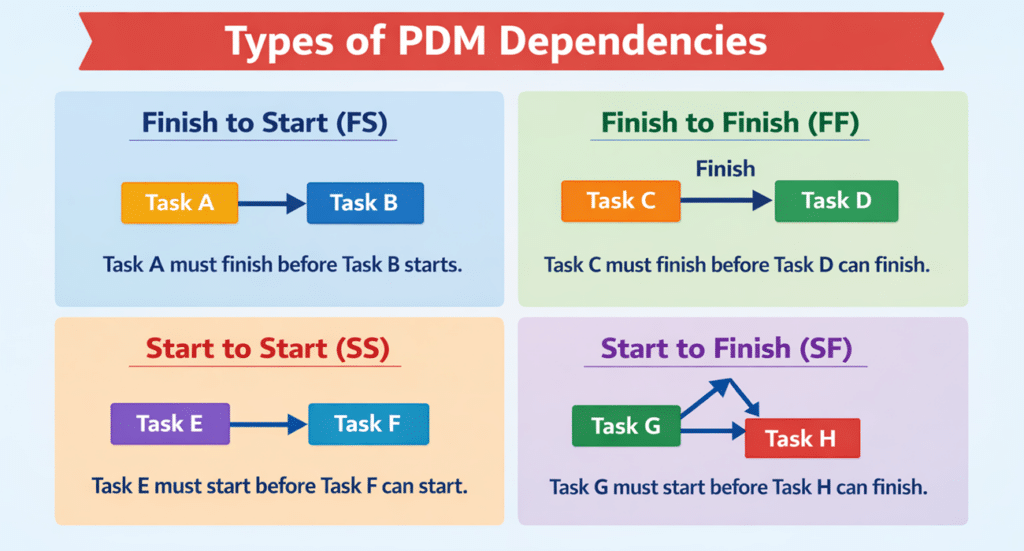
Understanding these relationships helps you decide when tasks can start or finish.
Finish-to-Start (FS)
This is the most common relationship. Task B can’t begin until Task A finishes. Imagine you’re pouring concrete (Task A) and then framing walls (Task B). You can’t frame until the concrete cures. FS relationships create a clear chain of events.
Finish-to-Finish (FF)
In this relationship, Task B can only finish once Task A finishes. The tasks may run in parallel. For example, editing a report (Task A) and proofreading it (Task B) might happen simultaneously, but proofreading can’t wrap up until the final edit is done.
Start-to-Start (SS)
SS means Task B can start after Task A starts. Both tasks can proceed together. Think about painting a room (Task A) and installing floor tiles (Task B). You might start tiling after the painting begins, even if the painting isn’t done. This relationship shortens the project because tasks overlap.
Start-to-Finish (SF)
The rarest dependency, SF, indicates that Task B can’t finish until Task A starts. An example might be switching from an old system to a new one. The old system (Task B) must remain online until the new system (Task A) is ready to take over.
Example of PDM Dependencies
To make these relationships easier to grasp, the infographic below shows simple diagrams for each type. Each panel uses boxes to represent tasks and arrows to indicate dependencies.
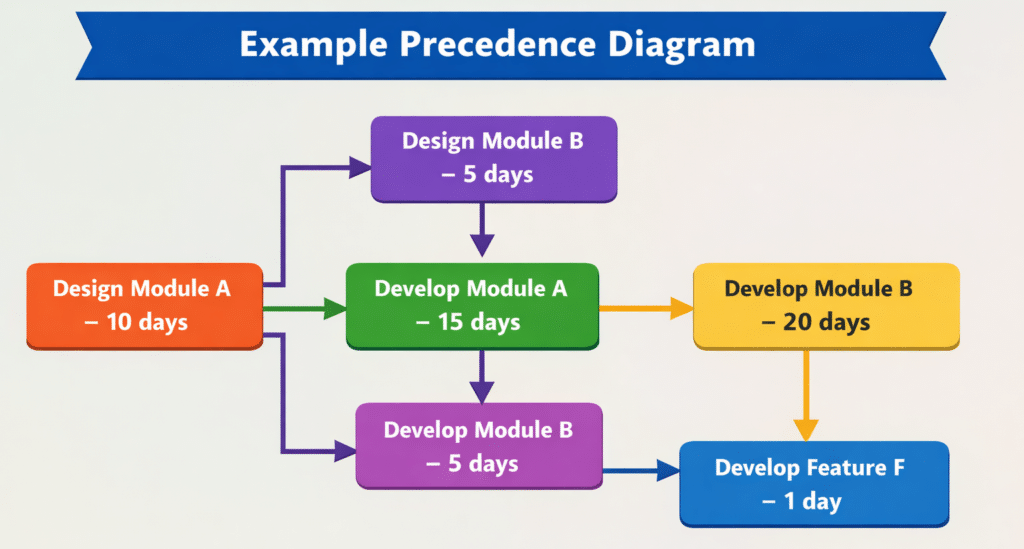
Looking at the diagram, the critical path runs through Tasks A, C, and D because their combined duration (10 + 15 + 20 = 45 days) is longer than any alternative. Task B (Design Module B) can overlap with other work, and Task E depends on both modules being ready. If you shorten the development time of Module D, you’ll reduce the entire project duration.
Best Practices and Tips
Developing reliable precedence diagrams involves more than drawing boxes and arrows. Here are some practical tips:
- Keep names concise: Long activity names clutter diagrams. Use verbs (“Install server”) and nouns (“Software build”) without unnecessary details.
- Limit dependencies: Link activities only when they truly depend on each other. Too many connections make the network hard to read.
- Distinguish dependency types: Clearly label non-FS relationships (SS, FF, SF) so that readers don’t assume everything is finish-to-start.
- Use realistic durations: Over-optimistic estimates create fragile schedules. Base your durations on historical data or expert judgment.
- Review with your team: Collaborate with subject matter experts to validate dependencies and durations.
- Update regularly: As work progresses, refresh the diagram to reflect new information. An outdated network is worse than no network at all.
- Leverage software wisely: Tools like Microsoft Project, Primavera P6, and web-based planners automate calculations. However, understand the logic first so you can spot errors.
Following these practices will help you build diagrams that are both accurate and understandable. They also demonstrate professionalism and attention to detail—factors that contribute to your credibility as a project manager.
FAQs
Q1. What’s the difference between PDM and the critical path method?
PDM is a way to draw the network of activities, while the critical path method is a technique for analyzing that network to find the longest sequence of tasks. They complement each other.
Q2. Is the start-to-finish relationship ever used in real projects?
Yes, but rarely. It typically appears when an existing system must stay active until a new system is ready to take over. Most projects rely on finish-to-start or start-to-start relationships.
Q3. Can precedence diagrams handle resource constraints?
PDM focuses on logical sequencing rather than resource allocation. To model resource limits, pair the diagram with resource leveling techniques or use software that integrates both scheduling and resource analysis.
Q4. What’s the difference between a PDM diagram and a Gantt chart?
A PDM diagram is a logic network focused on the dependencies and sequence between tasks. A Gantt chart is a bar chart focused on the timeline and schedule, showing tasks against a calendar. PDM is used to discover the correct sequence and find the critical path, while a Gantt chart is often used to communicate the final schedule. Most project management software will generate a Gantt chart from your PDM network data.
Q5. What are the most common mistakes when creating a precedence diagram?
Common pitfalls include:
- Missing Dependencies: Overlooking necessary logical links, creating an unrealistic schedule.
- Over-Complicating the Network: Adding unnecessary dependencies (often resource-based, not logic-based) that create false critical paths.
- Ignoring Non-FS Relationships: Using only Finish-to-Start links can unnecessarily lengthen the project schedule and prevent accurate task overlap.
- Not Updating the Diagram: Treating the network as a one-time planning exercise instead of a living document that should be updated as the project progresses.
Q6. Can I use PDM with Agile or iterative project management?
Yes, PDM can be effectively used within Agile sprints or for planning larger Agile releases. While the overall product backlog is fluid, the sprint backlog contains committed, well-defined tasks. You can use a lightweight PDM approach to sequence tasks within a sprint to optimize workflow, identify intra-sprint dependencies, and ensure the sprint goal is achievable. It provides clarity on “what needs to be done first” within the time-boxed iteration.
Summary
The precedence diagramming method helps you organize work in a clear and visual way. It shows how tasks are linked and the order in which activities should happen. By using simple nodes and arrows, you can find risks, delays, and overlaps early. This method improves planning, communication, and schedule control. When used correctly, PDM makes timelines easier to manage and helps projects stay on track from start to finish.
Further Readings:
- What are Network Diagramming Methods?
- What is the Critical Path Method?
- What is Critical Chain Project Management?
- Total Float Vs Free Float
- What is Lead and Lag Time in a Network Diagram?
This topic is important for the PMP exam.

I am Mohammad Fahad Usmani, B.E. PMP, PMI-RMP. I have been blogging on project management topics since 2011. To date, thousands of professionals have passed the PMP exam using my resources.




Pleaase can you help me sketch the network diagram for this job.?
ACTIVITY DEFINTION
A. Planning and design activity
Activity A will include preliminary plan and design of the Recreational Hall. In addition, the project manager during the duration of this task should confirm funding source and shortlist proposals submitted by constructors. This activity will take two (2) days.
B. Acquire subcontractor
The project manager and panel of selection members will conduct research and interview of the shortlisted contractors. Then confirm and acquire subcontractors. Activity B will take one (3) day.
C. Design package
Activity C is when project team finalize the building architecture, mechanical, electrical and plumbing infrastructure. In addition, design and do listing of cabinetry, appliances, and countertops, flooring, electrical, lighting and painting. This activity will take 5 days.
D. Review Scope of Work
DBTI project team and subcontractor to review the scope of work and design packages. This activity will take 2 days to complete.
E. Construction Materials Costs
Collect three quotation of all the required construction materials for costing and purchase. This activity should take 1 day.
F. City permits and inspect
The PNG Building board is responsible to approve the design as per legal standards and policies of PNG. This activity will take 2 days to complete.
G. Demolition
Demolition activity (G) will include creating of demolition plan; hire demolition equipment, secure waste container and truck for disposal of rubbish, hire demolition team and complete demolition. This activity will take 2 days to complete.
H. Demolition cleanup
Clean and prepare site for construction. This activity should take 1 day.
I. Procurement of materials
Purchase materials for the various construction. This activity will take 3 days.
J. Mechanical
Complete mechanical rough in, installation and testing. This activity will take 3 day to conclude.
K. Electrical and Computer infrastructure
Complete electrical and computer infrastructure rough in, installation and testing. This activity will take 10 days to complete.
L. Plumbing
Complete plumbing rough in, installation and testing. This activity will take 12 days to complete.
M. Paint
Paint the interior and exterior of the Recreation Hall. This activity will take 1 day to complete.
N. Cabinet/Countertops
Install cabinets and countertops. This activity will take 3 days to complete.
O. Installation of appliances
Installation of all kitchen appliances. This activity will take 4 days to complete.
P. Test and commission
Test refrigerators, dishwasher, microwave and over. If all appliances are working, commission for use. This activity will take 3 days to complete.
Q. Cleanup
Remove unused material and remove trash. This activity will take 1 day.
R. Turnover
Subcontractor sign off to DBTI. This activity will take 2 days.
?
b) ACTIVITY LIST and ATTRIBUTES
1. Activity A will kick off the project.
2. Once preliminary planning and design is completed, activity B can start.
3. Activity C can also start when A is completed.
4. Activity D is a successor of activity B
5. Activity C and D must be completed before activity E and activity F can start.
6. Demolition can start when PNG Building Board gives the approval of the construction.
7. After demolition is finished, clean up in preparation for the construction to start.
8. Purchasing of construction materials can start after receipt and approval of quotation.
9. After demolition cleanup and procurement of materials are completed, the project team can now start on activities J, K, L, M and N.
10. Installation of electrical appliances and equipment can start after J, K, L, M and N are completed.
11. Testing and commission of the Recreational Hall after O is completed.
12. Clean up after testing and commissioning of the refurbished building.
13. Project team successfully handover the property to the institution.
Draw a PDM network for a project with the following activities. Show all steps including removing redundant relations; and sequence steps.
– Activity B depends on A;
– Activity G follows E, F & D;
– Activity E depends on B and A;
– Activity F can start when D & B are completed;
– Activity C is followed by F and follows A;
– Activity D is dependent upon A and B.
Hello Shehan, you can find a few answers on the following page:
https://pmstudycircle.com/study-notes/
Consider a project that you have worked in. discuss the practicality of application, advantages and disadvantages of following theories.
1.Precedence diagrams
2.Resource aggregation
3.Resource leveling and smoothing
4.Crashing
5.Fast tracking
6.Line of balance
7.Linear programming
(please answer this questions as you can. for a research purpose)
Hi Fahad
Thanks for your post. This really helps. Can you also give an example of AOA diagram. This helps to clarify the difference between the two.
PERT is an example of aoa.
By looking at the dependency diagram, how do we know which is a start to finish, finish to start, finish to start and start to start? I understand the concept, but looking at the picture don’t know how to identify the difference?
I am referring to your book pmp question bank page 16
Pictures of dependencies are shown in this blog post. What you did not understand?
The example Mona as given in the PMBOK 5th edition makes the understanding clear. But the job of a security guard in shift does not fit into the definition of “Project”. However, to understand the Start-to-Finish concept, this example is fine.
I am in the midst of preparing an assignment and in one question I am asked to ” propose practical project management planning and execution guidelines for ensuring that projects are completed within reduced lead times, reduced cost while at the same tine still meeting specifications” where do i begin?
I came across a familiar example for Start to Finish activity.
Example: While farming in a field lets take two activities 1) Furrowing 2) placing seeds/saplings
Now apply the S-F principle here; The first activity is furrowing and the second activity is Placing seeds/saplings.. So the placing seeds cannot be finished until furrowing is started.(assumption made: placing seeds/saplings in a discrete manner)
if there was no relation on the arrow, how should calculate the successor? do we have to assume it or what?
There will always a relation between two tasks if they are connected by an arrow.
i may be wrong but FF seems to have a wrong example.
“For example, let us say that you coding a program for a client, and the client is providing you the characteristics of the program. In this case, you cannot finish coding for your program until the client gives you his complete requirements. Here, both activities should finish simultaneously.”
according to PMBOK: WRITING (PRE) a document to be completed to finish the EDITING (SUC). this is a better example.
in your example the actually requirements is the predessor and coding is successor. then how programming will finish when the client finishes the requirements? in real world you get a requirements list, then you develop and then finish. here i understand the requirements flowing and the programmer is coding as and when he gets a piece of requirement! :-)
good day
please assist ,
what is mean by tabulating various types of time dependencies that one may encounter when using the precedence diagraming method
Please read following blog post:
https://pmstudycircle.com/2012/07/precedence-diagramming-method-activity-on-node-method-scheduling/
Thank you for your respong…
I have read it and understand the blog post….. what i dont understand about the question is that how do you start to draw a table of those Dependencies….. what is on which column…..
Once again thank you…
Soon I will update this blog to accommodate your concern.
Thank you Fahad
You are welcome Confidence.
Guys don’t get panic….. its simple….. schdeuling techniques can be as follows:
1. bar chart / gantt chart
2. milestone chart
3. line of balance and
4. network diagram
i. critical path method (CPM)
note: network diagram for CPM could be either Activity on Arrow network (AOA) or Activity on Node (AON) / (Precedence Diagramming Method (PDM)). SO IF NETWORK IS DRAWN AND IT IS NAMED AS NETWORK THAN THAT IS TRUE …SIMPLY OBSERVE WHETHER IT IS AOA OR PDM….
ii. programme evaluation and review technique (PERT)
Well said Subash.
Can we find Float of an activity by the help of LS and LF values as we did in following by ES and EF values
ES of next activity — EF of current activity –1
like
LS of next activity — LF of current activity –1 (is this formula is OK)
Thanks
Read below given blog post:
https://pmstudycircle.com/2013/03/total-float-versus-free-float/
What’s the exact difference between precedence diagram and a network diagram?
Precedence diagrams are network diagram.
There’s a question which shows a diagram like yours in this blog and then puts following question:
51. The above diagram is called:
a. Activity on arrow network diagram
b. Network diagram
c. Precedence diagram
d. Gantt chart
If they are the same, then why the answer is “Precedence diagram”? I chose B, which is a wrong answer.
Can you please help me with that?
Let me explain it to you with an example.
You have been shown a pineapple and asked to identified it. The options are:
a) Pineapple
b) Orange
c) Fruit
d) Banana
Now let’s say you have selected answer c that is “Fruit” .
Is this a wrong answer? No, it is not. It is a fruit. This is a correct answer but not a the best answer given in the options.
You have been asked to select the best correct answer; which is pineapple.
So the correct answer would be: pineapple.
Likewise, in your question, you have to chose the best answer.
Hope it helps.
That’s exactly the kind of question that I hate. It doesn’t test your ability as project manager. If you check PMBOK 5th edition, figure 6-11, it shows a precedence diagram and the figure title is network diagram! How can we not make this mistake like Lee did?
Hi Fahad,
i always get confuse in dependencies related question. Any tip to clear the concept or to read and understand question in a way so that i can answer.
You can refer my blog post on critical path method.
https://pmstudycircle.com/2014/01/critical-path-method-cpm-in-project-management/
Please i want full diagram for two storey building. Thanks
Sorry Joseph, I don’t have diagram for any two story building.
This is very helpful to me. Btw, do you have any example or case study or maybe real data involving PDM network? I’m doing a research on this topic and I found really hard to obtain project schedule with PDM networks. I really appreciate it if you could give me some suggestions. Thanks.
Sorry Atiqah, I don’t have any case study on it.
Hi,
Could you tell me how to calculate the forward and backward pass for a network, maybe using an example exercise. Just to be clear how the steps go. I feel it will give me a more clear picture.
Thankyou
I mean the forward and backward pass for a PDM network.
Here, everything is explained with an example:
https://pmstudycircle.com/2014/01/critical-path-method-cpm-in-project-management/
An example for SF could be turning ON the room heater in a hotel room (Activity 1) and ensure ‘comfortable & satisfied’ check-in of the guests to the room by the front office assistant/bell man (Activity 2), the ‘comfortable & satisfying’ check-in of the guests to the room by the front office assistant/bell man can be considered COMPLETE only when the room heater has been turned ON and the room has STARTED to warm up.
I agree SF is a very rare scenario in a PM context.
Well said Kay.
I am in the midst of preparing an assignment and in one question I am asked to conduct a forward and backward pass using the “precedence diagram method (Activity on node – AON)” and the next questions asks me to display the completion time for the entire project in a network diagram.
My question is, wouldn’t I just refer my professor to the network diagram in the previous question? the forward and backward pass essentially calculates my project duration. How are these diagrams I am being asked for different from each other?
Kristen,
This free pdf download is an excerpt from the Head First PMP book … it might help you. I’ve been putting off this section, deciding Earned Value was easier, lol, so not going to be able to offer much help.
http://www.headfirstlabs.com/PMP/criticalpath/HeadFirstPMP_CriticalPathDrill.pdf
~Z
Forward pass helps you to identify the early start and early finish of an activity, while backward pass helps you to find late start and late finish of an activity.
please data provide and solve as reference.
This is very helpful site Thanks.
Can some one post lots of CPM (Time management) and costing examples? I started solving practice test, I found that, I’m spending lot of time thinking about complicated CPM and costing problems. I need to do more practice with this.
I will appreciate, if some one suggest me good web sites for these examples.
Thank you.
Hello Mahesh,
Not specifically for time and cost management questions, but you can find some sample PMP exam questions here at
https://pmstudycircle.com/pmp-questions/
Really helped me in my assignment….fanks
I am glad that it helped you.
I don't agree with the explanation above for START-FIHNISH dependency. When you say
"…you can not move to your new home until it is ready. Hence, second activity (construction of new home) must be finished before first activity starts (you start moving into new home)…"
you're just defining a FINISH-STAR dependency where the precedent activity is CONSTRUCTION OF A NEW HOME and the subsecuent activity is MOVE IN NEW HOME.
Think in this way –
You have to vacate your home as first activity, and moving into new home as second activity.
Now, you can not move into new home until it is completed.
This example is just to make picture clear to you. Anyway, if you can suggest any other good example, you are welcome…
And, thanks for stopping by!
I agree with Spanish. I am struggling with an example for start to finish that makes sense. Your example appears to simply be poor sequencing of activities. I’m hoping there is a sr pm out there who can help.
Hello Newb,
Start to finish is very rare sequence of activity and not used very frequently. While writing this blog post, I tried to find a good and simple example of it. Although, I found few examples of this activity but they were all very typical and not easy to understand.
Therefore, I thought myself and came up a simple example of this sequence. I agree with you that this may not be the perfect example, but if you consider the scenario given in the example, I believe that it serves its purpose.
I found a good example of Start-to-Finish in PMBOK, 5th edition:
First security guard shift (successor) cannot finish, until the second security guard shift (predecessor) starts.
You may think that this is just a matter of re-ordering your activities and describes a Finish-to-Start relationship. But, in this case, you really cannot Finish the first shift, until the second shift has started. Hence, describing a Start-to-Finish relationship.
Atleast , made sense to me :)
Thanks Mona for sharing your understanding.
ASSALAM O ALAIKUM SIR I am student of final year civil engineering dear Sir I WANT TO ASK ONE THING Regarding PDM( PREDECCENCE DIAGRAMING METHOD) . SIR IN PDM METHOD DOES AN ACTIVITY OR TASK STARTS FROM SAME DAY OR NEXT DAY ?
SIR EARLIER WE R TOUGHT AS AN ACTIVITY STARTS FROM NEXT DAY AND WE DO +1 IN THE DEPENDENDENCIES IF ZERO ACTIVITY THEN WE DO NOT ADD +1 IN ITS DEPENDENCY IN PDM METHOD IS IT CORRECT ANSWER IF NOT THEN PLZ GIVE ME A SUITABLE & CORRECT ANSWER TO CLEAR MY CONCEPT THANKS REGARDS
Fahad Hussain
If you starts from zero, no need to add 1.
but in this case, first security guard is the predecessor if you see the sequence of activities, so the first activity cannot be finished until the second activity starts. But this is the contradictory to the SF definition
example is good but alter the words predecessor and successor
……
What did you mean?
Makes sense, Thanks
Perhaps I have a very local example. In the night time in your room, there is a high power bulb is en-lighting. you have to get a low power bulb enlightened. So, you go to the switchboard and first switch on the low power bulb then you switch off the high power bulb.
hi, i am just a student and i may not be right but i wanted to quote an example of start to finish, here..we have an automatic power (electricity) generator at home… as soon as the power goes off it starts automatically after 5 seconds..
but the again when the power(electricity) is resumed.. it waits for 5 secs and automatically shuts off.. so u can say it waited for the electricity to start and then finish its working.. it cant finish working unless the electricity is started.
LET US HAVE A EX,
IF SHIFT 2 WATCHMAN HAS TO ASSUME THE CHARGE, SHIFT ONE WATCHMAN HAS TO HANDOVER IT TO FIRST ONE. FINISH THE RESPONSIBILITY/CHARGE TO STARTOR ACQUIRE THE NEW ONE
The difference between finish-start and start-finish is that start-finish cannot finish before the next task starts. In finish-start you can start next task whenever that previous task is done, this is how we schedule most things. In start-finish the finishing of the first task is dependent on the next task picking it up. These are likely to be time-sensitive.
The shift work example is one of the best. Current shift cannot leave until next shift comes online. If next shift does not arrive, current shift must stay on. Your task is finished ONLY when the next shift starts, you cannot finish your task otherwise. Finish is dependent entirely on the start of the next task (shift).
Another simple example would be holding a heavy load above your head. You cannot finish until the next person comes in to transfer the load, otherwise you’ll drop it on yourself and die. This isn’t a task that can be finished by person A and resumed later by person B; person B must start the task in order to relieve A. Person A cannot decide he is finished until B starts.
Not sure there are other contexts where this is useful outside of relief crews, but if you manage a 24hr operation it becomes quite important.
Thanks Loyang for sharing examples.
I need some formules fore solving this kinds of network.
Hope this blog post will help you:
https://pmstudycircle.com/2014/01/critical-path-method-cpm-in-project-management/
S-F are used when the predecessor activity is a start milestone and the successor a finish milestone, because milestones either have a start or a finish.
They can also be used in cases where the successor activity is in progress prior to completion of the predecessor, but can’t be completed until the predecessor is started. This functions sort of like a F-S with negative lag, but can more accurately reflect the logic between two activities. The predecessor doesn’t drive the start of the successor, something else has to.
I presume that the author is some what correct in giving the example, as he says that the demolition of the older house (S) can’t be attained until there is a complete transfer to the new constructed one(F). Thanking you…
Yes Mayeena.