Precision and accuracy are simple concepts, but many people mix them up. If you work with data or manage projects, you need to clearly understand precision vs accuracy. Accuracy means your result is close to the true value. Precision means your results stay consistent each time.
You may be precise but still wrong, or accurate but not consistent. This is why accuracy vs precision matters in real work.
In this blog post, you will learn the difference between accuracy and precision with clear examples. You will also see how to improve both, so your decisions become more reliable and effective.
What Do Accuracy and Precision Mean?
Accuracy describes how close a measurement or result is to the true or target value. If you aim for a goal and hit it dead center, your shot is accurate. Precision, on the other hand, measures how close repeated measurements are to each other.
You can be precise without being accurate if your shots cluster together but miss the target. Both concepts are important because you want your measurements to be correct and repeatable.
To visualize the difference, imagine throwing darts at a bullseye. The image below shows four scenarios: accurate only, precise only, both, and neither. In the “accurate only” quadrant, the darts land near the bullseye but scatter slightly; in the “precise only” quadrant, they cluster together away from the center.
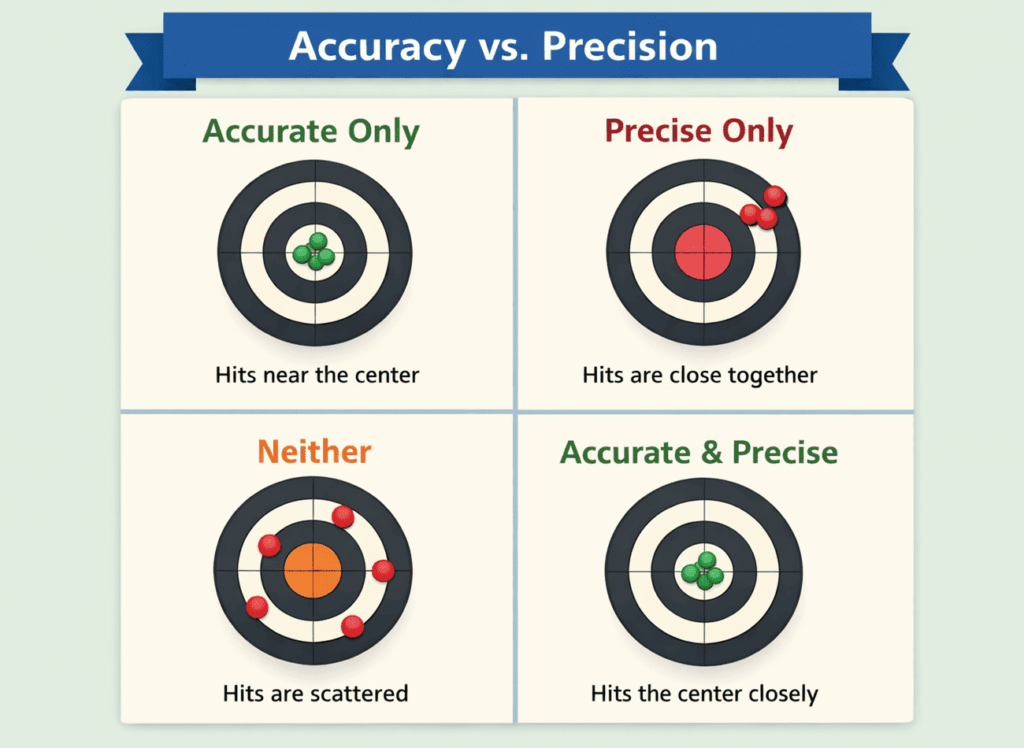
The ideal scenario is both accurate and precise: darts grouped tightly at the center.
The table below shows the key differences between accuracy and precision:
| Parameter | Accuracy | Precision |
| Definition | How close the results are to the true value | How close repeated measurements are to one another |
| Focus | Correctness | Consistency |
| Measurement | Determined from a single result | Requires multiple results |
| Error type | Systematic errors | Random errors |
| Example | Hitting the center of a dartboard | Darts clustered together but not necessarily on the bullseye |
Real-Life Examples
Building a shared database: Imagine your team feels scattered; build a central database with real-time access to project data. If collaboration improves across all projects, your effort was both accurate (it solved the problem) and precise (the process is repeatable). If only a few projects benefit, you have achieved accuracy without precision. If you fill the database with similar entries that don’t help anyone, you’re precise without being accurate. When nobody can access the database, you are neither accurate nor precise.
Improving customer response time: Suppose your support team aims to respond to all tickets within 48 hours. If every ticket is answered within 2 days, you have high accuracy and precision. When some tickets meet the 48-hour goal, and others don’t, you’re accurate but not precise. If responses are sent at the same interval but exceed 48 hours, you’re precise but not accurate. A slower or inconsistent response shows neither.
Dressing for work: Checking tomorrow’s weather helps you choose your outfit. If the forecast predicts rain and it rains, your preparation is accurate. Packing an umbrella and boots is precise because those items relate to wet weather. If it doesn’t rain, you were precise, your gear matched each other, but not accurate, since you misjudged the weather.
Precision Vs Accuracy: Which is More Important?
In many cases, you need both accuracy and precision, but sometimes one outweighs the other. Accuracy is critical when the correct answer matters more than consistency. In medical diagnosis, a doctor must identify the right condition; being consistently wrong is dangerous. For GPS navigation, reaching the correct destination matters more than following the exact same route every time.
Precision becomes more important when repeatability is key. In manufacturing, smartphone components must fit together perfectly every time; precision ensures that each part matches the others. In competitive sports, a darts player who consistently hits the same spot can adjust their aim more easily than one who occasionally hits the bullseye but lacks consistency.
How to Measure and Improve Both
Knowing the difference between accuracy and precision helps you choose the right strategy. Here are some proven techniques:
Techniques to Improve Accuracy
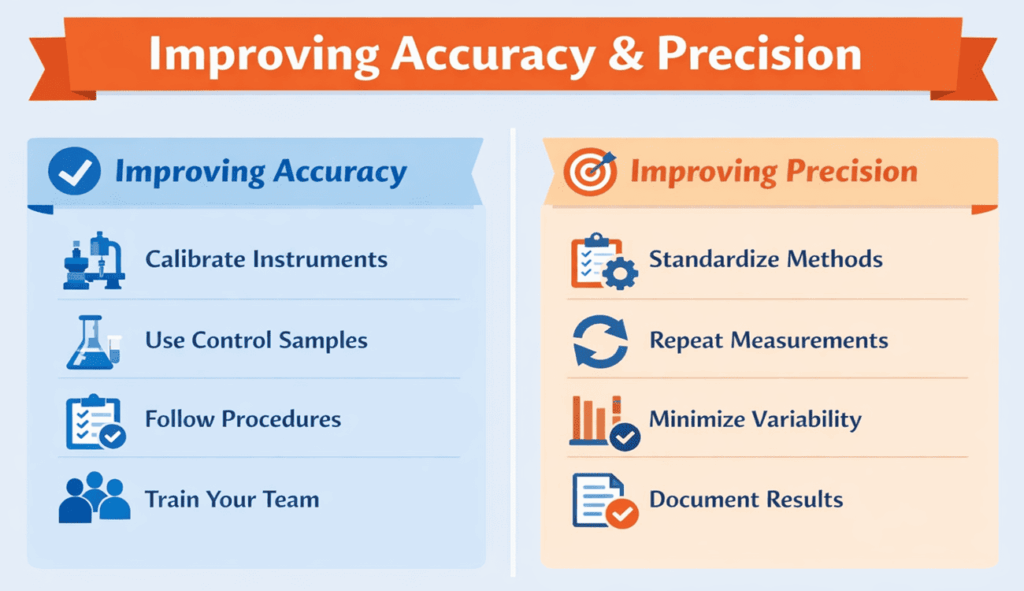
- Data validation: Cross-check numbers against independent sources to ensure alignment. For example, analysts might compare revenue reports with bank statements.
- Bias reduction: Use diverse samples and double-blind methods to minimize systematic errors.
- Calibration: Regularly calibrate tools and models against known standards so results align with reality.
- Error analysis: Investigate the root cause of discrepancies to correct processes and avoid repeating mistakes.
Techniques to Improve Precision
- Standardized procedures: Develop detailed operating procedures so every team member follows the same steps.
- Continuous monitoring: Use dashboards or control charts to track performance and detect variability in real time.
- Track key performance indicators (KPIs): Monitor granular metrics like sales velocity and response times to detect subtle shifts.
- Repeated sampling: In quality control, regularly sample products to verify that production remains within tight specifications.
The infographic below summarizes these techniques.
Achieving Both Accuracy and Precision in Your Work
Balancing accuracy and precision takes practice, but you can start small. Set clear targets and check results against reliable benchmarks. Record your methods carefully so you can repeat successful processes. Use tools that provide real-time feedback, and don’t be afraid to adjust when data shows a consistent error. Over time, small adjustments compound, and your measurements will land on target more often.
FAQs
Q1. How can I remember the difference between accuracy and precision?
Think of the first letters: Accuracy is about being Correct, while Precision is about being Consistent. This simple mnemonic keeps them straight.
Q2. Can you be both accurate and precise at the same time?
Yes. When your results are correct and repeatable, you’ve achieved the ideal: you hit the target, and you do so consistently.
Q3. Why are accuracy and precision independent?
You can be consistently wrong. For example, a scale that always reads five pounds heavy is precise (consistent) but not accurate (correct).
Q4. What is the role of calibration in accuracy and precision?
Calibration aligns your tools with known standards, reducing systematic error and improving both accuracy and precision. Regular calibration keeps measurements reliable.
Summary
Accuracy and precision play a key role in how you measure results and make decisions. Accuracy ensures your outcome is correct, while precision ensures consistency over time. You need both to build trust in your data and improve performance. When you understand the difference between accuracy and precision, you can fix errors, refine processes, and get better results. Start by checking your methods, using reliable tools, and tracking outcomes closely. Small improvements in accuracy and precision can lead to strong, lasting success.
These topics are important for the PMP exam.

I am Mohammad Fahad Usmani, B.E. PMP, PMI-RMP. I have been blogging on project management topics since 2011. To date, thousands of professionals have passed the PMP exam using my resources.