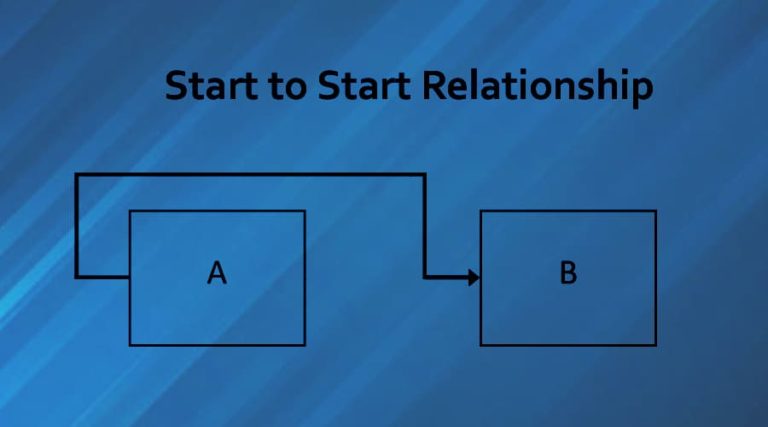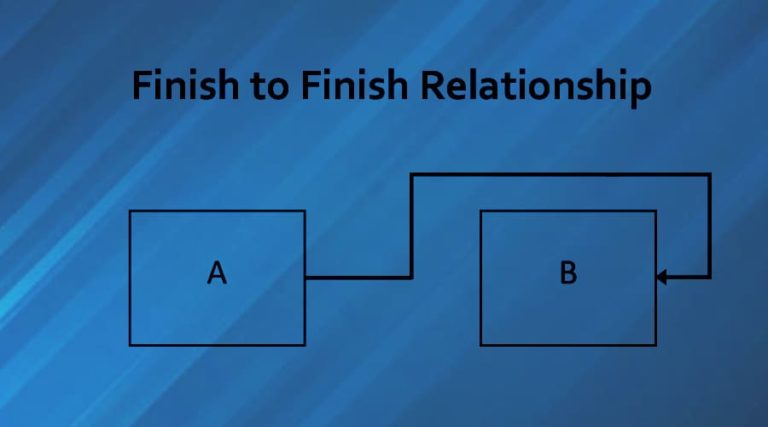
Today, we will discuss the finish-to-start relationship. This is the most commonly used relation in the network diagram.
Before we discuss the finish-to-start (FS) relationship in detail, let’s understand the terms we’ll use.
A predecessor activity comes before a dependent activity in a schedule. A successor activity is a dependent activity that comes after another.
A lead is when a successor activity is started before the predecessor finishes and is indicated by the “-” sign.
A lag is a delay of a successor activity, denoted by the “+” sign.
Finish-to-Start Relationship
A project network diagram can have four types of dependency:
- Finish-to-start
- Finish-to-finish
- Start-to-finish
- Start-to-start
In this blog post, I will provide details of the finish-to-start (FS) relationship.
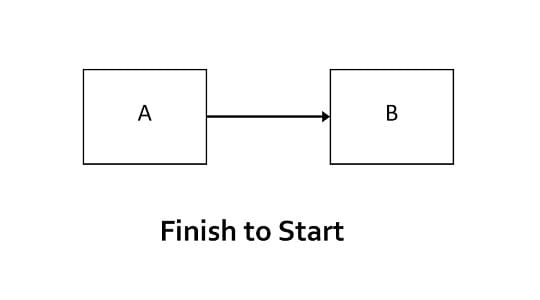
The PMBOK Guide states, “Finish to Start is a Logical Relationship in which a Successor Activity cannot start until a Predecessor Activity has finished.”
This is the most commonly used relationship in a network diagram; the start of the successor activity depends on the predecessor activity’s finish.
Representation of Finish-to-Start Activity
Here is how a finish-to-start relationship is shown in a network diagram.
The bar chart or Gantt chart of the same is below:

Example of Finish-to-Start Relationship
Let’s say you are constructing a room.
To install the ceiling, you have to construct the walls. In this example, the first activity is constructing walls, and the second activity is the ceiling.
Let’s see a scenario with lag.
After plastering the wall, you will wait two days for it to cure before starting to paint. Here, the relation is finish-to-start with two days of lag.
The next example has lead.
Suppose you are constructing a two-floor building. You have two activities in sequence: electrical work and painting. The electrical work will take ten days, and the painting will take six days.
However, as you complete the electrical work on the ground floor in five days, you begin painting while the electrical work on the second floor continues.
Here, you have a finish-to-start relationship with five days of lead.
Uses of Finish-to-Start Relationship
This relationship is used in all types of project network diagrams, including activity-on-node diagrams and activity-on-arrow diagrams.
Roles of Finish-to-Start Relation in Schedule Compression
This relationship is useful when the project is delayed, and the project manager has to compress the schedule.
Finish-to-start is also useful when you want to complete the project earlier and are looking for activities that can be run in parallel.
Conclusion
Finish-to-start is the most commonly used relationship in project scheduling. This relationship is crucial for developing project timelines and ensuring that tasks are executed in the correct order. By understanding this relationship, project managers can create more efficient schedules, improve resource allocation, and complete the project with minimal obstruction.
Here is where this post on the finish-to-start relationship ends.
Further Readings:
- What is the Precedence Diagramming Method?
- What is the Critical Path Method?
- What is Critical Chain Project Management?
- What is the PERT Chart?
- What is the Gantt Chart?
This topic is important from a PMP exam point of view.

I am Mohammad Fahad Usmani, B.E. PMP, PMI-RMP. I have been blogging on project management topics since 2011. To date, thousands of professionals have passed the PMP exam using my resources.