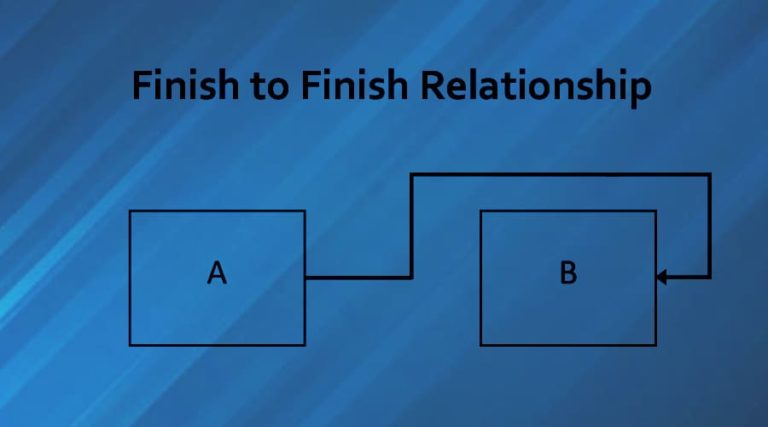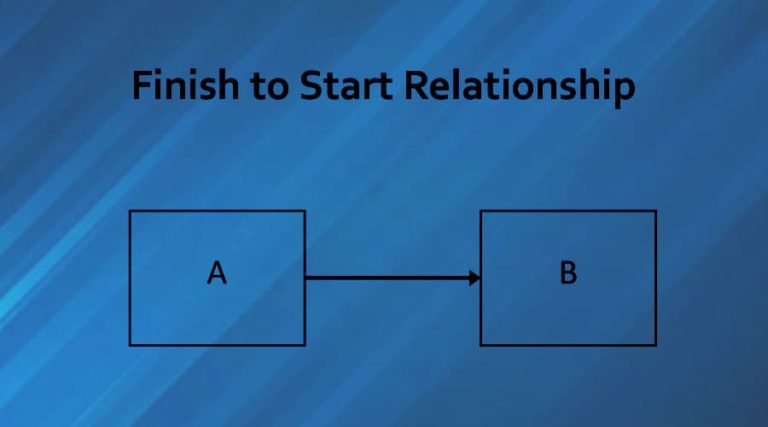
A start-to-start relationship is a project management dependency mainly used in developing activity-on-node network diagrams. It is not as commonplace as the finish-to-start relationship.
This blog post will discuss the start-to-start (SS) relationship in project management.
Before we proceed, let’s understand some terminology used in this blog post.
A predecessor activity comes before another activity in the schedule relationship diagram.
The following activity is known as a successor activity.
A lead is when the successor activity starts while the predecessor is not completed.
A lag is when there is a delay between these activities.
The “+” sign denotes lag, and the lead is the “-” sign.
Start-to-Start Relationship
A project network diagram can have four types of dependency:
- Finish-to-start
- Finish-to-finish
- Start-to-finish
- Start-to-start
In this blog post, I will provide details of the start-to-start relationship.
According to the PMBOK Guide, “Start to Start is a Logical Relationship in which a Successor Activity cannot start until a Predecessor Activity has started.”
Simply put, the start of the successor activity depends on the start of the predecessor activity.
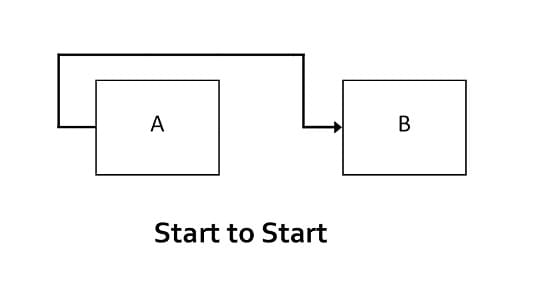
Representation of a Start-to-Start Activity
Here is how a start-to-start relationship is shown in a network diagram.
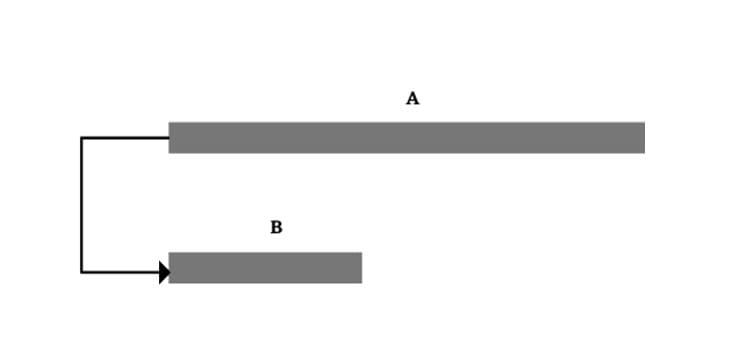
Here is how a start-to-start relationship is shown on a bar or a Gantt chart.
Example of a Start-to-Start Relationship
Say you are renovating a building and need to paint a wall. For this to happen, you have to apply the prime at the same time. This is an example of a start-to-start relationship.
In another example, the leveling of concrete (successor) cannot begin until the pouring of the foundation (predecessor) begins.
Conclusion
The start-to-start relation is uncommon and is used for “activity on node” diagrams. In this type of project management relationship, both activities start together.
This relationship can significantly impact project scheduling and resource management. By allowing tasks to begin concurrently, it helps optimize project timelines and resource utilization. Effective planning, monitoring, and communication are key to leveraging Start-to-Start relationships to achieve project success.
Here is where this post on the start-to-start relationship ends.
Further Readings:
- What is the Precedence Diagramming Method?
- What is the Critical Path Method?
- What is Critical Chain Project Management?
- What is the PERT Chart?
- What is the Gantt Chart?
This topic is important from a PMP exam point of view.

I am Mohammad Fahad Usmani, B.E. PMP, PMI-RMP. I have been blogging on project management topics since 2011. To date, thousands of professionals have passed the PMP exam using my resources.