
Today, we will discuss start-to-finish relationships in a project network diagram. This project management dependency is not as common as a finish-to-start relationship, but knowing about it will help you develop a sound schedule network diagram.
Let’s start by understanding the terminology.
A predecessor activity will be completed before another activity. A successor activity will be completed after another activity.
A lead occurs when the successor activity starts before the predecessor activity is completed. This is an advancement, denoted by the “-” sign. A lag is a delay between a predecessor and a successor activity, denoted by the “+” sign.
Start-to-Finish Relationship
A project network diagram can have four types of dependency:
- Finish-to-start
- Finish-to-finish
- Start-to-finish
- Start-to-start
According to the PMBOK Guide, a start-to-finish (SF) relationship is “A logical relationship in which a successor activity cannot finish until a predecessor activity has started. ”
Simply put, the finish of a successor activity depends on the start of the predecessor activity.
Representation of Start-to-Finish Activity
Here is how a start-to-finish relationship is shown in a network diagram.
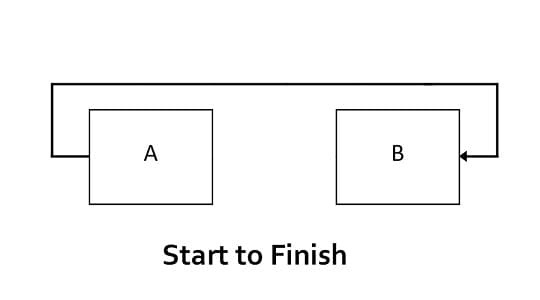
Here is how a start-to-finish relationship is shown on a bar or a Gantt chart.

Example of Start-to-Finish Relationship
Consider a construction project where you need to move to a new house. To be able to do this, the new house needs to be already built. This is an example of a Start-to-Finish relationship.
Consider another example.
A new accounts payable system (successor) has to start before the old accounts payable system can be shut down (predecessor).
Conclusion
Start-to-finish is rarely used in developing a scheduling network diagram. Though less common, this relationship type is key in strict sequencing scenarios. Properly managing start-to-finish dependencies contributes to the success of the project by minimizing risks and ensuring that each phase progresses efficiently from initiation to completion.
Here is where this post on the start-to-finish relationship ends.
Further Readings:
- What is the Precedence Diagramming Method?
- What is the Critical Path Method?
- What is Critical Chain Project Management?
- What is the PERT Chart?
- What is the Gantt Chart?
This topic is important from a PMP exam point of view.

I am Mohammad Fahad Usmani, B.E. PMP, PMI-RMP. I have been blogging on project management topics since 2011. To date, thousands of professionals have passed the PMP exam using my resources.






Do you think that the following two are consistent
1. According to the PMBOK Guide, a start-to-finish (SF) relationship is “A logical relationship in which a successor activity cannot finish until a predecessor activity has started
2. A new accounts payable system (successor) has to start before the old accounts payable system can be shut down (predecessor).
In addition I feel that the completion of the new has may not necessary require the start of moving (evacuating) from the old one)
I frequently have observed inconsistent concepts b/n the definition given by PMBOK and many examples given by different authors including PMBOK example given to SF