
Today, we will discuss the finish-to-finish relationship.
The finish-to-finish relationship (FF) is not very common in network diagrams. This project management dependency is used in activity-on-node diagrams but not in activity-on-arrow diagrams.
Before discussing this relationship, let’s understand the terms we will use.
A predecessor activity comes before another activity in a schedule. A successor activity comes after another activity.
A lead is when the second activity starts before the first is completed. A lag is when the second activity is delayed after the first activity is completed.
Lag is shown by the “+,” and the “-” sign denotes lead.
Let’s get into detail about the FF relationship.
Finish-to-Finish Relationship
A project network diagram can have four types of dependency:
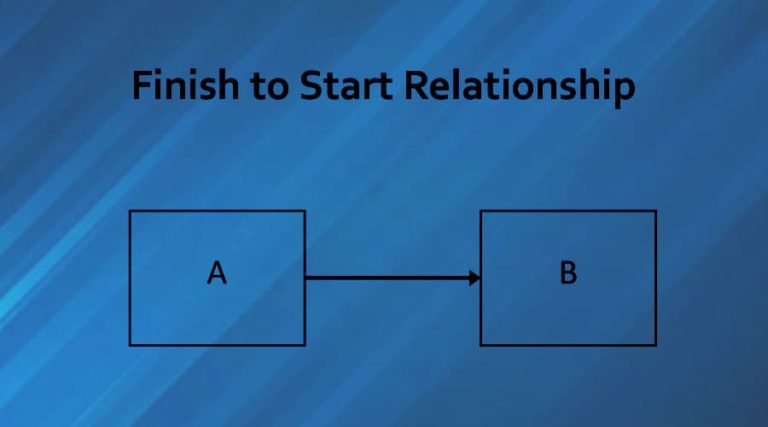
- Finish-to-start
- Finish-to-finish
- Start-to-finish
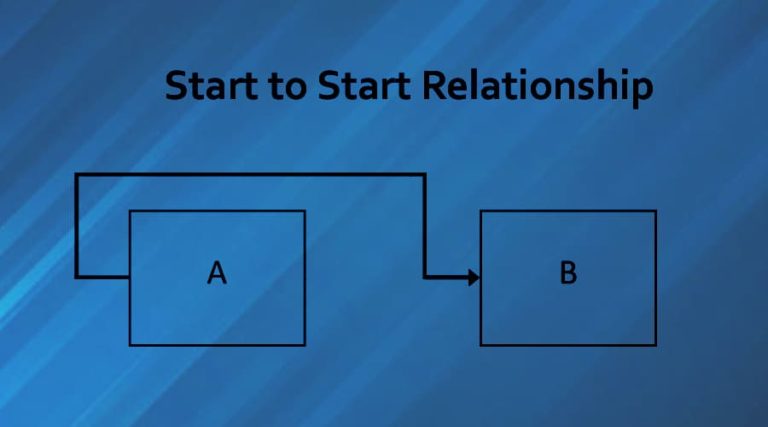
- Start-to-start
In this blog post, I will provide details of the finish-to-start relationship.
The PMBOK Guide states, “Finish to Finish is a Logical Relationship in which a Successor Activity cannot finish until a Predecessor Activity has finished.”
In simpler words, the end of the successor activity depends on when the predecessor is done.
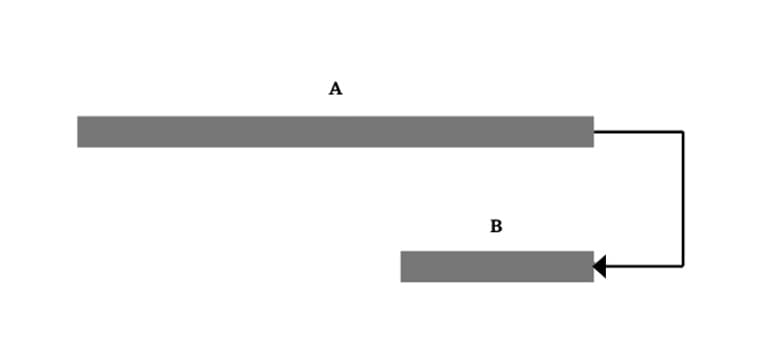
In this scenario, two activities can run in parallel, but the second task can be completed only when the first task is done.
Representation of Finish-to-Finish Activity
Here is how a finish-to-finish relationship is shown in a network diagram.
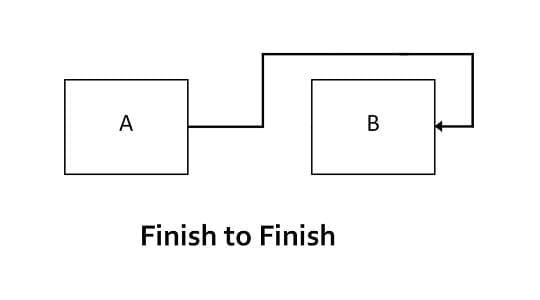
And this is how a finish-to-finish relationship is shown on a bar or a Gantt chart.
Example of a Finish-to-Finish Relationship
Writing a document (predecessor) must be completed before editing the document (successor) can be completed.
Consider a project where the software needs to be implemented, but the requirements are still in progress. In this scenario, coding cannot be finished without the collecting requirements, a finish-to-finish relationship.
Let’s see an agile example.
Consider that the project follows the adaptive (agile) approach with a one-week sprint. On the last day, developers have no time to deliver the product for testing. So, to ensure the finish is the same (almost) from both development and testing, a project manager introduced a Test-Driven Development framework where both can happen in parallel.
In this approach, test cases are written at the beginning of the sprint, the tester runs them, and all of them should fail. As the sprint progresses, the developer and tester keep working in parallel.
Here, the finish is the same, but instead of following finish-to-start, we are not worried about starting the successor activity a little early.
Conclusion
Finish-to-finish is a relationship in which a successor activity cannot be completed before a predecessor activity finishes. While less common than other dependencies, it plays a vital role in certain workflows, ensuring processes are completed in a controlled sequence. Properly managing these relationships helps minimize risks, avoid bottlenecks, and maintain a smooth project timeline.
Here is where this post on the finish-to-finish relationship ends.
Further Readings:
- What is the Precedence Diagramming Method?
- What is the Critical Path Method?
- What is Critical Chain Project Management?
- What is the PERT Chart?
- What is the Gantt Chart?
This topic is important from a PMP exam point of view.

I am Mohammad Fahad Usmani, B.E. PMP, PMI-RMP. I have been blogging on project management topics since 2011. To date, thousands of professionals have passed the PMP exam using my resources.
Two project activities A and B (B obegin dependetn A) have afinish_ finish relstiondhip with 8 days lag. The estimated duration for the activity are 10 and 15 respectively. If activity A is scheduled to start on the 12th day from the beginning of project, on which day can you schedule to start activity B?
Two project activities A and B (B obegin dependetn A) have afinish_ finish relstiondhip with 8 days lag. The estimated duration for the activity are 10 and 15 respectively. If activity A is scheduled to start on the 12th day from the beginning of project, on which day can you schedule to start activity B? Please, solve
13