
A work breakdown structure (WBS) helps answer a simple but important question: how can you organize a large project without missing any work? A WBS solves this problem by breaking the entire project into smaller, easier-to-manage parts. Each section focuses on a specific deliverable or task, making planning, budgeting, scheduling, and tracking much simpler.
In project management, the work breakdown structure is one of the best tools for controlling scope and improving team coordination. Whether you manage a construction project, software launch, or marketing campaign, a clear WBS helps your team stay organized and focused.
In this blog post, I will explain what WBS is, why it matters, and how to create one successfully.
Key Takeaways
- A Work Breakdown Structure organizes a project’s total scope into manageable elements.
- WBS elements follow a hierarchy: the project at the top and detailed work packages at the bottom.
- The WBS aids planning, scheduling, cost estimating, resource allocation, progress tracking, and risk management.
- There are two common types: deliverable-based and phase-based, but hybrid models also exist.
- A good WBS follows the 100 percent rule, avoids overlapping scopes, and stays no deeper than needed.
What is a Work Breakdown Structure?
A Work Breakdown Structure (WBS) is a project management tool that breaks a large project into smaller and manageable parts. It organizes the total scope of work into a clear hierarchy, starting with the main project goal at the top and smaller deliverables or work packages below it.
A WBS helps project managers plan tasks, assign responsibilities, estimate costs, and track progress more effectively. It also improves communication because every team member can clearly understand what work must be completed.
The WBS follows the “100% Rule,” meaning it includes all project work without overlap or missing tasks. It does not show the schedule or timeline. Instead, it focuses on defining the work required to achieve the project’s objectives successfully and efficiently.
Why Use a Work Breakdown Structure?
Breaking a project into smaller pieces yields several benefits:
Better Planning and Cost Estimation
When you know all the tasks and deliverables, it becomes easier to estimate time, resources, and costs. NASA points out that each WBS element has clear objectives and measurable completion criteria, which support accurate technical, schedule, and cost plans. With clear boundaries, it is harder to underestimate or forget work.
Improved Resource Allocation and Accountability
A WBS assigns responsibility to specific individuals or teams. When everyone knows what they own, accountability increases. This clarity also helps managers allocate resources to the right tasks at the right time.
Clear Communication and Alignment
A WBS acts as a common language for the team and stakeholders. It shows how individual pieces fit into the big picture. In its blog on project success, the Project Management Institute (PMI) emphasizes that clarity of vision and a well-articulated purpose understood by all stakeholders improve perceived success. A WBS helps provide that clarity.
Early Risk Identification
Decomposing work allows teams to see where risks may lie. Since each element has defined objectives and constraints, it is easier to spot potential trouble and plan mitigation.
Support for Earned Value Management and Reporting
Because WBS provides a structure for cost and schedule aggregation, it supports methods like Earned Value Management (EVM). NASA explains that the WBS numbering system ensures project costs and performance data can be traced back to the correct work scope.
Work Breakdown Structure Types
Most projects use one of two common WBS approaches: deliverable-based or phase-based. Each method suits different kinds of projects, though hybrid approaches are also possible.
Deliverable-Based WBS
In a deliverable-based WBS, the breakdown is organized around the final products. Each high-level deliverable is decomposed into smaller deliverables until you reach work packages. This approach is ideal when tangible outputs are clear.
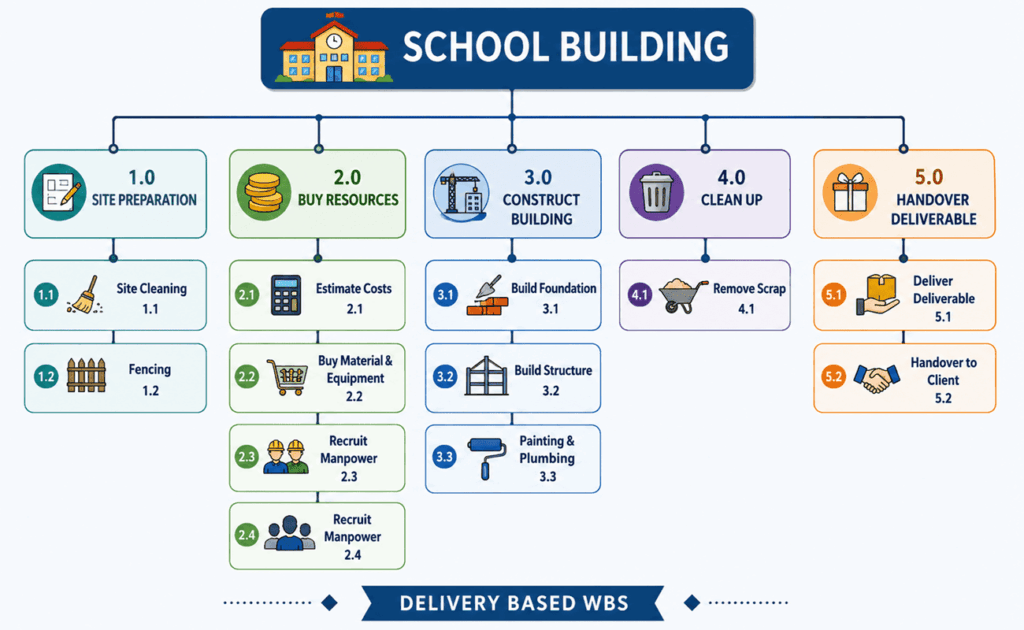
For example, a small house construction project can be broken down into design, construction, and finishing deliverables, with each further decomposed into sub-deliverables such as architectural plans, foundation, framing, roofing, interior fittings, and landscaping. The figure below illustrates such a structure.
Phase-Based WBS
A phase-based WBS follows the project life cycle. Each phase, initiation, planning, execution, monitoring and control, and closure, is broken down into key tasks or deliverables. This method suits projects that follow a sequential process.
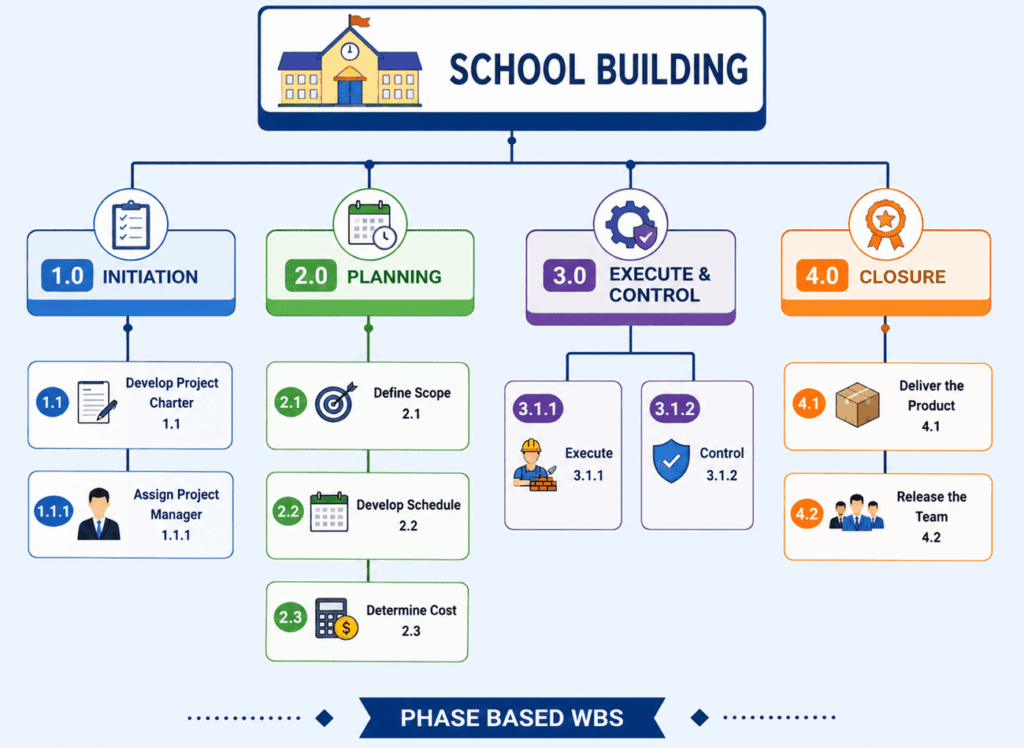
In construction, for example, the initiation phase might involve defining requirements and securing funding; planning covers design and procurement; execution handles building activities; monitoring tracks progress and quality; and closure addresses inspections and handover. A phase-based WBS aligns tasks with stages of the project timeline. The illustration below shows a sample phase-based WBS for a construction project.
Other Variations
Beyond the common approaches, several other structures exist. A noun-oriented WBS organizes tasks around specific deliverable items, such as hardware components in an engineering project. A verb-oriented WBS focuses on actions or processes (e.g., design, build, test).
A time-phased WBS aligns tasks with specific calendar periods or milestones. A geographical WBS groups work by location, which is useful when activities span multiple sites. A cost breakdown WBS organizes tasks by cost categories, and a profit-enter WBS groups work by business unit. These variants may be combined to suit complex projects.
Key Elements of a WBS
A well-structured WBS contains several building blocks:
- Work package – the smallest unit of work that can be scheduled, budgeted, and assigned to a team member. Each work package includes specific deliverables, duration, budget, and owner.
- Planning package – a placeholder for future work when details are not yet defined. It allows teams to plan without committing to specific tasks until more information is available.
- Control account – a management control point that integrates scope, cost, and schedule. Control accounts allow a manager to monitor performance for a collection of work packages.
These elements appear in the WBS dictionary, which documents descriptions, start and end dates, budgets, and responsibilities. A clear dictionary reduces misunderstandings.
How to Create a Work Breakdown Structure
Creating a WBS is both an art and a science. The following steps provide a practical approach:
1. Define the Project Scope
Start by collecting project objectives, goals, and boundaries. A clear scope statement ensures that everyone agrees on the end goals. Identify what is in scope and what is out of scope. Engage stakeholders early to avoid surprises later.
2. Identify Major Deliverables or Phases
List the high-level deliverables or phases that must be completed to achieve the project goals. For a deliverable-based WBS, these could include design documents, prototypes, production units, and documentation. In a phase-based WBS, the phases might be planning, execution, and closure.
3. Choose the Structure and Define Levels
Decide whether to organize by deliverable, by phase, or by a hybrid approach. Determine how many levels you need. NASA’s guidelines allow up to seven levels for cost tracking, but most projects use two to four levels. Each level should follow the 100 percent rule: the sum of the child elements equals the parent’s scope. Avoid overlapping scopes; elements at the same level must be mutually exclusive. Do not break work down too far; small projects rarely need more than three levels.
4. Decompose Each Element
Break down each top-level element into smaller, more specific components. Continue decomposing until you reach work packages that can be estimated, scheduled, and assigned. Ask questions like: What deliverables must we produce? Which tasks are necessary to achieve these deliverables? Can we measure completion? Keep decomposition balanced across branches to avoid overdetailing one part while leaving another vague.
5. Develop the WBS Dictionary
For every element, document descriptions, ownership, budgets, and completion criteria. The dictionary becomes a reference for the team. It also supports change management because any modification to the WBS should also update the dictionary.
6. Create the Project Schedule
Use the WBS as the foundation for the project schedule. Convert work packages into activities, sequence them logically, estimate durations, and assign resources. Develop a network diagram and identify the critical path. Because each work package has a defined scope and constraints, the schedule becomes more realistic.
7. Maintain and Update
A WBS is a living document. Update it when the scope changes. Revisit the WBS periodically to ensure it still reflects project realities. Resist adding extra depth unless necessary; complexity can hinder understanding.
WBS Rules and Best Practices
Developing a WBS is guided by a few simple but powerful rules:
- The 100 percent rule – Each level of the WBS must account for all work required to complete its parent. Nothing extra and nothing missing.
- Mutual exclusivity – The scope of work for each element at the same level should not overlap. Overlaps cause confusion and double-counting.
- Controlled depth – Avoid decomposing tasks beyond what is needed for planning and control. Two or three levels suffice for most projects; large projects may need more, but seldom more than seven.
- Clear naming and coding – Use descriptive titles and a logical numbering scheme. NASA requires a numbering system that identifies each element’s level and relationship.
- Involve the team – The people doing the work should help build the WBS. Their input improves accuracy and buy-in.
Pros and Cons of Using a WBS
Advantages
Clarity and Focus – Breaking a project into manageable parts makes it easier to understand. Team members see how their work contributes to the whole.
Better Planning and Estimating – Each work package has a defined scope and constraints. Managers can estimate time, resources, and costs more accurately.
Improved Communication – A WBS provides a common reference point. When everyone uses the same structure, misunderstandings decrease.
Enhanced Risk Management – Decomposition reveals potential risks early. Teams can plan mitigation before issues become crises.
Support for Performance Tracking – Because each element has measurable outcomes, progress can be tracked easily. Earned Value Management relies on a well-structured WBS to integrate scope, schedule, and cost.
Disadvantages
Time-Consuming to Build – Creating a detailed WBS takes effort, especially for large projects. Getting the structure right requires input from multiple stakeholders.
Risk of Over-Detailing – Too many levels can overwhelm the team and create unnecessary documentation. Use just enough depth to plan and control.
Requires Ongoing Maintenance – Projects evolve. A WBS must be updated whenever the scope changes. Without maintenance, it can become outdated and misleading.
May Not Suit Very Small Projects – For a small effort with only a few tasks, creating a full WBS might be overkill. In such cases, a simple task list may suffice.
WBS Vs Project Schedule
New project managers sometimes confuse a WBS with the project schedule. The WBS answers the question “What work must we do?” whereas the schedule addresses “When and in what order will we do it?” The WBS is hierarchical; the schedule is chronological. The WBS provides work packages that feed the schedule. The schedule then sequences activities, defines durations, and identifies dependencies such as critical paths. While closely related, they serve different purposes.
FAQs
Q1. What is the 100 percent rule?
The 100 percent rule means that each level of the WBS must include all work needed to complete the parent element. No work should be omitted or counted twice. Following this rule ensures full scope coverage.
Q2. How many levels should a WBS have?
Most projects require only two to four levels. NASA’s guidelines allow up to seven levels for cost tracking, but adding more levels increases complexity. Use as many levels as necessary to plan and manage the work, but avoid unnecessary detail.
Q3. How does WBS improve project success?
A WBS clarifies scope, improves planning, and promotes accountability. PMI research shows that projects with clear vision and measurement practices achieve higher Net Project Success Scores (NPSS). Clarity begins with a well-designed WBS.
Q4. Does a WBS reduce risk?
Yes. By breaking the work into manageable pieces, risks become easier to identify and address early. PMI notes that nearly 45 percent of projects that ultimately succeeded were considered at risk at some point in their lifecycle. Early identification and action can turn a risky project into a success.
Q5. What happens if we skip the WBS?
Without a WBS, teams may overlook tasks, misjudge effort, or duplicate work. A WBS forms the backbone of planning and control. Skipping it increases the chance of scope creep and stakeholder dissatisfaction.
Summary
A work breakdown structure is one of the most effective tools for organizing and managing projects. It simplifies complex work by breaking the project into smaller, easier tasks. A well-designed WBS improves planning, communication, budgeting, scheduling, and progress tracking. It also helps teams avoid confusion, reduce risks, and stay focused on project goals. Whether the project is small or large, using a clear work breakdown structure increases control and improves the chances of delivering successful results on time and within budget.
This topic is important for the PMP exam.

I am Mohammad Fahad Usmani, B.E. PMP, PMI-RMP. I have been blogging on project management topics since 2011. To date, thousands of professionals have passed the PMP exam using my resources.






Pls, do you have a sample 2 storey reinforced concrete building?