
A stakeholder in project management is a person, group, or organization affected by the project or its outcome or has any interest in the project.
According to the PMBOK Guide, “A stakeholder is an individual, group, or organization who may affect, be affected by or perceive itself to be affected by a decision, activity, or outcome of a project.”
Small projects have a few stakeholders; however, larger projects have many stakeholders, including communities and the public. In these cases, managing stakeholders can be challenging.
For example, a dam construction project has many stakeholders, such as the government, local authorities, the population that will be displaced, the population continuing to reside near the dam, environmentalists, the project management team, higher management, etc.
Not all stakeholders are equal. Some are powerful, others not noninfluential, and they will have different requirements and expectations. You should treat them according to their influence on the project or its objective, requirements, and expectations. Failing to do so can jeopardize your project’s success.
In this case, you can prioritize and group the stakeholders into key and non-key stakeholders.
Stakeholders Vs Key Stakeholders
As I explained earlier, a stakeholder is someone who is impacted by or has an interest in your project. They can be internal (project team, management) or external (customers, suppliers, regulators).
While a project can have many stakeholders, key stakeholders are the most influential and critical to its success. They have significant power, interest, or control over the project’s resources or outcomes. These include sponsors, high-level decision-makers, or any party heavily impacted by the project’s results.
While all stakeholders deserve attention, key stakeholders require focused engagement because they can influence decisions, provide resources, or create roadblocks. Prioritizing key stakeholders helps ensure project alignment with critical goals, reduces risks, and promotes smoother communication throughout the project lifecycle.
You must identify key stakeholders early to complete the project with minimal obstruction.
Overlooking any important stakeholder can make the situation difficult later. It may cause a project delay, cost overrun, and, in the most severe cases, abrupt project termination.
Examples of Project Stakeholders
Below are lists of stakeholders divided into key and non-key stakeholders:
Key Stakeholders
- Project Sponsor
- Project Manager
- Senior Leadership/Executive Team
- Clients/Customers
- Functional Managers
- Vendors/Suppliers
- Regulators
- Project Team Members
Non-Key Stakeholders
- Support Staff
- General Employees
- Local Community
- Media
- Industry Associations
Types of Stakeholders in Project Management
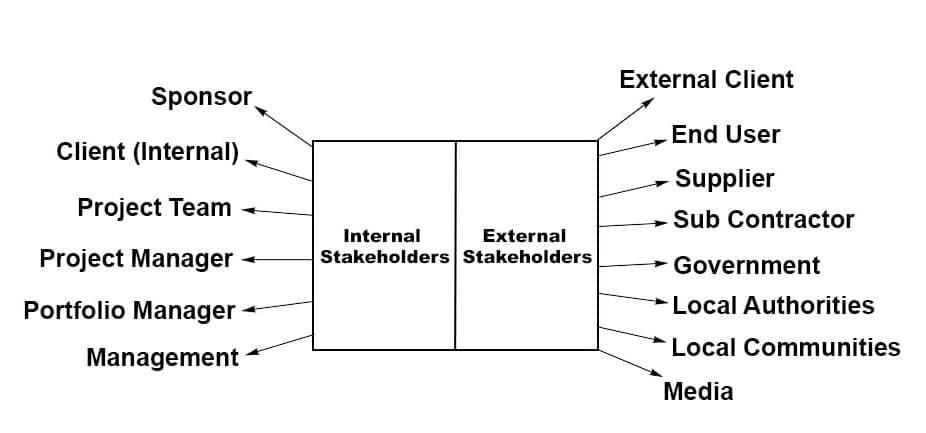
Project stakeholders can be grouped into two categories:
- Internal Stakeholders
- External Stakeholders
Internal Stakeholders
Internal stakeholders are within the organization. They are directly involved with the project or work with the organization managing it.
Example of Internal Stakeholders
- A sponsor
- An internal customer or client (if the project is for an internal need of an organization)
- A project team
- A program manager
- A portfolio manager
- Management
- Another group’s manager (e.g., functional manager, operational manager, admin manager, etc.).
These stakeholders generally have the highest interest in the project’s success.
External Stakeholders
External stakeholders are outside the organization. They are not directly involved with the project but indirectly affected by the project or its outcome.
Example of External Stakeholders
- An external customer or client (if the project is a result of a contract)
- An end user of the project’s outcome
- A supplier
- Subcontractors
- The government
- Local authorities
- Local communities
- The media
As you can see, external stakeholders include clients, governments, and local authorities, which are powerful entities. Therefore, you must manage them carefully.
Identifying Project Stakeholders
To identify project stakeholders, start by reviewing your project’s objectives. Think about everyone who might be affected by the project or is interested in its success. Stakeholders can be people or groups inside or outside your organization.
First, look at internal stakeholders. These include the project team, project manager, and sponsors. Also, consider departments like finance, marketing, or IT that might contribute to or be impacted by the project.
Next, consider external stakeholders. These can be customers who will use the project’s outcome, suppliers providing materials, or regulatory bodies that need to approve the project. Don’t forget local communities, especially if the project affects the public.
Talk to experts, team members, and leaders who know the project well. Conduct brainstorming sessions.
Organize your list by writing down each stakeholder’s role and how the project affects them. To spot key stakeholders, focus on those with the most influence or interest. Always update your list as the project progresses.
How to Manage Project Stakeholders
To manage your project stakeholders, follow the steps below.
1. Identify Stakeholders
After signing the project charter, you should identify your project stakeholders. You can start reviewing project documents such as the project charter, procurement documents, agreements, and previous checklists. Some useful tools and habits include brainstorming, facilitated workshops, interviews, etc.
2. Stakeholder Analysis
After identifying stakeholders, you should analyze them to find their interests and influence on the project. You can use the salience model, power/interest grid, or another suitable method for stakeholder analysis.
3. Prioritize Stakeholders
After analyzing project stakeholders, you must prioritize them according to their power and interest in the project. Prioritization will provide information on stakeholders who require more attention or can be ignored.
4. Develop a Stakeholder Management Plan
Based on the information collected, you will develop your stakeholder engagement plan, which will provide information on handling each stakeholder. An influential and powerful stakeholder will receive more attention than a low-power and low-interest group of stakeholders.
Positive Stakeholders and Negative Stakeholders
Stakeholders can be positive or negative.
A positive stakeholder sees the project’s positive side and benefits from its success. These stakeholders help the project management team to complete the project successfully.
On the other hand, a negative stakeholder sees the outcome and may be negatively impacted by the project or its outcome. This type of stakeholder is less likely to contribute to the project’s success.
Many professionals think competitors are negative stakeholders, as your project also affects them. However, competitors are not negative stakeholders because you manage your stakeholders proactively and fulfill their requirements, but you cannot manage or fulfill your competitors’ requirements.
You should identify your stakeholders early in the project and record them in the stakeholder register.
Stakeholder Vs Shareholder
Stakeholder and shareholder are different terms, though many professionals confuse these terms with each other.
A stakeholder is a person or group with any interest in the project or is impacted by its outcome. On the other hand, a shareholder has a financial investment in the project or the business. All shareholders are stakeholders, but not all stakeholders are shareholders.
Summary
Stakeholders are individuals or groups affected by or interested in the project. It is important to identify stakeholders at the beginning of the project and develop a strategy to manage them and their requirements. This will help you complete the project with minimal obstruction because obtaining their positive involvement with your project will provide the support you need.
Further Readings:
- Stakeholders in Project Management
- Identify Stakeholders in Project Management
- Stakeholder Engagement: How to Manage Project Stakeholders?
- Salience Model to Analyze Project Stakeholders
- How to Create a Stakeholder Map?
This topic is important from a PMP certification exam point of view.

I am Mohammad Fahad Usmani, B.E. PMP, PMI-RMP. I have been blogging on project management topics since 2011. To date, thousands of professionals have passed the PMP exam using my resources.


page number of document?
for refrences
Hello Ali, you can refer to the stakeholder management knowledge area in the PMBOK Guide.
can you explain types of stakeholders in terms of 1) neutral stakeholders 2) Supportive stakeholders 3) leading stakeholders 4) Influencing stakeholders
Hello Asfand, please read the following blog post:
https://www.projectengineer.net/guide-to-stakeholder-management/
how do you know those stakeholders?? Is it just something like assume or create a persona?
If they are impacted by your project, then they are your project’s stakeholders.
help me
Hello Farah,
How I can help you?
:Project stakeholders are categorized in to three types.
Really great article that’s helped me a lot today with my studies. Thank you. Researching shareholders next!
You are welcome Sam.
What are the deliverables of the project?
A deliverable is a tangible or intangible good or service produced as a result of a project that is intended to be delivered to a customer (either internal or external). A deliverable could be a report, a document, a software product, a server upgrade or any other building block of an overall project. (Source: Wikipedia)
What is the background of the project ?
Please read the following article:
http://www.mymanagementguide.com/project-background/
Who are the key stakeholders
For example, client, top management, any government department, etc.
I need to know whether Project Manger is also a stakeholder or NOT .
Pl explain.
Yes, the project manager is a stakeholder because it is his or her project.
Its very useful article & informative but there is no elaboration on negative and positive stakeholders..!
Hello Talat,
I will include it in the next update of this blog post.
I am preparing for the CAPM exam, I was wondering if you could guide or give out some tips that would benefit me in preparing for the exam. Your guidance will be greatly appreciated.
Thank you.
Do you have any project management experience or planning to attend a training?
Thanks fahad for this article, pls can u direct me to a Web site where i can get ” The role of user as stakeholder in project management process”.
You can search on Google. I don’t have any resource with me.
This is superb contributions to PM student, but what of categories of stake holders, as antogonistic, low priority as well as supportive stake holders taught by my lecturer???
You can define how are you going to classify stakeholder in your project management plan and go for it.
Hello, I am a student and this is really beneficial for me.
Just wanted to know if you could give me the questionnaire of this research it would be really helpful.
Sorry Kinan, I don’t have it.
Please what are the modalities that must be established for a group creativity problem solving?
Please read following article published on projectmanagement.com
https://www.projectmanagement.com/blog-post/8359/Group-Creativity-Techniques-to-Collect-Requirements-
Very informative article,thanks fahad
You are welcome Tylor.
Very well written
You are welcome Karan.
Fahad, Very scholarly piece on Stakeholders in PM. I enjoyed reading it.
Thanks Vijay for your comment.
Dear Mr. Fahad
If i still have some invoices not paid to the seller , is this mean the project still not closed ???
Thanks
You have to close all procurement contracts before closing the project.
Thanks FAHAD..
you shared a useful knowlede..
Thanks for your comments Saddam.
I think it date is very helpful for me to prepare my presentation..
Thanks Umair for your comment.
Stakeholders are classified according to: Power, Influence, and what others?
Hope this will clarify your doubt:
https://pmstudycircle.com/2012/06/stakeholder-analysis-stakeholder-management-strategy/
we need the positive impacts of involving stakeholders in projects
We also need to manage negative impacts of stakeholders..
it a wonderful article, has helped me a lot
thanks
You’re welcome Koech.
that was wonderful, will real assist,
thanks you
It’s like you’re on a misoisn to save me time and money!
:)
Real concise and comprehensive.
Thanks
You are welcome Merle.
One of the best explanations and easy to understand, Thankyou for posted that data for guiding us!
keep posting all relevent material of Project managemnet.
Thanks Sumair for you comment.
VERY USE FULL ARTICLE
Thnx
You are welcome Sadham.
That was a really helpful piece of writing, gonna help me out with my college report a heep!
Cheers!
I am glad that you find it useful.
You need to separate true stakeholders from project team members and SMEs. The true stakeholders are identified through understanding the organisation, operating model and also related dependent projects.