
Schedule delays and cost overruns are common in project management. Even a small issue can devate you project baselines. That’s why, to keep the project on track, you use various reserves, such as the contingency reserve and the schedule reserve. These reserves act as safety buffers. They help you manage risks without losing control of time or budget.
In this blog post, I will explain contingency reserve and schedule reserve, how to calculate them, and when to use each one. If you want your projects to stay on track, understanding these reserves is vital.
Let’s get started.
What Are Project Reserves?
A reserve is time or money set aside to deal with risks. You may encounter three types of reservers:
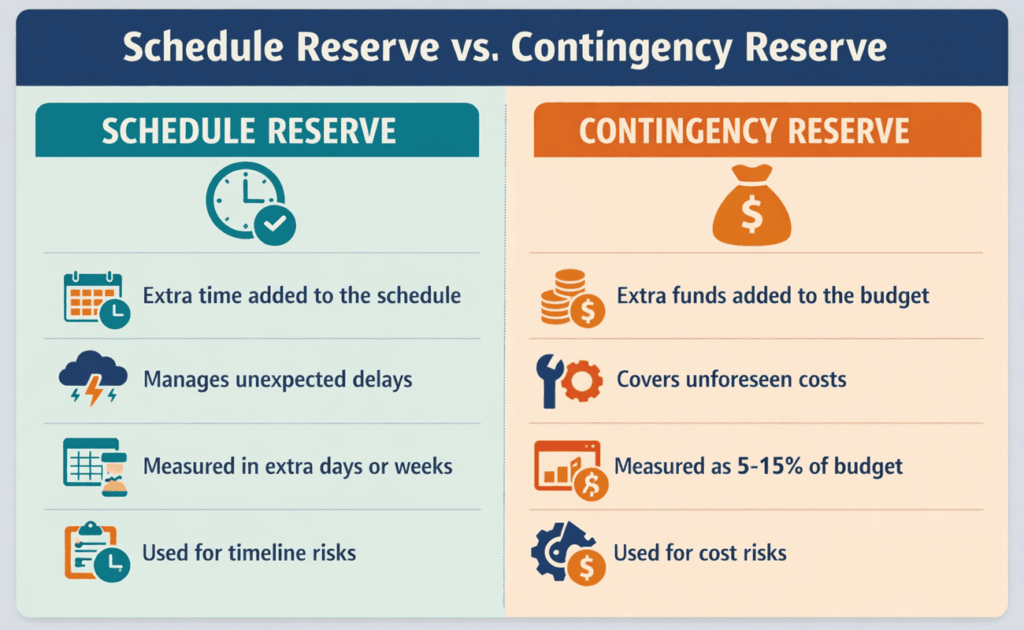
- Schedule reserve (sometimes called schedule margin) adds extra time to the schedule to absorb delays.
- Contingency reserve adds money to the budget to cover known–unknown risks that have been identified and analyzed.
- Management reserve covers unknown–unknown risks that are outside the baseline scope and can only be released by senior management.
Keeping these reserves separate allows you to manage them transparently and track how they are used.
Understanding Schedule Reserves
A schedule reserve is a time buffer built into the project timeline. It protects the end date when activities run longer than planned. Bad weather, illness, late approvals, or a critical team member leaving can all delay tasks. Without a time reserve, the team must either compress later tasks or negotiate a deadline extension. Neither option is ideal. A modest time cushion can keep the overall schedule intact and reduce stress.
Schedule reserves are not chosen at random. NASA’s schedule management handbook suggests that a funded schedule margin of less than two months per year of remaining schedule is considered low. In other words, if your project has 12 months remaining, an additional two months of funded margin provides a reasonable buffer for unforeseen events. Heavier uncertainty or complex deliverables may call for even more.
As project work becomes more complex, schedules change more frequently. A 2024 analysis of construction schedule data found that the average number of schedule updates per project almost doubled, from 1.4 in March 2022 to 2.4 by May 2024. More frequent updates mean teams identify problems sooner and adjust resources earlier. Without a schedule reserve, however, even minor delays can erode buffer time.
Understanding Contingency Reserves
A contingency reserve is a portion of the budget set aside to cover known risks with a cost impact. For example, a project may need extra funds if soil conditions require deeper foundations or if a critical supplier goes out of business. Contingency reserves do not cover scope changes; that is what change control is for. They cover events that were foreseen but could not be accurately costed.
How much should you set aside? Many experts advise that 5–15% of the total project cost is a reasonable contingency reserve, depending on the project’s size and uncertainty. Complex projects in early design stages need reserves at the higher end of this range. Simpler, well-defined projects may get by with less.
Organizations with mature risk analysis often use Monte Carlo simulations to model potential cost impacts and calculate a reserve based on probability rather than guesswork. Whatever method you choose, be transparent: contingency funds are not a slush fund but a calculated safety net.
Calculating Your Schedule Reserve
Calculating a realistic schedule reserve begins with a robust risk register. Identify tasks with high uncertainty or long lead times. Create optimistic, most likely and pessimistic estimates and analyze the impact of each risk on your timeline. Techniques like schedule risk analysis (SRA) or Monte Carlo simulations produce probability curves showing how likely you are to meet a given finish date.
Add funded margin where risks are clustered, often near critical milestones, rather than simply tacking days onto the end.
Use these guidelines as a starting point:
- For each year of work remaining, set aside at least two months of schedule margin; adjust upward for complex or high-risk projects.
- Place reserves strategically before critical events (e.g., testing, regulatory approvals) rather than only at the end.
- Update your schedule regularly. The rise in schedule updates from 1.4 to 2.4 updates per project within two years shows that more frequent reviews help teams identify slippage early.
- Track funded margin consumption in each update and log the cause of any drawdown (e.g., late design deliverables, slow permitting). This helps avoid using the entire buffer too soon.
Calculating Your Contingency Reserve
For contingency reserves, start by listing identified cost risks, market volatility, design changes, and labor shortages, and assigning probabilities and cost impacts. There are two common methods:
- Percentage method: Allocate a percentage of the total project cost. According to many experts, 5–15% of project costs is typical. Choose the higher end for projects in early design or high-risk sectors (e.g., renewable energy), and the lower end for mature projects.
- Quantitative risk analysis: Use statistical methods, such as Monte Carlo simulation, to model thousands of possible outcomes. Derive a reserve that aligns with your organization’s risk tolerance (for example, enough contingency to cover 80% of simulations). This approach requires historical data and specialized software but yields more accurate results.
Whatever method you select, document the assumptions and review the reserve at each stage-gate. As risks are closed, unused contingency can be released or reallocated. Treat contingency drawdowns like any expenditure—record the reason, amount, and remaining reserve.
Management Reserve and Unknown-Unknowns
A management reserve is a budget set aside for risks that are unknown and cannot be identified in advance. It is not part of the cost baseline and is controlled by executive management. For example, if a new regulation suddenly changes safety requirements, the contingency reserve may not cover the costs.
Releasing management reserve requires a formal approval and usually triggers a baseline change. Including management reserve in your overall funding request ensures that the project can weather true surprises without threatening its viability.
Monitoring Reserves Through the Project Lifecycle
Reserves are not a “set-it-and-forget-it” tool. They require ongoing monitoring and adjustment:
- Regular schedule updates: Adopt a disciplined process for updates. Weekly or bi-weekly updates improve accuracy and reduce the workload per update.
- Risk reviews: Revisit the risk register after each update. Identify new risks, retire closed risks, and adjust reserves accordingly.
- Earned value and performance metrics: Use indices like the Baseline Execution Index (BEI) or Schedule Velocity Index (SVI) to flag when tasks consistently finish later than planned. NASA’s schedule metrics indicate that a low schedule margin (less than 2 months per year remaining) is a warning sign.
- Transparency and governance: Establish clear rules for accessing contingency and schedule reserves. Document every drawdown and communicate reserve status with stakeholders. This builds trust and prevents misuse.
Best Practices and Lessons Learned
- Plan early and revisit often. Create reserves during initial planning and update them after each design or scope change. Early planning prevents last-minute scrambling.
- Perform quantitative risk analysis where possible. For large or complex projects, invest in tools and training to run Monte Carlo simulations. Data-driven reserves improve accuracy and credibility.
- Keep reserves visible. Include schedule reserves as separate line items in your schedule and track them with codes. Show contingency as a separate budget line so stakeholders know how much cushion remains.
- Don’t confuse reserves with slack. Slack (float) is the natural flexibility in your schedule network, while schedule reserve is a planned buffer. Avoid consuming float unintentionally; treat the schedule reserve as a separate activity.
- Communicate with your team. Explain why reserves are in place and how they will be used. Encourage proactive reporting of issues so the reserves are used wisely.
FAQs
Q1. How do I know if my contingency reserve is enough?
Start with a guideline such as 5–15% of total costs. Adjust based on risk analysis. If major risks remain unaddressed, increase the reserve or re-scope the project.
Q2. Can I move the unused schedule reserve to contingency?
No. Schedule and contingency reserves protect different dimensions of the project. If you release unused schedule margin, update the baseline and obtain approval before reallocating funds.
Q3. When should I release management reserve?
Only when a true unknown risk materializes, and the contingency reserve is inadequate. The release of management reserve usually triggers a baseline change and senior-level approval.
Summary
A well-run project recognizes that change and uncertainty are inevitable. By allocating time and money for risks, tracking how those reserves are used, and adjusting them as the project evolves, you protect your schedule, budget, and team morale. Whether you are leading a small software rollout or a complex infrastructure build, investing the effort to plan, monitor, and govern your reserves pays dividends. Ready to take your risk management to the next level? Put these guidelines into action, track your reserves diligently, and watch your projects stay on course.

I am Mohammad Fahad Usmani, B.E. PMP, PMI-RMP. I have been blogging on project management topics since 2011. To date, thousands of professionals have passed the PMP exam using my resources.