Examples help explain a concept better. Therefore, in today’s blog post, I will share enough examples of Agile methodology so you can understand it clearly and apply it to your next project.
Agile methodology is a flexible way of managing projects that focuses on teamwork, quick delivery, and adapting to change. It is not just one method but a collection of different approaches, such as Scrum, Kanban, and Extreme Programming. Each has its own process, but they all follow the same Agile principles.
I will explain these agile methodologies and then provide real-world examples of projects that successfully used them.
However, first, let us understand the Agile Methodology.
What Is Agile Methodology?
Agile methodology is a modern approach to project management that focuses on flexibility, teamwork, and delivering value quickly. It started in 2001 when a group of software developers created the Agile Manifesto to improve software project management.
Instead of following a fixed, step-by-step plan, Agile breaks work into small, manageable parts called iterations or sprints. After each sprint, teams review progress, gather feedback, and make changes if needed.
This approach helps you respond quickly to new requirements or problems. Agile encourages regular communication between team members and with customers, ensuring the final product meets real needs. It is widely used in software development but is also effective in marketing, construction, and other industries.
Agile promotes continuous improvement, making it a preferred choice for projects where change is common. By focusing on collaboration and adaptability, Agile helps deliver better results in less time.
9 Examples of Agile Methodology
Now, I will provide you with the nine most popular examples of Agile methodologies:
1. Scrum

Scrum is the most popular Agile framework used to manage projects. According to this survey, 87% respondents use Scrum. It organizes work into short cycles called sprints, usually lasting one to four weeks. Each sprint has a clear goal, and the team works together to achieve it.
A Scrum Master helps remove obstacles and ensures everyone follows the process. Every day, the team meets briefly to share progress and challenges. Each sprint starts with planning and ends with a review and a retrospective to improve future work.
Scrum helps teams stay focused, adapt quickly, and deliver high-quality results step by step. Scrum helps improve responsiveness and quality. According to this survey, 85% practitioner reported improvement in the quality of their work.
2. Kanban
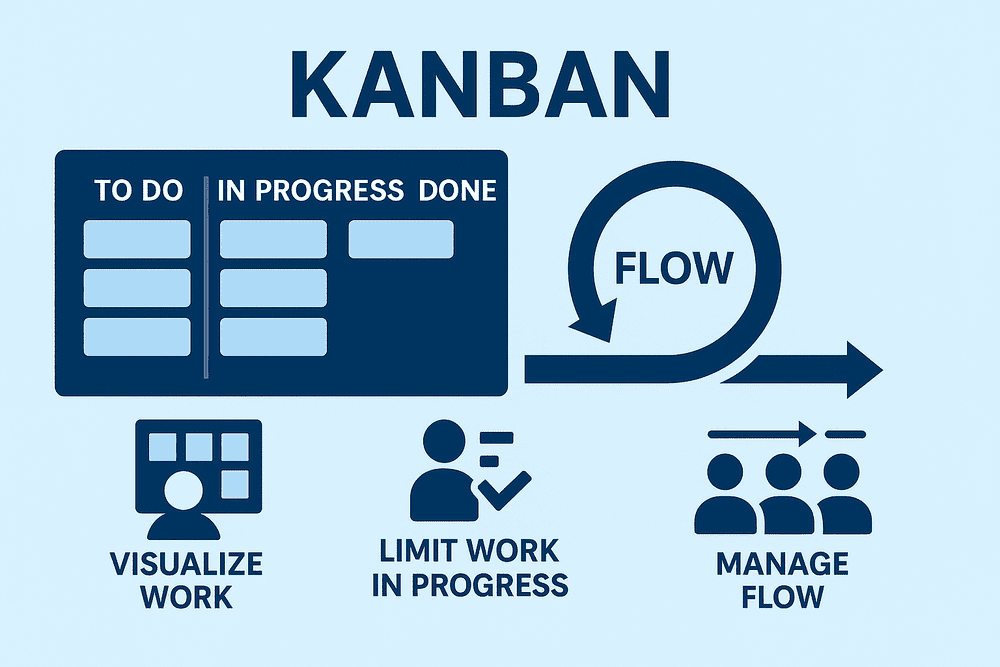
Kanban is the second most popular Agile methodology; 56 % of respondents use it. Kanban is a visual method for managing work and improving processes. It uses a board with columns such as “To Do,” “In Progress,” and “Done.”
Each task is written on a card and moved across the board as the team works on it. This makes the flow of work clear to everyone. Kanban limits how many tasks can be in progress at once, which helps teams focus and avoid overload.
By seeing bottlenecks early, teams can fix problems quickly. Kanban is flexible, simple to start, and helps deliver value continuously while improving efficiency over time.
3. Scaled Agile Framework (SAFe)

SAFe is the third most popular method; 53 % of organizations use it. The Scaled Agile Framework (SAFe) helps large organizations apply Agile practices across many teams. It provides a structured way to align strategy, planning, and delivery.
SAFe organizes work into different levels: team, program, large solution, and portfolio. Teams work in short iterations and deliver value continuously. Program Increment (PI) planning brings multiple teams together to set goals for a few months. Leaders guide priorities while teams stay self-organized. SAFe promotes collaboration, transparency, and faster delivery at scale.
By using SAFe, organizations handle complex projects, respond to change quickly, and ensure that all teams work toward the same business goals.
A case study shows that Air France teams following SAFe achieved a 20% higher release effectiveness compared to waterfall teams.
4. Scrum of Scrums

This is another popular example of agile methodology used by 28 % of companies.
Scrum of Scrums is a method used when many Scrum teams work on the same project. Each team selects one representative to join a larger daily meeting. In this meeting, they share updates, progress, and challenges that affect multiple teams.
The goal is to keep all teams aligned and working smoothly together. It helps identify dependencies, remove obstacles, and avoid delays. Like the daily Scrum, these meetings are short and focused.
Scrum of Scrums makes large projects easier to manage by improving communication and coordination across teams, ensuring everyone moves toward the same goal effectively and efficiently.
Dell’s implementation of Scrum of Scrums resulted in 100 % on?time releases and a 94 % drop in defects.
5. Extreme Programming (XP)

Extreme Programming (XP) is an Agile method that focuses on improving software quality and responding quickly to changing customer needs. It uses short development cycles, frequent releases, and continuous feedback to keep projects on track.
Developers work in pairs, review each other’s code, and write automated tests to catch errors early. Customers stay closely involved, giving feedback and setting priorities. XP values simplicity, teamwork, and communication. Making minor improvements often reduces risks and ensures the software meets user needs.
This method helps teams deliver reliable, high-quality software while staying flexible in a fast-changing environment.
6. Dynamic Systems Development Method (DSDM)

The Dynamic Systems Development Method (DSDM) is an Agile project framework that focuses on delivering solutions quickly and effectively. It uses timeboxing, where work is divided into fixed periods to ensure timely results.
DSDM values active user involvement, clear business goals, and regular feedback. Teams build solutions in small steps, starting with essential features and adding more over time. It emphasizes collaboration between users and developers, flexibility in handling changes, and strong project control.
By following these principles, DSDM helps organizations reduce risks, manage costs, and deliver high-quality products that meet real business needs.
7. Feature-Driven Development (FDD)
Feature-Driven Development (FDD) is an Agile method that focuses on building and delivering features. A feature is a small, helpful part of the system that adds value to the user.
FDD starts with creating a model of the system, then listing and prioritizing features. The team plans, designs, and builds features in short cycles. Each feature is developed by a small team and tested before release. The method uses regular progress tracking, making it easy to see results.
FDD works best for large projects and helps teams deliver reliable software quickly while keeping the process simple and structured.
Real-World Agile Examples Across Industries
The following are a few examples of projects using Agile methodologies:
Healthcare: Implementing Electronic Health Records
Hospitals face complexity when deploying an Electronic Health Records (EHR) system. A health organization applied Scrum to deliver the project in small increments. User stories captured the needs of doctors and nurses, ensuring that the software met diverse requirements.
Continuous integration allowed regular updates and immediate feedback. Best practices included engaging end-users early, prioritizing patient safety, and running regular retrospectives to resolve issues.
Operations: Business Process Outsourcing
A business process outsourcing (BPO) firm needed to improve customer service delivery. By combining Scrum and Kanban, the team visualized its workflow on a Kanban board and held daily stand-ups for fast communication.
Customer feedback loops were built into each sprint, allowing the process to evolve in real time. Managers maintained a visible board so that team members could track progress and encouraged cross-functional collaboration.
Public Sector: Government Digital Services
Developing a digital services platform for citizens involves diverse stakeholders and evolving requirements. A government agency adopted an iterative Agile approach, using sprint reviews and ongoing stakeholder engagement to keep the project aligned.
Iterative development enabled the team to adjust based on regulatory changes and feedback from end-users. Cross-functional teams combined technical and policy expertise to balance innovation with compliance.
Software Startups: Rapid Product Development
A tech startup building a new product used Extreme Programming (XP) to accelerate development. Practices like Test-Driven Development (TDD) and pair programming ensured high-quality code. The startup delivered a minimum viable product (MVP) quickly and iterated based on user feedback.
By catching bugs early through TDD and sharing knowledge via pair programming, the team reduced technical debt and maintained agility.
Sales & Marketing: Agile Campaign Management
Marketing campaigns face rapidly changing market conditions and customer behaviors. A sales team applied Scrum to organize a campaign into sprints and used Kanban boards for task management. After each sprint, the team integrated market feedback and adjusted strategies.
This Agile approach allowed rapid adjustments and ensured the campaign launched on time and under budget.
Advantages of Agile Methodologies
- Flexibility and Adaptability: Teams can quickly respond to changes in requirements or priorities.
- Customer Involvement: Continuous feedback ensures the final product matches customer needs.
- Faster Delivery: Work is delivered in small increments, so value reaches users early.
- Improved Quality: Frequent testing and reviews help detect and fix issues early.
- Better Collaboration: Daily communication improves teamwork and transparency.
- Reduced Risk: Regular progress checks lower the chances of project failure.
Limitations of Agile Methodologies
- Less Predictability: Costs, timelines, and scope may shift due to constant changes.
- Requires Active Customer Input: Success depends on continuous client involvement.
- Challenging for Large Teams: Scaling Agile practices can be difficult in large organizations.
- Documentation May Be Limited: Focus on working software sometimes reduces detailed records.
- Needs Skilled Teams: Agile requires experienced and disciplined members to succeed.
Conclusion
Agile methodology offers flexible and practical ways to manage projects in different industries. By using methods like Scrum, Kanban, Lean, Extreme Programming, and Feature-Driven Development, teams can adapt quickly, improve collaboration, and deliver value faster. Each Agile example shows how it helps meet customer needs while reducing risks and boosting quality. Whether in software development, construction, or business projects, Agile provides clear benefits through teamwork and continuous improvement.
By learning from these examples of agile methodology, you can see how Agile turns challenges into opportunities and ensures better results. Agile is not just a process; it is a mindset for success.
Further Reading:
- What is Agile Methodology in Project Management?
- Agile Vs Scrum
- Waterfall Vs Agile
- Waterfall Vs Agile Vs Scrum Vs Kanban
- 7 Best Agile Project Management Software: Free and Paid
Reference:

I am Mohammad Fahad Usmani, B.E. PMP, PMI-RMP. I have been blogging on project management topics since 2011. To date, thousands of professionals have passed the PMP exam using my resources.