

Today we will discuss the five conflict resolution techniques we use in project management to resolve conflict.
These techniques are universal to any type of workplace.
However, in project management, the work environment is dynamic and stressful, unlike the functional environment. Conflicts are common occurrences. If you are managing projects, you know how important it is to manage conflicts, and that is why you should understand conflict resolution techniques.
Conflict Resolution Techniques
Conflict can occur when two or more stakeholders have different opinions or interests.
Schedule priorities, scarce resources, technical reasons, and personal issues can all cause clashes. According to the American Management Association, managers manage conflicts 24% of their time.
Don’t panic; the situation is usually not as bad as you think. Resolving conflicts appropriately can build trust and sometimes bring new ideas and opportunities. This can make the difference between a positive and negative outcome.
If you don’t solve the conflict, your team members will lose trust. It will weaken your position as a project manager and the ability of your team to bond, which may affect your project’s success. You must deal with conflict before it is beyond resolution.
The following are a few consequences of improper conflict management:
- Low team morale
- Negative impact on the project manager’s authority
- Increased number of personal clashes
- Low productivity and efficiency
- Low-quality work
If required, project managers must monitor and resolve conflicts as quickly as possible to keep them from becoming bigger issues.
Now, we will talk about conflict resolution techniques.
This blog follows the PMI guidelines and PMBOK Guide. Here are the five techniques:
- Withdraw/Avoid
- Smooth/Accommodate
- Compromise/Reconcile
- Force/Direct
- Collaborate/Problem Solve
These conflict management strategies are also known as Thomas-Kilmann’s five approaches to resolving conflict.
Let’s discuss each technique in detail.
#1. Withdraw of Avoid
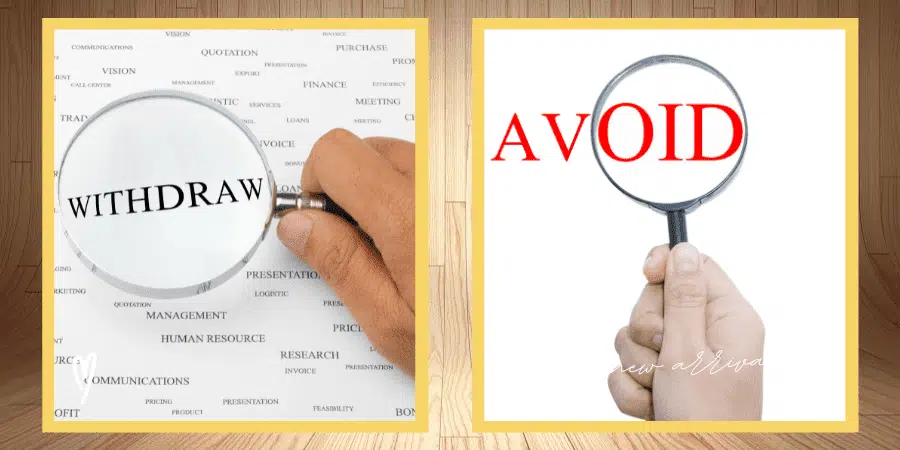
In this conflict resolution technique, you avoid the conflict or retreat and allow the conflict to resolve itself. This is for when stakes are low, and the conflict is likely to disappear on its own.
Use this technique in the following cases:
- Individuals involved in the conflict are not influential stakeholders.
- The issue does not require a time investment.
- An intense argument has already happened, and the individuals need time to cool off.
- You do not have enough information to pursue other techniques.
Advantages
This technique saves time that you can invest elsewhere. It is a good conflict management strategy to apply to low-level disagreements and gives you enough time to prepare if the conflict re-emerges.
Disadvantages
Withdrawing or avoiding is not really a resolution, does not resolve a conflict, and may weaken your position because parties may assume you have an unfair bias. Team members may think you are lacking skills or are not authoritative.
Many experts don’t consider this technique as a conflict management strategy because avoiding and escaping is not a solution.
#2. Smooth or Accommodate

In this conflict resolution strategy, you find areas of agreement, try to smooth out the situation, and circumvent tough discussions.
The smoothing technique gives more consideration to one party than the other. You downplay the seriousness and behave as if the conflict never existed.
This technique is helpful in the following cases:
- You don’t have time to deal with it.
- You require a temporary solution to the problem.
- The conflict is minor and involves less influential stakeholders.
Advantages
This conflict resolution strategy does not require much effort. You can focus on essential issues by ignoring unimportant arguments. Situations can be potentially handled simply while bringing harmony, creating goodwill, and providing enough time to find a permanent solution.
Disadvantages
If you fail to bring a balanced approach, one party may take advantage since you are giving them more consideration. Other parties not being accommodated may question your authority or stop reporting conflicts.
This conflict resolution strategy is not recommended as it often weakens the project manager’s authority.
#3. Compromise or Reconcile
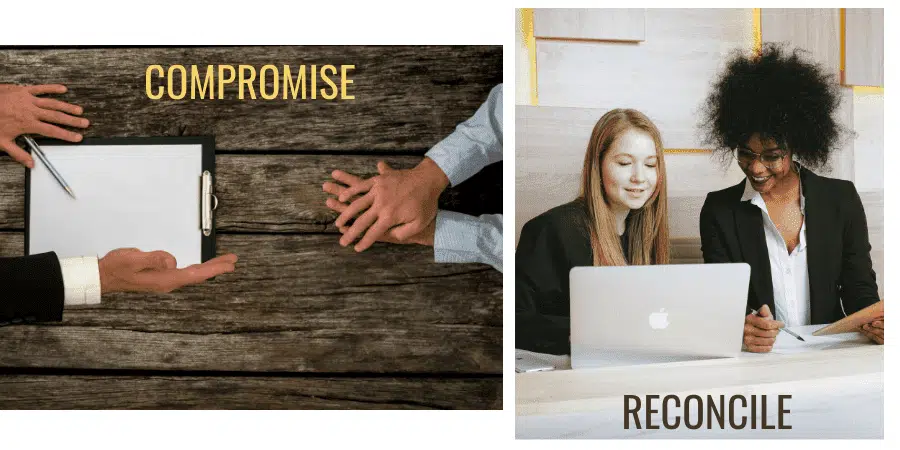
In this conflict management strategy, you take suggestions from both sides and partially satisfy them. This technique is useful when the stakeholders involved hold equal power.
You may use this technique in the following cases:
- All parties involved need to win
- When you have an equal relationship with both parties
- Collaborative and forcing techniques have failed
- When you need a temporary solution
Advantages
This technique brings quick results, lowers stress, and keeps all parties placated until you can find a permanent solution. You can cool off and revisit the situation later.
Disadvantages
This conflict management technique does not generate trust in the long run; all parties remain unsatisfied, and the conflict could resurface at any time. Morals are not being strengthened. You may have to ensure all parties abide by the agreement.
#4. Force or Direct
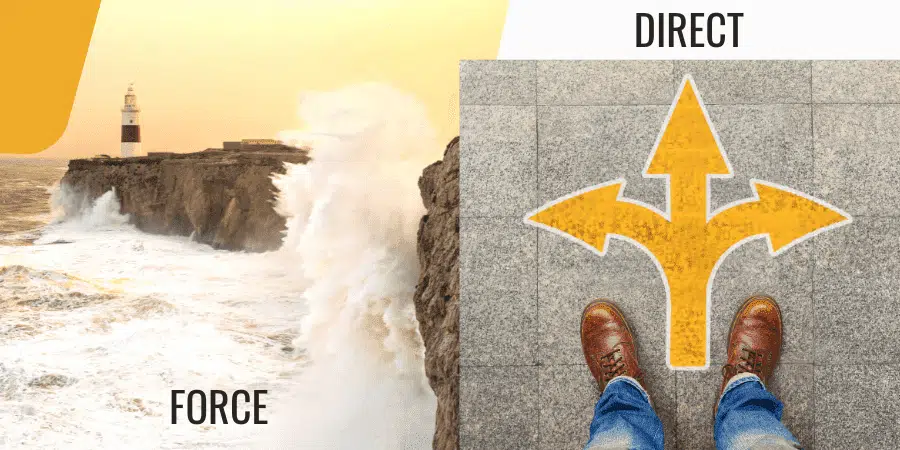
In this conflict management strategy, you agree with one party’s viewpoint and enforce their wishes. This is a win-lose situation and risks demoralizing the team.
You can use this conflict resolution technique in the following cases:
- When you need a quick solution
- When you know that one party is right
- You do not have time to investigate
- When the conflict is not very important
- When the relationship with stakeholders is not essential
Advantages
This technique provides a quick solution. It requires almost no effort from the project manager and may help establish their authority.
Disadvantages
Using this technique may cause a negative impression on you. You may lose opportunities gained from the opposing party’s viewpoint. You cannot apply this technique with powerful stakeholders. It may backfire and worsen the conflict.
#5. Collaborate or Problem Solve
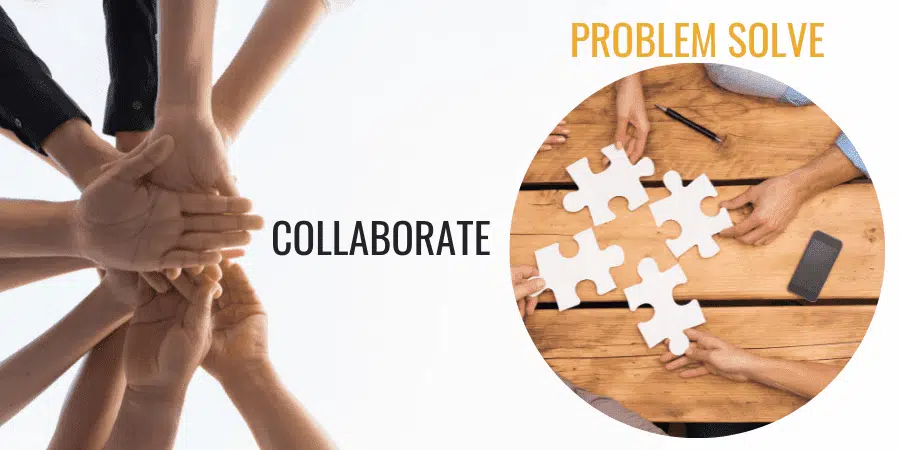
In a collaborative conflict resolution strategy, you discuss the issue with all parties and agree on a solution while considering multiple viewpoints.
You may use this technique in the following cases:
- When incorporating multiple views
- If influential stakeholders are involved
- When a consensus is required
- If you want to distribute responsibility
Advantages
This is a real problem-solving technique that provides a solution to the conflict. It brings consensus, commitment, and shared responsibility for the outcome. This technique creates a win-win situation, builds your team’s confidence, earns respect, and establishes your authority.
Disadvantages
You cannot use this technique when you need a quick solution because it takes time and effort. It is generally used for conflicts that may affect your project, not all issues.
Which Conflict Resolution Technique Should I Use?
The PMI does not recommend using any specific technique for all conflicts; it depends on the situation and the stakeholders involved.
For example, if two ground-level laborers have a conflict, what should you do?
You may ignore it.
However, if you see that some important stakeholders have a conflict, you will intervene, solve the conflict, and spare your project from harm.
Although no single technique can be used for all conflicts, it is thought that the “Collaborate or Problem Solve” method brings the most consensus and commitment.
How to Prevent Conflict
You cannot keep all conflict from happening, but following a few rules can minimize it. These guidelines are:
- Establish Strict Ground Rules: These help discipline team members, which results in less conflict.
- Have an Effective Communication Plan: This can help you avoid many conflicts. Define how much and how often you will communicate with your stakeholders.
- Have a Better Stakeholder Management Plan: Your project is successful if your stakeholders are happy. Project management is all about managing stakeholders’ requirements.
- Solve Conflict Early: This takes less time and effort. Make sure an unresolved conflict doesn’t resurface again later.
The Role of the Project Manager in Conflict Resolution
I have explained all strategies to resolve conflicts and how you can use them. As a project manager, you have to respond rationally and reach a solution that best serves your objective.
While resolving a conflict, keep the following points in mind:
- Each participant deserves respect
- Be calm and rational.
- People are separate from problems
- Each participant should be listened to patiently
- There are always areas of agreement and disagreement
- You should explore all possible solutions.
- Mind your biases and don’t pick sides
- Don’t force or pressure participants
- Postponed conflicts may fester.
- Focus on the conflict, don’t let escalate the issue or generalize it.
Summary
As a project manager, you are responsible for keeping conflicts under control. You cannot use any single technique for all types of conflict. However, you should use a conflict resolution strategy that inspires consensus and commitment from team members.
This is where this blog post on conflict resolution techniques ends.
Below is my old blog post on conflict resolution strategies based on the fourth edition of the PMBOK Guide. Since I have re-written it based on the sixth edition of the PMBOK Guide, the old blog post is no longer relevant, but I am keeping it archived.
“Conflict Resolution Techniques” was one of my favorite topics during my PMP certification exam preparation. Although, I observed a discrepancy between the PMP exam reference books and the PMBOK guide.
All the reference books suggest that confronting is the best conflict resolution technique and that a project manager should use this technique to resolve conflicts in all cases. However, the PMBOK Guide (fourth edition) favors the collaborative technique.
I have repeatedly reviewed this edition of the PMBOK Guide but could not find any support for this. To my surprise, nobody is discussing this discrepancy.
Therefore, I am launching my blog to address this issue, which is my first blog post.
Let’s get started.
Conflict happens while managing projects. The PMI recognizes this fact, and they have incorporated conflict resolution techniques into the PMBOK Guide.
Sources of conflict include scheduling priorities, technical problems, personal issues, scarcity of resources, etc.
According to the PMBOK Guide (fourth edition), you can use six conflict resolution techniques to resolve conflicts:
- Withdrawing or Avoiding
- Smoothing or Accommodating
- Compromising
- Forcing
- Collaborating
- Problem Solving or Confronting
Now I will discuss each technique and the best conflict resolution as per the PMBOK Guide.
- Withdrawing or Avoiding: The project manager chooses to avoid the conflict, and those involved find a solution.
- Smoothing or Accommodating: The project manager is involved in the conflict, tries to avoid areas of disagreement and tough discussions, and focuses on commonalities. Smoothing is a way to avoid tough discussions.
- Compromising: This is a mid-way approach. Here, everybody gains some, but no one gets exactly what they want. This is a lose-lose approach.
- Forcing: The project manager favors one party at the expense of the others. This technique risks demoralizing team members and may cause serious conflict in the future. This is a win-lose approach.
- Collaborating: The project manager works with all parties to find a resolution that involves multiple viewpoints to create the best solution. This technique reinforces mutual trust and commitment. This is an example of a win-win approach.
In the fourth edition of the PMBOK Guide, Collaborating and Problem Solving were different techniques. However, the fifth and sixth editions, both are the same technique. Also, problem-solving was known as confronting in the fourth edition, but it no longer appears in current PMBOK Guides.
A Note on Problem Solving or Confronting Technique
In confronting technique, the project manager must find a solution for a conflict. He will conduct a root cause analysis and provide a platform for all parties to express their disagreements and arrive at a solution.
So, Which is the Best Technique to Resolve a Conflict?
I have reviewed many books and internet resources to discover the best conflict resolution technique. Amazingly, I got the same answer: Confronting or Problem-Solving is the best technique for conflict resolution.
However, I do not agree with this.
A project manager’s job is not easy; they must constantly deal with multiple conflicts. No two conflicts are the same, so why would you always use one technique?
Project managers must use their judgment and experience to decide which conflict resolution technique is most suitable for each situation. The technique selected depends on the situation, timing, and the individuals involved.
The primary objective of the project manager is to complete the project successfully.
A project manager is not a detective. It’s not their job to look for the root cause, dig every available detail and scraps of evidence, and then reach a conclusion.
With problem-solving techniques, one person wins, and another loses; this is not a win-win situation and will leave one party unsatisfied even if they are in the wrong.
A prudent project manager will try to avoid this situation and look for a solution to satisfy all parties. The collaborating conflict resolution technique, which is a win-win situation for all.
Let us see what the PMBOK Guide says:
Page-239, second paragraph:
“If conflict escalates, the project manager should help facilitate a satisfactory resolution. Conflict should be addressed early and usually in private, using a direct, collaborative approach.”
Page-229, last paragraph:
“… managing conflicts in a constructive manner, and encouraging collaborative problem solving and decision-making.”
No statement in the PMBOK Guide suggests using the problem solving/confrontation technique for all conflicts; however, I noticed that the PMBOK Guide recommends the collaborative technique.
It seems that the PMI agrees with me too!
My View
I do not recommend using the collaborative technique to solve all conflicts. However, it is the only technique that leads to consensus and commitment among all parties involved in the conflict.
The strategy of conflict management depends on the conflict. You can use the technique you think best suits the situation to resolve the conflict. However, I cannot agree that confronting is the best conflict resolution technique, and you should not use it blindly.
What conflict resolution techniques help you most to resolve conflicts? Please share your experience through the comments section.

I am Mohammad Fahad Usmani, B.E. PMP, PMI-RMP. I have been blogging on project management topics since 2011. To date, thousands of professionals have passed the PMP exam using my resources.

Sir, i realy appreaciat your idea and its very educative, please sir what technique should be use in resolving the conflict over land.
I am really impressed with the topics dealt with conflict resolutions
Thanks Elfatih.
what the role as the PM or team member if conflict start to effect core project or one constrains should i start interfere to solve it or ask them to solve it by them self.
or should i report it
If you are not PM, you should report to PM.
If you are a PM you should use your best judgement to handle the issue.
Thanks for your notes and questions bank. Your notes really inspired me how to study PMP exam and I got it passed yesterday.
Congratulations Albert on passing the PMP exam.
Very informative,thanks.
You are welcome Rondity.
Hi Fahad,
I failed my first test and preparing for the second one.I prepared well with lot of material including PMBOK. But,i am unable to justify my weak areas.I purchased your 400 questions and scored 80% .Practiced well in all the areas.Can you advise me please?
Send me an email at [email protected] with all details, I will reply you.
Is I have to explain again the need of new requirements to members, which technique should I use? And when we are discussing alternative which one? I found the blog quite clear but to be honest I fail to differentiate when to use collaboration and compromise. Pls can you help me
Compromise is relatively quicker process where you take suggestion from both parties and reach on a conclusion.
In collaborative approach you have a detailed discussion with both parties to reach on a best solution.
may be you are right but in my opinion all strategy are for work and in my case the compromise is the best option for me. Thankyou for your material.
It depends on the situation and stakeholders involve with the conflicts.
Hello Fahad,
I successfully completed the exam and now Certified PM :) I want to thank you for these notes that really helped me understand the processes better in simpler terms. You are great teacher! I had purchased your formula guide and EVM guide as well which was immense help as well. Thank you and God bless you.
Congratulations Hazra on passing the PMP exam.
Hello Fahad,
Your blog is great help. I am currently preparing for my PMP exam. Every time I am stuck or fail to understand a term/usage/formula, I come here and your explanation(s) helps me understand it. I want to thank you for that. And I also appreciate that you update your notes when there is a new edition of PMBOK. So this is a great reference site for people like me preparing to give their exams. Best
You are welcome Hazra. Now the six edition of the PMBOK is arriving next year, so I will have update them again.
Thanks for your comment.
Hey Fahad,
Thanks for your awesome notes. I also purchased the question set on Kindle.
Helped me clear the test on first attempt.
Regards,
Amol
Congratulations Anmol on passing the PMP exam, and I am glad that I could be of help to you.
I like your post, Thank you for the efforts in updating to latest PMBOK and helping the community.
Thanks
Qhayum
Thanks Qhayum.
Can I please ask this question?
Is problem solving the most effective, sustainable conflict resolution technique?
Please provide reasons to substantiate your response.
Discuss your opinion point by point. Thank you
Please read the blog post again till end. This topic has been explained in detail.
Okay Ram, in future update I will try to include some scenario based examples.
Hi,
I do see 3 to 5 questions coming out in MOCK Exams from Conflict resolution techniques. They are very close in resemblance among each other. However I commit the mistake between Smooth/Accomodate, Compromise/Reconciliation and also between Force/Direct, Withdraw/Avoid.
Judgement becomes tough & above explanations are quite lengthy to recall/remember. In such case, is it possible to provide one scenario(Same people) with different situations that match the 5 conflict resolution techniques to understand?
Many Thanks.
Regards,
Ram Narayan
No more conflicts. These techniques are great(Withdraw/Avoid,Smooth/Accommodate, Compromise/Reconcile,Force/Direct,Collaborate/Problem Solve) http://ku.ac.ke
Thanks James for visiting and leaving comment.
I checked the PMOBOK fifth ed. and as you mention, but I also noticed the word confront (in pencil) near the word collaborate. I remembered that our instructor told us they have same meaning.
“but I also noticed the word confront (in pencil) near the word collaborate” – I did not understand what do you mean?
Fahad,
Another nice post. In fact, conflict management technique is a fav topic of mine as well.
However, I am unable to get – how compromise is loose-loose. Wont it be loose-win, even if temporary?
In compromise both parties have to give up something to reach on a common consensus.
(Please note that this article is based on the fourth edition of the PMBOK Guide, in fifth edition, PMI has amalgamated collaborative and problem solving techniques.)
Hello All
Which one is the worst conflict resolution method? I think its :forcing/directing, but ive seen places which advocate that withdrawing/avoiding is the worst one. Please share your thoughts.
It depends on situation.
Hi,
In PMBook 5th edition, collaborating and problem solving are given as synonyms. As for confronting it disappeared, however I just did the exam and it is still the term they use for this. The way I see it, confronting is the same general ideology than collaborating and problem solving, all seeks win-win situation.
Here is an excerpt from 5th ed.:
“There are five general techniques for resolving conflict. As each one has its place and use, these are not given in any particular order”
[…]
“Collaborate/Problem Solve. Incorporating multiple viewpoints and insights from differing perspectives; requires a cooperative attitude and open dialogue that typically leads to consensus and commitment.”
I also think confronting/problem solving/collaborating leads to best solutions. As with many other things in life, we often have to select optimal result given the constrains rather than the very best one.
Confronting is not a win-lose, its aim at win-win. you confront ideas of both party and the aim (the very reason why it’s time consuming) is by sharing actively their point of view, a common agreement will emerge (which can be to agree about one or the other party position or on a new position). Since it must be common agreement, it can only be win-win (unless it is a disguised compromise because one of the party pretend to agree). It is really the equivalent of collaborating/problem solving.
In the fourth edition of the PMBOK Guide, confronting and collaborative approach were different, now they are synonyms….
I’m sorry. Read the PMBOK again, and your sources. The PMBOK and PMI reinforce that the book is a “best practices” book, every management book is; take great care to understand and internalize that because the real world is quite different. No credible source can provide us with the “one and only” way, or the best way for all management situations.
The PMBOK does not say (quoting you) “applying the same technique to all conflicts” would be justified.
It actually says the opposite, which ironically is the case your’re making. “…each one has its place and use,”. For example, avoiding a problem, can be VERY effective in certain situation; particularly on a “high functioning” team.
Now, you’re right about the industry consensus on confronting providing the best outcomes and usually as the favorable approach… It is! You just have to know when you have the OPPORTUNITY to use it, and how to employ it.
(I’m a PMP and a “seasoned” Construction PM) Good luck to you!
I should add; collaborating and confronting are cross from parallels. That might be confusing you. If you read the Thomas-Kilman Conflict Mode Instrument; that definition of collaboration is very close to confronting. That and correctly diagnosing the issue goes hand in hand.
However, collaboration is less optimal since it takes time. Every time a conflict comes up; there’s not always time to have a campfire and roast marshmallows. I think the PMBOK is trying to show that finding the root problem, is not always an outcome of collaboration.
Hello eh,
You said that:
‘No credible source can provide us with the “one and only” way, or the best way for all management situations.’
I am agree with you on it.
Again you’ re saying:
The PMBOK does not say (quoting you) “applying the same technique to all conflicts” would be justified.
I’m totally agree with you here again, and in fact to prove this point I wrote this blog post. In this blog post I’m only trying to say that PMBOK does not say that you should apply one technique on all conflicts.
I would agree on collaborating is best solution and that also eventually goes to the root cause and as well buys in everybody OK which is a permanent solution than confronting/problem solving.
for the purpose of get few marks we have to choose confronting !
Thanks for agreeing with me.
I feel Fahad is right. Collaborating is the best technique to resolve the conflicts. In most of the real situations , we need all the team members to get along / participate without any grudges. This technique generally helps to take all the team members towards goals without hurting individual’s self esteem. Confronting can not be win – win always. I feel usage of techniques depends upon situation and project managers understanding.
Hello,
thank you for this post.
I really liked it.
Although I am still not sure I fully understand the difference between confonting and collaborating. Are there any specific features of these techniquest that can help differentiate them clearly?
Currently, I have a feeling that Confronting and Collaborating are almost the same thing
In collaborating, you incorporate multiple viewpoints and negotiate for the best solution. It is a win win approach, on the other hand confronting is problem solving technique. In confronting you will find the root cause of the problem and then reach to its solution. Confronting is a win lose situation.
Hello Fahad,
I was going through the above comments where you mentioned that confronting is a win-lose situation. But if go by Rita Mulcahy , she mentioned confronting as Win-win situation.
Even in some of the multiple choice questions is it considered as win-win situation. can you please help to understand this better. Thanks in advance.
Regards,
Gagan
In problem solving one loses and other wins regardless of who is on right path.
Not exactly. 2 people may be, dont have any right path, they go to discussion/argument to figure out what is the best way to deal with the conflict.
Confronting/problem solving includes:
– Find the root cause of problem, not what is presented to you or what appears to be the problem
– Analyze the problem
– Identify solution
– Pick a solution
– Implement a solution
– Review the solution and confirm that the solution can deal with the problem.
Hence, Confronting is win-win situation. Win-lose situation refer to Forcing solution (1 win, 1 lose)
Two team members are having conflict, most of the time one is correct and other is wrong.
In this case, if you go for the confronting then obviously the person who is in right path will win and other loses.
Collaborating does not necessarily fix the problem and may show up again, only Confronting does this, it gets to the “root cause”
Yes, you are right but it does not mean that the project manager should always go for confronting.
A project manager has to decide that which technique suits best to the situation.
I see your point thank you.
You are welcome.
What technique is used when a PM suggests to the Team members to contribute their respective PROS and CONS about the issue at hand and then suggests they discuss it. Is this collaborative or confronting?
It depends on what resolution he takes at the end. If he combines multiple view point and find the best agreeable solution, then it will be collaborative. And if he takes resolution of conflicts based on only facts then it will be confronting.
I think confronting will work here because PM trying to go to the root cause of this problem
You may be right but only discussion does not mean that he will chose the confronting. He may also go with the collaborative technique or try to smooth the situation. All depends on the situation and problem at the hand.
Yes you are absolutely right ! good
Thanks for agreeing with me!
:)
I like your post very much and am in a project management class right now. Although confronting has a negative connotation, it is not always such. Confronting a problem and dictating how it should be resolved is the PM's job and if the other techniques do not work this approach should be taken. PM'S will run into personalities that will have a conflict with everything or everyone. Taking a direct confrontational approach may be required and should not be seen as a negative componant. Your assessment is great and accurrate.
Thank you for liking my post.
My point is—there is no single universal technique which applies to all conflicts and the PMBOK Guide does not recommend using conflict resolution technique every time a conflict occurs.
good I appreciate yourwork I using as a projects references
Thanks Nasry.