

Estimate to Complete (ETC) is a forecasting tool used with the earned value calculation to develop performance reports.
The cost will constantly change during your project. Therefore, clients are relentlessly interested in the costs of the remaining tasks.
In project management, you must adopt proven techniques to reach an estimate for the stakeholders.
One such technique is the Estimate to Complete (ETC). This is another forecasting technique used along with the Estimate at Completion.
In today’s blog post, we will discuss this forecasting technique, its definition, formula, and examples with calculations.
Estimate to Complete (ETC)
Definition: Estimate to Complete ((ETC) is a forecasting technique that gives you the approximate cost required to complete the remaining project work.
This is an important forecasting technique. I will explain this topic with three simple examples. Afterward, we will solve some mathematical questions.
Example I
You are constructing a house with a budget of 100,000 USD. You are halfway to completion, and you find that you may have to spend more than you planned. Therefore, you ask a team member to give you a new estimate for the remaining work.
They calculated the cost of the remaining work and informed you that from now on, it will take 70,000 USD to finish building the house.
This 70,000 USD is the Estimate to Complete.
Example II
You are working on a project that is 30% completed.
The Estimate to Complete is the expected cost to complete 70% of the remaining work.
Example III
There is another scenario to calculate the Estimate to Complete.
You are constructing a five-story building and cannot complete the project because of financial issues. Therefore, you cut your building from five to three stories to adjust the budget.
The Estimate to Complete will help you calculate your savings.
There is another forecasting tool that is often confused with the Estimate to Complete. This tool is the Estimate at Completion (EAC).
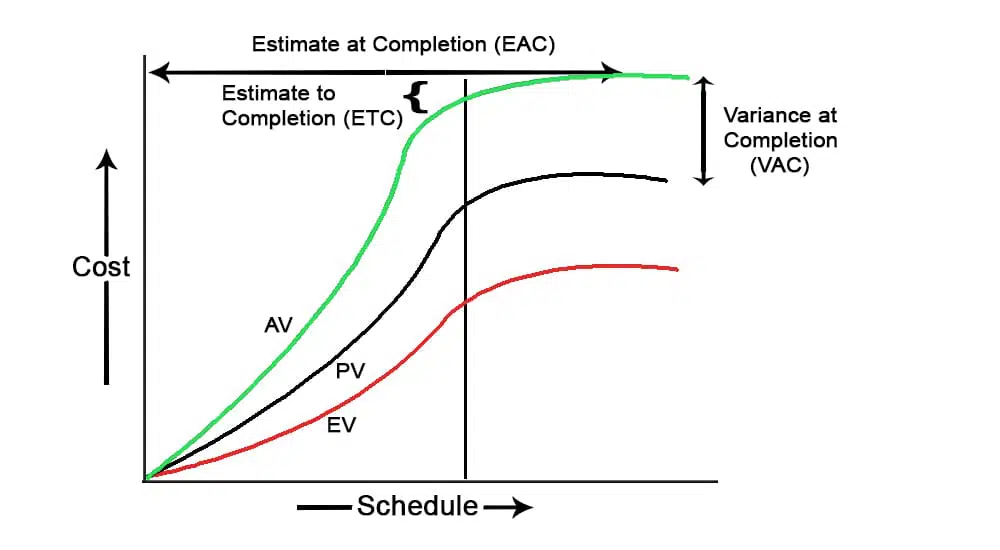
Estimate at Completion is the project’s total cost at the end, while the Estimate to Complete is the cost required to complete the remaining work.
When the project starts, the EAC is equal to the ETC. As the project progresses, the ETC decreases; in the end, it becomes zero.
Estimate to Complete (ETC) Formula
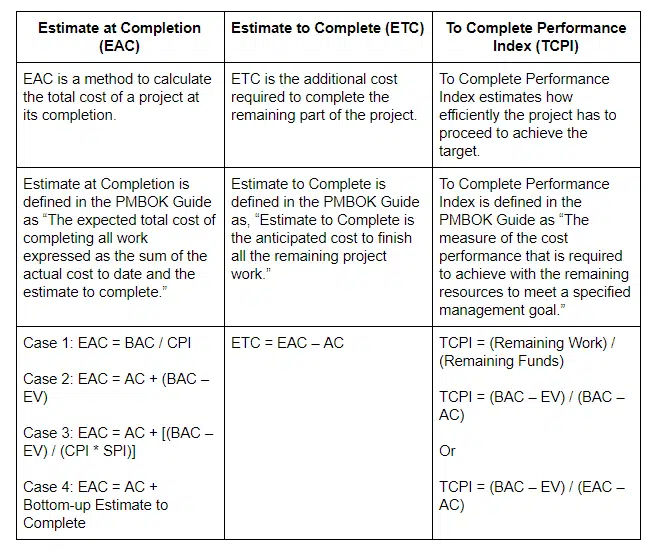
You can use two formulas to calculate ETC:
- Bottom-up Cost Estimation
- ETC = Estimate at Completion – Actual Cost
ETC Examples with Calculations
We will discuss the two examples of ETC using both formulas and calculations.
Case I: Bottom-Up Cost Estimation
Here, you calculate the cost of the remaining work. Afterward, you add them to get the total cost of the remaining work.
There is no formula for the Bottom-Up Cost Estimation technique.
Example of ETC (Case I)
You have a project to build a government department’s building for 500,000 USD. You have spent 200,000 USD to date. However, you realize that your cost estimation was flawed, and you need to re-calculate your budget for the remaining part of the project.
So, you re-estimate the cost of the remaining work. The new estimate is: 125,000 USD for construction, 75,000 USD for plumbing, 150,000 USD for painting, and 50,000 USD for other expenditures.
Calculate the Estimate to Complete (ETC).
Given in the question:
BAC = 500,000 USD
AC = 200,000 USD
Construction Cost =125,000 USD
Plumbing Cost = 75,000 USD
Painting Cost =150,000 USD
Other expenditures =50,000 USD
You are using Bottom-Up Cost Estimation. You will calculate the cost of each activity/work package, and then you will add them to get the final figure.
Estimate to Complete = Cost of construction + Cost of plumbing + Cost of painting + Other expenditures
= 125,000 + 75,000 +150,000 + 50,000
= 400,000 USD
Hence, the Estimate to Complete is 400,000 USD.
Case II: ETC = EAC – AC
Finding the Estimate to Complete is straightforward in this case. You will calculate the Estimate at Completion, and then subtract the actual cost from it.
Estimate to Complete = Estimate at Completion – Actual Cost
ETC = EAC – AC
There are several ways to calculate the EAC. You can visit my blog post on Estimate at Completion to calculate the EAC in different cases.
Example of ETC (Case II)
You have a project with a BAC of 100,000 USD and 12 months. 6 months have passed, and you have spent 60,000 USD. Upon closer view, you find that only 40% of the work has been completed. Your project is expected to perform at the same cost.
Find the Estimate to Complete (ETC) for this project.
Given in the question:
Budget at Completion (BAC) = 100,000 USD
Actual Cost (AC) = 60,000 USD
Planned Value (PV) = 50% of 100,000 USD
= 50,000 USD
Earned Value (EV) = 40% of 100,000 USD
= 40,000 USD
To determine the ETC, you need the EAC.
And, EAC = BAC / CPI
Hence, Cost Performance Index (CPI) = EV / AC
= 40,000 / 60,000
= 0.67
Therefore, Cost Performance Index (CPI) = 0.67
Now, Estimate at Completion (EAC) = BAC / CPI
= 100,000 / 0.67
= 149,253
Estimate at Completion (EAC) = 149,253 USD
Now, Estimate to Complete (ETC) = EAC – AC
= 149,253 – 60,000
= 89,253 USD
Hence the Estimate to Complete (ETC) for this project is 89,253 USD.
Estimate to Complete (ETC) Table
Estimate to Complete (ETC) Graph
Summary
The Estimate to Complete (ETC) is the expected cost required to complete the remaining work of the project. You will use this forecasting tool when the previous estimate is no longer valid and needs a new estimate for the remainder of the work. This tool is useful whenever the cost baseline deviates. You will use this tool to communicate the information to stakeholders to approve the new budget.
How have you used Estimate to Complete (ETC) in your project? Please share your experience in the comments section.
This blog post is the sixth in a series of eleven on earned value management and project forecasting. Please read through my earlier posts before reading this post if you’re coming here from a search engine or a referral.
The following are the links for other blog posts:
- Earned Value Management
- Elements of Earned Value Management
- Budget at Completion in Project Management
- Cost Variance in Project Management
- Schedule Variance in Project Management
- Cost Performance Index in Project Management
- Schedule Performance Index in Project Management
- Schedule Variance and Cost Variance
- Schedule Performance Index and Cost Performance Index
- Estimate at Completion
- Estimate to Complete (You are here)
- To Complete Performance Index
The Estimate to Complete (ETC) tool is essential for the PMP exam. You may see a few questions from this topic on your exam.

I am Mohammad Fahad Usmani, B.E. PMP, PMI-RMP. I have been blogging on project management topics since 2011. To date, thousands of professionals have passed the PMP exam using my resources.





Is it possible to have ETC in minus figure?
You are three months into the five-month bathroom remodeling project. The original budget (BAC) is R1.500 and you have completed approximately 40% of the work. You currently are running over-budget, as indicated by a cost performance index (CPI) of 0. 67. Actual costs to date have been R900.
Calculate the following and interpret the results:
1. You learn that the contractor found some mold in the shower and needed to replace it, causing a one-time variance.What is the Estimate to Complete (ETC)?
2. You learn that the workers that are being used are actually much more expensive than you originally estimated, this would be a typical variance as its going to continue to affect the project. What is the Estimate to Complete (ETC)?
Example of ETC (Case II) is great but slightly inaccurate. The result should be 90K solid.
The error comes from rounding 60/40, which is 0.67 rounded from 0.666666666…… , however, if you calculate EAC directly like so:
ETC = EAC – AC =
(Budget at completion / CPI) – AC =
(Budget at completion / (EV / AC) ) – actual =
(Budget at completion * AC / EV) – actual =
(100k * 60k / 40k ) – 40k =
90k.
… then you don’t get rounding errors.
But that doesn’t actually matter because I think PMI tests do the same mistake.
ETC = (BAC – EV)/(CPI*SPI) should also be correct if its asked to completed the work as planned?
From where did you get this formula?
Hello Fahad,
Would you please explain why the following equation did not give the same result as I use
( ETC = BAC – EV )to get ETC
While you use EAC – AC = ETC
Thank you very much for your time
Waiting your response
Sorry for the confusion, at first I did not pay attention to Sandra’s comment, I thought it was a algebraic realignment of terms, which it was not.
Please read the below given blog post:
https://pmstudycircle.com/2012/05/estimate-at-completion-eac-a-project-forecasting-tool/
Hi, I am studying in Italy; your blog is tremendously helpful. I wish my teachers were as clear as you are.
Thanks Daniela for your comment.
Excellent Explanation….. very well written… Have been studying for past 2 months but was lost…This is much better than other explanations… Thanks!!!
I am glad that you liked my blog Amita. Let me know if you need any help from me.
Hello,
thank you so much for these very good examples. Could you help me find out how to calculate the estimated time to complete? Especially in cases where one is behind schedule.
Thank you in advance,
Daniela
You can refer below given post:
https://pmstudycircle.com/2012/05/estimate-at-completion-eac-a-project-forecasting-tool/
@ Anish,
I’ll take any advice you or anyone can provide for taking the test this year. Thanks so much!
Deby202
Dear Fahad
I wish to inform you that I passed PMP on 13th Feb, 2014. I also wish to inform you that It was nice experience going though your explanation of the terms. There is no feedback area , so writing it here. Thanks once again.
Regards
Congratulations Anish for passing the Exam. Would be glad if you share you detailed lessons learned here at PMSC.
Fahad
I calculated one of our project by this formula and the result is (-), so it means that there is no cost to complete the project?
Can you provide more detail on it?
@Sandra
You can use ETC=BAC-EV if CPI so far is = 1
The general equation is ETC=(BAC-EV)/CPI
Hi Sandra,
would you please clear it why the result not the same. as per Fahad , he said that you can use it
ETC = BAC – EV , but if I use it , it will give me different result
Thanks
@Sandra: As you said EAC = AC + (BAC-EV). My question is how did it come from? As I know, BAC-EV =AC so that means EAC = AC + AC? If yes, it’s incorrect. Please let me know
Thanks
Kenzao
If past performances are likely to occur in the future, then EAC= AC+(BAC-EV)/CPI where CPI is Cost Performance Index so far.
If past performances are in line with planification, then CPI=EV/AC=1
Your statement BAC-EV=AC is not true (never true !!!)
Hi,
Since ETC = EAC – AC, rearranging it will give EAC = AC + ETC.
But EAC = AC + (BAC – EV), so can I say that ETC = BAC – EV?
Why can’t I just use ETC = BAC – EV in the example above to calculate the answer?
Thanks.
Of course Sandra, you can use it, who is stopping you!No, you cannot.
There are different situations to calculate the EAC. You can not mix them together algebraically. Unless you know the situation exactly, you can not use formulas and come to a conclusion.
Please read below given blog post:
https://pmstudycircle.com/2012/05/estimate-at-completion-eac-a-project-forecasting-tool/
it is really useful article to understand the concepts
Thanks Muthu.
After posting the question, i had realized that EAC is calculated once the project is started. BAC is calculated at the begining of the project.
Thanks.
You are welcome Ravindra.
Fahad,
Its’ a nice article.
Theoretically, it looks like Budget at completion (BAC) & Estimate at completion (EAC) both are same. Practically (based on the formulas) they are not same. What is your opinion?
Theoretically when project starts, BAC and EAC are same. But as the project progresses EAC keeps on changing unless you’re exactly proceeding as per your approved planned and your actual exependiture remains equal to the planned exependiture
Dear Fahad, When i can find ALL the PMBOK Formulas? Thank you!
I don’t have any blog post listing all PMP formulas, therefore I suggest you search it on Google and you will find what you are looking for.
The simple answer is that ‘estimate’ is a result of a calculation while ‘budget’ is a result of a decision.
Good evening,
If I apply the instructions above, I seem to get a different answer when working on a practice PMP exam question. If any one could help me out, I’d really really really appreciate it!
A project was estimated to cost $ 200,000 with a timeline of 10 months. Due to a shipment delay, the schedule was slightly delayed. This was however made up by receiving the first batch of materials for the project by air. The net result was that there was some additional cost in the project. At the end of the second month, the Project Manager reviews the project and finds that the project is 20% complete and Actual Costs are $ 50,000. The Estimate to complete (ETC) for the project would now be:
A. $160,000
B. $210,000
C. $250,000
D. $200,000
Hi – in this case you cannot just reestimate using the bottom up estimation technique. Here you have the following situation:
1. Your scheduled was delayed due to shipment delayed (eventhough it then got back on track)
2. You had additional costs due to getting the materials through the air.
3. You have already spent $50k
4. In this situation you need to consider both, your CPI and your SPI because your schedule was delayed and you had some additional costs which you impact your budget at completion.
In order to get your ETC you use the formula ETC = EAC – AC. How do you get the EAC? One of the formulas to get the EAC is EAC= AC + (BAC – EV) / CPI*SPI. Now lets calculate:
By now you know the following:
1. BAC = $200,000 for 10 month project duration
2. AC = $50,000 spent to date
3. You have only completed 20% of your work by the second month (this is your Earned Value)
But, what is your Earned Value (EV)? Well, if your project is expected to cost $200,000 in 10 months, that means that you are supposed to spend $20,000 per month. This means that by second month you have spent $40,000 (this is your PV). Since you have already completed 20% of the work, this means that by now your EV should be $40,000 in month two ($200,000*20%).
Knowing your EV, PV and AC, now you can calculate your CEAC= AC + (BAC – EV) / CPI*SPIPI and SPI.
Lets calculate the CPI and SPI:
CPI = EV/AC = $40,000/$50,000 = 0.8 – bad
SPI = EV/PV = $40,000/$40,000 = 1 – good
Now calculate the EAC:
EAC= AC + (BAC – EV) / CPI*SPI
EAC = $50,000 + ($200,000 – $40,000) / 1(0.8)
EAC = $50,000 + ($200,000) = $250,000
Now calculate your ETC
ETC = EAC – AC
ETC = $250,000 – $50,000 = $200,000. So correct answer is D. Hope this helps!!!!!
What if I use EAC=AC+(BAC-EV). That gives EAC as 210,000 and ETC as 160,000 which is option A. Which one do we need to use?